Those who want to deionize water in an industrial plant rarely think about a single lab value. In practice, it's about operational safety, quality, plant availability, and traceability. Deionized water is an operating medium. It affects heat exchangers, boilers, electrolysis cells, rinsing processes, coating quality, analysis results, battery materials, and electronic components.
The crucial point is: water quality doesn't only become relevant when a limit value is exceeded. It determines beforehand whether a process remains stable. Dissolved ions increase electrical conductivity, promote deposits, influence corrosion mechanisms, disrupt sensitive reactions, and can directly lead to product defects in high-purity applications.
For asset and operations managers, deionized water is therefore not merely a procurement issue. It's a technical risk decision. Under-specifying risks quality losses. Over-specifying may lead to unnecessary investment in treatment, monitoring, and consumables. The economically sound approach lies in between: water quality must match the application, throughput, plant risk, documentation requirements, and planned operating model.
This is precisely where an industrial article differs from a classic glossary entry. The question isn't just: What is deionized water? The better question is: What water quality does my process need, how do I keep it constant, how do I detect deviations early, and how does the entire system remain economical over its lifecycle?
Deionizing water means removing dissolved charged components from the water. These include cations like calcium, magnesium, sodium, iron, or copper, as well as anions like chloride, sulfate, nitrate, bicarbonate, or silicate. In industrial practice, this is usually done using ion exchange resins, reverse osmosis, electrodeionization, or a combination of these methods.
In classic ion exchange, interfering ions are bound to functional groups in the resin. Cation exchangers remove positively charged ions, while anion exchangers remove negatively charged ions. In mixed-bed systems, both resin types are combined to achieve very low residual conductivities. For large volume flows, a pre-treatment stage like reverse osmosis is often used to remove the bulk of the salt load. Downstream EDI or mixed-bed stages then perform polishing, i.e., fine demineralization to the required target quality.
It's important to note: Deionization primarily removes ions. It is not automatically synonymous with particle-free conditions, low microbial counts, TOC control, or the removal of all organic substances. For many industrial applications, low conductivity is sufficient as a key parameter. For pharmaceuticals, microelectronics, semiconductors, or certain battery processes, it is not sufficient. Additional parameters are required there, such as organic carbon, particles, silicate, metals, microorganisms, endotoxins, or defined distribution conditions at the point of use.
For operators, this means: Deionized water is not a blanket quality standard. It is a result of specification, raw water analysis, process engineering, measurement concept, distribution, regeneration, and maintenance.
The terms deionized water, deionized water, fully demineralized water, and demineralized water are often used interchangeably in everyday language. Nevertheless, for industrial decisions, a precise classification is worthwhile.
Deionized water describes water from which most dissolved ions have been removed. The focus is on charged components and thus on conductivity. Demineralized water also describes water from which minerals or dissolved salts have been largely removed. Full demineralization goes a step further in technical language: it aims at the extensive removal of the entire ionic salt load.
For operations, this distinction is not academic. Softened water, for example, may contain significantly less calcium and magnesium, but still carry many other ions. The conductivity does not decrease to the same extent. Fully demineralized or deionized water, however, reduces the entire ionic load. This is crucial for low-salt heating and district heating systems, feedwater, process water, hydrogen electrolysis, battery production, surface processes, and ultrapure water applications.
A good specification document should therefore not just demand "demineralized water". It should describe the target conductivity required at the point of use, whether the value is temperature-compensated to 25 °C, which additional parameters are monitored, how long the quality must remain stable, and what happens automatically in case of deviations.
Electrical conductivity is the most important rapid indicator for ionic impurities. The more dissolved ions present in the water, the better the water conducts electricity. The fewer ions present, the lower the conductivity. In industrial practice, it is usually expressed in µS/cm and temperature-compensated to 25 °C.
A target value of 0.1 µS/cm is demanding. It corresponds mathematically to a resistivity of approximately 10 MΩ·cm. This is significantly below typical requirements for many heating or general industrial water applications and approaches the realm of high-purity water. For comparison: Theoretically, extremely pure water at 25 °C has a conductivity of about 0.055 µS/cm or approximately 18.2 MΩ·cm. In practice, this range is very sensitive. Even slight CO2 absorption from the air, unsuitable sampling, contaminated measuring cells, or dead spaces in the distribution system can shift measured values.
This makes it clear: 0.1 µS/cm is not just a matter of the resin. It's a system issue. Anyone aiming to maintain this value in continuous operation needs a suitable process chain, clean hydraulics, protected distribution, online measurement, temperature compensation, alarms, bypass or reject logic, and proactive regeneration or service planning.
A single lab measurement does not yet prove stable operation. What is crucial is whether the target quality is achieved under real-world conditions: with fluctuating raw water quality, varying flow rates, downtimes, temperature changes, start-stop operation, and consumption peaks.
Ions don't always cause immediately visible damage in industrial systems. This is precisely why they are underestimated. Many effects develop gradually, manifesting only as deposits, corrosion, process drift, increased energy consumption, higher reject rates, or reduced component lifespan.
Typical risks include:
In heating and power generation systems, the focus is often on deposits and corrosion. In battery and electronics applications, the emphasis is more on contamination, product purity, and reproducible process conditions. In hydrogen applications, interfering ions can affect the efficiency and lifespan of electrolysis cells. In the semiconductor industry, even a very low residual ionic load is only one part of the specification, as particles and organic traces are also critical.
The common denominator is: Water is not neutral just because it looks clear. Its chemical composition determines whether systems run stably and products remain consistently good.
A constant 0.1 µS/cm is not achieved by an oversized single unit, but by a clean process chain. The process always begins with raw water analysis. Without knowledge of conductivity, hardness, silicate, CO2, TOC, temperature, particles, iron, manganese, chlorine, microbiology, and flow profile, any design remains uncertain.
The second step is pretreatment. Depending on the raw water, filtration, softening, activated carbon, dosing, dechlorination, antiscalant strategy, or degassing may be required. These stages protect membranes, resins, and EDI modules. Stable pretreatment is often the difference between a system that looks good on paper and one that runs reliably in everyday operation.
The third step is primary desalination. For larger industrial volumes, reverse osmosis is often the economical foundation because it continuously removes a significant portion of the salt load. Afterward, EDI can follow as continuous fine desalination. For particularly low conductivities or fluctuating requirements, a mixed-bed polisher can be a sensible final safety stage.
The fourth step is distribution. High-purity water quickly degrades if piping, seals, tanks, vents, or dead legs are not suitable. The lower the target conductivity, the more important materials, flow velocity, recirculation, flushability, and short distances to the consumer become.
The fifth step is monitoring. For 0.1 µS/cm, conductivity, temperature, flow, and pressure should be monitored online. Depending on the application, pH, TOC, silicate, sodium, particles, oxygen, or microbiological parameters may also be monitored. A clear response to limit violations is crucial: alarm, automatic switchover, rejection, bypass, production halt, or defined release by quality assurance.
The sixth step is service. Resins deplete, membranes age, sensors drift, and filters become loaded. Anyone aiming to maintain a target value in continuous operation plans maintenance not by gut feeling, but based on measurement data, consumption, resin capacity, differential pressure, conductivity trends, and production risk.
Distillation is a proven process: water is evaporated and then condensed. Many dissolved salts remain behind. For certain laboratory, pharmaceutical, or specialized applications, distillation can still be useful, especially when thermal safety, microbiological aspects, or specific regulatory requirements are paramount.
However, for industrial water volumes, distillation is often not the most economical solution. The reason is the energy requirement. Evaporating water means forcing a phase change. This costs significantly more energy than processes that remove ions via membranes or resins. Furthermore, large distillation plants are demanding in terms of space, maintenance, and process technology.
Ion exchange, reverse osmosis, and EDI work differently. They separate ions and dissolved substances without having to evaporate all the water. This enables much better high throughputs, continuous operation, and modular scaling. For operators, it's not just the purity of a liter that matters, but the cost per cubic meter with stable quality, low downtime, and predictable service.
Ion exchange has another advantage: it can be used very effectively as a polishing stage. After reverse osmosis, the salt load is already significantly reduced. A mixed bed then doesn't have to bear the entire raw water load, but only remove residual ions. This extends service life, reduces regeneration effort, and improves cost-effectiveness.
Distillation therefore does not automatically create a superior industrial concept. The right decision depends on the application, volume, purity parameters, energy price, hygiene requirements, and verification logic. For large industrial volumes with a focus on low conductivity, ion exchange in combination with reverse osmosis or EDI is usually the more robust and efficient architecture.
Demineralization is often reduced to a cartridge or a resin bed. That's too simplistic. In industrial applications, demineralization is a system consisting of pretreatment, demineralization, polishing, measurement, distribution, regeneration, and documentation.
For small to medium flow rates, a mixed-bed cartridge can be a very good solution. It is compact, relatively easy to integrate, and produces low conductivities. However, for larger volumes or continuous production, cost-effectiveness is heavily determined by the salt load. The more ions the resin has to absorb, the faster it is exhausted. This increases the frequency of changes, logistical effort, and risk of downtime.
Therefore, the combination of reverse osmosis and downstream ion exchange is often sensible. Reverse osmosis handles the primary demineralization, while the resin provides the final quality stage. EDI can supplement where continuous operation with low chemical consumption and high automation is required. Mobile systems can secure projects, revisions, commissioning, or emergencies.
This system logic is particularly well-suited for ORBEN because the performance areas do not have to be considered in isolation. Regenerable mixed-bed resins, Harz-Express, stationary water systems, ultrapure water concepts, and mobile trailer systems provide different answers to the same fundamental question: How do I produce the required water quality in the right quantity, at the right time, and with verifiable proof?
The suitable architecture depends on four questions:
A stationary plant is sensible when the demand is continuous, well-plannable, and long-term. This applies, for example, to production lines, power plants, electrolyzers, laboratories, pharmaceutical, and process plants. Here, integration, automation, maintainability, and permanently low operating costs are key factors.
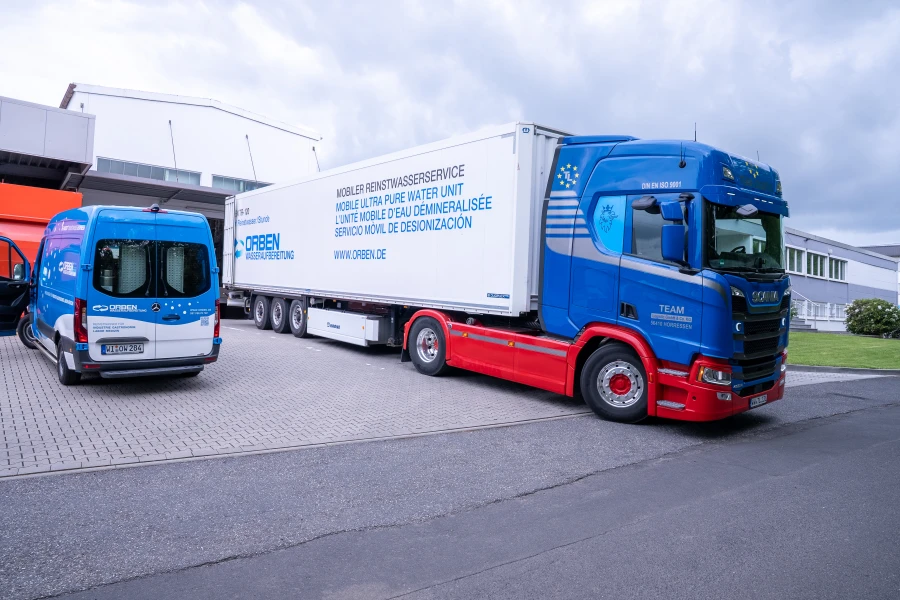
Mobile water treatment is sensible when a project is time-limited or an existing plant needs to be backed up. Typical cases include revisions, commissioning, refurbishments, tank fillings, emergencies, peak loads, or temporary production expansions. The advantage lies in speed and flexibility: the required water quality is produced on-site without having to immediately invest in a stationary plant.
Hybrid concepts combine both worlds. A stationary base-load plant covers normal operation. Mobile systems secure peaks, maintenance windows, or unplanned outages. For operators of critical assets, this is often the least risky solution because it combines technical quality and supply security.
Deionized water systems can be seamlessly integrated into fully automated production lines, provided they are not planned as standalone units. The interface to production control is crucial.
Robust integration includes:
In sensitive processes, the system should not react only when poor quality water has already reached the product. A proactive logic is better: identify trends, set tiered limits, establish warning thresholds, and automatically keep critical water quality out of the process.
For quality management, the data chain is crucial. Documenting conductivity, flow, temperature, service events, resin changes, batches, and releases allows for tracing deviations. This reduces discussions between operations, quality assurance, purchasing, and the supplier. Water quality thus becomes auditable.
Deionized water is relevant wherever dissolved salts interfere. However, the requirements vary greatly.
In power plants and large boilers, deionized water protects against deposits and corrosive effects. For feedwater, makeup water, and circulating water, stable chemical control is crucial, as damage is expensive and downtimes are critical.
In district heating and cooling systems, operational safety is paramount. Low conductivity, controlled pH, low oxygen content, and documentation help reduce scale formation and corrosion. Here, not only the initial filling plays a role, but also replenishment over many years.
In the chemical industry, water is often a reaction medium, rinsing medium, or auxiliary agent. Ions can influence reactions, impact catalysts, contaminate products, or cause deposits. Therefore, the specification must be defined per process.
In surface treatment and electronics manufacturing, rinse water determines residues, spots, adhesion, coating quality, and electrical properties. Here, low conductivity and consistent quality are particularly important.
In battery production, water quality can affect material purity and process stability. Depending on the process step, particles, organic substances, and metallic traces are relevant in addition to ions.
In hydrogen production, electrolysis requires high-purity water. Interfering ions can affect electrodes, membranes, and efficiency. For operators, it is also crucial that ultrapure water is not only generated but continuously available.
In laboratories, medicine, pharmaceuticals, and healthcare, the required quality depends heavily on the intended use. Analytical water, rinse water, purified water, and ultrapure water are not interchangeable. Specification, monitoring, and verification are crucial.
The modern semiconductor industry places the highest demands on water quality. There, "deionized water" as a term is insufficient. Semiconductor processes require Ultrapure Water, meaning water whose quality is controlled right up to the point of use.
For advanced semiconductor processes, a resistivity close to 18.2 MΩ·cm at 25 °C is often required. This corresponds to a conductivity of approximately 0.055 µS/cm and is close to the theoretical maximum for pure water. A target value of 0.1 µS/cm would already be very demanding in many industrial applications, but for state-of-the-art wafer processes, it is only one aspect of the consideration.
In the semiconductor industry, additional factors include:
ASTM D5127 classifies pure water qualities for electronics and semiconductor applications based on process requirements and feature size. SEMI F63 describes requirements and decision logic for Ultrapure Water in semiconductor manufacturing. In practice, modern fabs also define their own specifications because product generation, process step, tool manufacturer, and yield risk can vary significantly.
For industrial applications similar to ORBEN, an important lesson can be drawn: the more critical the process, the less a single conductivity value suffices. Conductivity remains a central indicator for ionic contamination, but it does not automatically prove particle, TOC, or microbiological quality. Therefore, high-purity water must be specified as a complete system.
For operational managers, measurement is only valuable if it is reliably documented. A conductivity value without a measurement point, temperature reference, calibration status, and operating condition is of little value in an audit.
A good documentation concept answers the following questions:
These questions are not only relevant for regulated industries. In energy, heating, and process plants, documentation also helps to find causes more quickly. If conductivity increases after a revision, the operator can check whether raw water, resin, sensors, CO2 ingress, distribution, foreign water, or operating mode is the cause.
Auditability is therefore an economic factor. It reduces search effort, disputes, warranty risks, and recurring errors.
The total operating costs of a deionization solution include more than just the purchase price and the resin filling. All costs over the entire lifecycle are crucial.
These include:
A system with a low initial investment can become expensive if it causes frequent changes, manual interventions, unclear readings, or production risks. Conversely, a higher-quality solution can be more economical if it offers longer service life, better automation, lower failure risks, and clear evidence.
Sustainability is increasingly factoring into the total cost of ownership. Regenerable, reusable resins reduce waste and conserve resources. When resins are regenerated by type and reused, the need for single-use materials decreases. For companies with environmental management, ESG goals, or internal sustainability requirements, this is not just a matter of image, but part of supplier and process evaluation.
A robust specification does not start with the product name, but with the application.
First, the critical application is defined. Does the process need the water for rinsing, reacting, cooling, filling, electrolysis, dilution, or cleaning? Next, the target quality is determined. Is a conductivity below 10 µS/cm sufficient, is below 1 µS/cm required, or is 0.1 µS/cm or ultrapure water quality needed?
Next, the operating profile is considered. A system with continuous 24/7 consumption requires a different architecture than a project with a one-time filling. Consumption peaks, downtime, and seasonal fluctuations must also be included in the design.
Subsequently, the raw water quality is evaluated. High salt load, silicate, CO2, organic substances, hardness, chlorine, or particles alter the process chain. A good concept protects the most sensitive stages from overload.
Then, a decision is made on whether to use a stationary, mobile, or hybrid approach. Stationary is ideal for continuous demand. Mobile is ideal for projects, overhauls, emergencies, and peak loads. Hybrid is ideal for critical infrastructures that need to reduce failure risks.
Finally, monitoring, documentation, and service must be defined. Without these layers, even the best process technology remains vulnerable in daily operations.
.webp)
Deionized water is used in industry wherever dissolved ions can cause deposits, corrosion, product defects, or process drift. Typical application areas include power plants, large boilers, district heating, chemical industry, surface treatment, electronics, battery production, hydrogen electrolysis, laboratories, pharmaceuticals, and ultrapure water processes. The target conductivity depends on the process. For many technical applications, values in the single to double-digit µS/cm range are sufficient. For demanding process and ultrapure water applications, values below 1 µS/cm or up to 0.1 µS/cm are required. In the semiconductor industry, requirements are often even higher and are supplemented by additional parameters.
A constant 0.1 µS/cm is achieved through a multi-stage process chain and meticulous operational management. Typically, this involves a combination of raw water analysis, pre-filtration, reverse osmosis, EDI or mixed-bed polishing, protected distribution, online conductivity measurement, temperature compensation, and a defined reject or alarm strategy. Additionally, resin exhaustion, CO2 ingress, sensor condition, dead spaces, materials, and maintenance intervals must be controlled. This value is less a product promise and more a system outcome.
Ion exchange removes ions without evaporating the entire water volume. Distillation, however, requires significant energy for the phase change. For industrial volumes, ion exchange, reverse osmosis, and EDI are therefore usually more scalable, less energy-intensive, and easier to integrate into continuous processes. While distillation may remain useful for specific applications, it is often not the most economical standard solution for large volume flows focused on low conductivity.
Integration is achieved through sensors, control systems, and defined quality releases. Conductivity, temperature, flow, and pressure are monitored online. If limits are exceeded, the system can automatically trigger an alarm, switch to reject mode, activate a backup stage, or block release to the consumer. Operating data, batches, resin changes, maintenance, and deviations can be documented via PLC or process control system interfaces. Crucially, water treatment does not operate as a secondary unit but becomes an integral part of process quality.
In the semiconductor industry, not just deionized water, but Ultrapure Water is usually required. Modern requirements are based on standards and guides such as ASTM D5127 and SEMI F63, as well as process-specific specifications of the respective fab. A resistivity close to 18.2 MΩ·cm at 25 °C is often required. Additionally, TOC, particles, silicate, dissolved oxygen, metals, ions, bacteria, and quality at the point of use are critical. A single conductivity value is insufficient for modern semiconductor processes.
In industry, deionizing water is not an isolated process step. It is a decision that impacts process stability, plant availability, product quality, documentation, and operating costs. The lower the target conductivity, the more the focus shifts from individual products to the overall system.
For simple applications, a mixed-bed cartridge may suffice. For large volume flows, continuous operation, or target values down to 0.1 µS/cm, a well-engineered combination of pre-treatment, reverse osmosis, EDI, mixed-bed polishing, online measurement, clean distribution, and scheduled service is usually required. For future industries such as battery production, hydrogen, and semiconductors, it is also crucial that purity is not only generated but continuously verified.
Therefore, the most economically sound solution is not the one with the lowest initial investment, but the one that reliably, verifiably, sustainably provides the required water quality with the lowest possible risk of downtime.


.svg)