Wer nach Heizungswasser aufbereitung sucht, denkt häufig zuerst an die Befüllung: Wasser analysieren, aufbereiten, Leitfähigkeit senken, pH-Wert prüfen, Anlage dokumentieren. Für kleine Anlagen mag diese Sichtweise zunächst ausreichend wirken. Für Wärmenetze, Energieanlagen, Prozesswärme, Kliniken, Industriegebäude und größere Bestandsanlagen ist sie jedoch zu kurz gedacht.
Denn Heizungswasser bleibt nicht automatisch in dem Zustand, in dem es eingefüllt wurde. Jede Nachspeisung, jeder Werkstoffkontakt, jede Leckage, jeder Sauerstoffeintrag, jede chemische Korrektur, jeder Harzwechsel und jede hydraulische Veränderung kann die Wasserqualität verschieben. Genau deshalb ist Heizungswasseraufbereitung im professionellen Betrieb kein einmaliger Vorgang, sondern ein überwachter Lebenszyklusprozess.
Für Asset- und Betriebsverantwortliche ist das entscheidend. Sie müssen nicht nur nachweisen, dass eine Anlage einmal normgerecht befüllt wurde. Sie müssen zeigen können, dass Leitwert, pH-Wert, Härte, Sauerstoff, Sichtbefund, Nachspeisemengen und Gegenmaßnahmen über die Betriebszeit nachvollziehbar geführt wurden. Im Zweifel zählt nicht der beste Einzelwert, sondern die belastbare Historie.
Das gilt besonders in Energie- und Prozessanlagen. Dort führen kleine Abweichungen nicht nur zu einem technischen Schönheitsfehler, sondern zu konkreten Risiken: Korrosion, Magnetitbildung, Ablagerungen, verengte Wärmetauscher, verschmutzte Regelventile, ineffiziente Wärmeübertragung, ungeplante Stillstände, Garantiefragen und Diskussionen mit Versicherern, Herstellern oder Auftraggebern.
Der Artikel zeigt, wie Betreiber ein praxistaugliches Monitoring-System für Heizungswasser aufbauen. Im Mittelpunkt stehen Probenahme, Leitwert, pH-Wert, Mess- und Prüftechnik, Online-Sensorik, Laboranalyse, Dokumentation und die Frage, wann eine mobile oder stationäre Aufbereitung sinnvoll wird.
In einer Heizungsanlage ist Wasser nicht einfach Wasser. Es ist ein technisches Betriebsmedium, das Wärme transportiert, Werkstoffe berührt, chemische Reaktionen beeinflusst und den Zustand der Anlage sichtbar macht.
In einem kleinen, überschaubaren Heizkreis kann eine jährliche Kontrolle ausreichen, sofern die Anlage stabil, dicht und gut dokumentiert ist. In einem Wärmenetz oder einer energieintensiven Prozessanlage ist die Lage anders. Dort kommen größere Volumina, längere Rohrleitungswege, höhere Temperaturen, wechselnde Lastprofile, mehrere Werkstoffe, Nachspeisungen, Pumpen, Speicher, Wärmetauscher, Übergabestationen und häufig auch externe Betreiber- oder Dienstleistergrenzen zusammen.
Das macht die Wasserqualität zu einem Führungsparameter des Anlagenbetriebs. Ein stabiler Leitwert zeigt, dass die Salzfracht im System unter Kontrolle bleibt. Ein plausibler pH-Wert zeigt, dass das chemische Milieu zur Werkstoffsituation passt. Ein niedriger Härteeintrag schützt vor Steinbildung. Ein kontrollierter Sauerstoffeintrag reduziert Korrosionsrisiken. Eine dokumentierte Nachspeisemenge zeigt, ob das System wirklich geschlossen arbeitet oder ob Wasserverluste verdeckt kompensiert werden.
Die entscheidende Frage lautet daher nicht: „Ist der heutige Messwert noch im grünen Bereich?“ Die bessere Frage lautet: „Passt der heutige Messwert zum Trend, zur Anlage, zur Nachspeisung, zur Betriebsweise und zu den letzten Maßnahmen?“
Genau dort entsteht der Unterschied zwischen einfacher Messung und professionellem Monitoring.
Für Heizungswasser in Gebäuden ist VDI 2035 der zentrale Referenzrahmen. Sie behandelt die Vermeidung von Schäden durch Steinbildung und wasserseitige Korrosion. Für industrielle Wärmeversorgung, Fernwärme und direkt verbundene Warmwasseranlagen spielt zusätzlich AGFW FW 510 eine zentrale Rolle. Beide Regelwerke verfolgen dasselbe Ziel: wasserchemisch verursachte Schäden vermeiden und Betriebssicherheit erhöhen.
Für Betreiber ist wichtig: Normen liefern keine einfache Einheitsantwort für jede Anlage. Sie geben Richtwerte, Schutzziele und Vorgehensweisen vor. Die konkrete Sollwertdefinition muss immer zur Anlage passen. Entscheidend sind unter anderem:
Im salzarmen Betrieb ist die elektrische Leitfähigkeit einer der wichtigsten Schnellindikatoren. Typische Richtwertbereiche liegen im niedrigen Mikrosiemensbereich, wobei die konkrete Bewertung an Norm, Betriebsweise und Anlage auszurichten ist. Für pH-Werte gelten je nach Werkstoffen unterschiedliche Zielbereiche. Aluminiumhaltige Systeme verlangen eine engere Betrachtung als reine Stahl- oder Kupfersysteme.
Für FW-510-nahe Anlagen kommt hinzu: Fernwärme- und industrielle Heißwassersysteme benötigen meist ein deutlich systematischeres Überwachungskonzept. Es reicht nicht, nach einer Störung eine Wasserprobe ins Labor zu geben. Betreiber brauchen ein Messsystem, das Normalbetrieb, Abweichung, Ursache und Gegenmaßnahme miteinander verbindet.
Ein professionelles Monitoring reduziert Heizungswasser nicht auf einen einzigen Wert. Leitfähigkeit ist wichtig, aber allein nicht ausreichend. pH ist wichtig, aber ohne Kontext missverständlich. Härte ist wichtig, aber bei Bestandsanlagen nur ein Teil der Geschichte.
Ein belastbares Monitoring betrachtet mehrere Parametergruppen.
Sie zeigt, wie viele gelöste Ionen im Wasser vorhanden sind. Steigt der Leitwert unerwartet, kann das auf Nachspeisung mit ungeeignetem Wasser, erschöpftes Harz, Fremdwassereinbruch, Leckagen an Wärmetauschern, chemische Dosierung oder Restverschmutzungen hinweisen.
Er beschreibt das saure oder alkalische Milieu des Wassers. Zu niedrige pH-Werte können Korrosion begünstigen. Zu hohe pH-Werte können insbesondere bei bestimmten Werkstoffen kritisch werden. Wichtig ist, dass sich der pH-Wert nach Befüllung und Betrieb einregeln kann. Eine übereilte Korrektur direkt nach dem Füllen kann mehr schaden als nutzen.
Sie zeigt, ob Härtebildner wie Calcium und Magnesium in relevanter Menge vorhanden sind. Gerade bei hohen Temperaturen und Wärmetauschern kann Härte zu Belagsbildung führen. Bei vollentsalztem Wasser sollte die Härte sehr niedrig sein.
Sauerstoff ist einer der zentralen Treiber für Korrosionsprozesse. Besonders häufige Nachspeisung, mangelhafte Druckhaltung oder ungeeignete Entgasung können Sauerstoffeintrag verursachen. In Fernwärme- und Industrienetzen ist die Entgasung deshalb ein Schlüsselthema.
Viele Messwerte sind temperaturabhängig. Leitfähigkeitsmessungen müssen sinnvoll temperaturkompensiert oder eindeutig mit Messtemperatur dokumentiert werden. Ohne Temperaturbezug können Messwerte falsch interpretiert werden.
Farbe, Trübung, Partikel, Geruch und Ablagerungen liefern Hinweise, die kein Zahlenwert ersetzen kann. Braunes Wasser, schwarze Partikel oder magnetische Rückstände deuten auf Prozesse hin, die unmittelbar bewertet werden sollten.
Sie ist einer der wichtigsten Betriebsindikatoren. Steigt die Nachspeisung, steigt meist auch das Risiko für Sauerstoff- und Salzfracht. Deshalb gehört ein Wasserzähler nicht nur in die Installation, sondern in die Auswertung.
In Anlagen mit Filtration oder Magnetitabscheidung zeigt der Differenzdruck, ob Filter belastet sind. Häufige Filterbeladung kann ein Hinweis auf Korrosionsprodukte, Restverschmutzung oder unzureichende Wasserstabilität sein.
Eine unzulässige Leitwertsteigerung erkennt man nicht erst, wenn ein Grenzwert überschritten ist. Man erkennt sie früh, wenn die Anlage einen definierten Normalzustand hat und Abweichungen gegen diesen Normalzustand bewertet werden.
Der erste Schritt ist daher ein belastbarer Referenzwert. Nach Befüllung, Entlüftung, Temperaturstabilisierung und einer sinnvollen Einregelphase sollte der Betreiber dokumentieren, welcher Leitwert im Normalbetrieb zu erwarten ist. Dieser Wert ist kein Schmuckwert für das Anlagenbuch, sondern der Vergleichspunkt für alle späteren Messungen.
Frühwarnzeichen sind unter anderem:
Besonders kritisch ist ein Trend, der im Tages- oder Wochenverlauf unspektakulär aussieht, über Monate aber eindeutig nach oben läuft. Genau solche Trends werden bei reiner Stichprobenmessung häufig zu spät erkannt.
Für die Praxis empfiehlt sich eine dreistufige Bewertung.
Erstens: Messwert plausibilisieren. Wurde korrekt kalibriert? Ist die Temperaturkompensation aktiv? Wurde die Probe an der richtigen Stelle genommen? Wurde ausreichend gespült? Ist das Messgerät sauber?
Zweitens: Betriebsereignisse prüfen. Gab es Nachspeisung, Leckage, Druckhaltungsprobleme, Reparaturen, Chemikaliendosierung, Harzwechsel, Filterwechsel, Spülung oder Inbetriebnahme neuer Anlagenteile?
Drittens: Ursache eingrenzen. Wenn der Anstieg real ist, muss geklärt werden, ob Salzfracht von außen eingetragen wird, ob Aufbereitungsharz erschöpft ist, ob ein Wärmetauscher undicht ist, ob Restverschmutzung mobilisiert wird oder ob eine chemische Konditionierung den Leitwert erhöht.
Ein Leitwertalarm ohne Ursachenanalyse ist nur ein lauter Ton. Ein Leitwertalarm mit Prüfplan ist ein Instrument zur Betriebssicherung.
Für Betriebe, Fachhandwerk und technische Betreiber in Thüringen ist die zentrale Frage nicht nur, welches Messgerät vorhanden ist. Entscheidend ist, ob Messung, Probenahme, Aufbereitung und Dokumentation zusammenpassen.
Für die Feldmessung werden typischerweise Messgeräte für Leitfähigkeit, pH-Wert, Gesamthärte und Temperatur benötigt. Je nach Anlagenklasse kommen zusätzlich Sauerstoffmessung, Trübungsbewertung, Filterkontrolle, Differenzdrucküberwachung und Laboranalytik hinzu. Für VDI-2035-nahe Anwendungen ist eine robuste mobile Messausstattung sinnvoll, weil Messungen häufig in Technikzentralen, Heizräumen, Baustellenumgebungen oder Bestandsanlagen erfolgen.
ORBEN bietet hierfür Mess- und Prüftechnik im Heizwasserumfeld, insbesondere Messboxen für Leitfähigkeit, pH-Wert, Gesamthärte und Temperatur. Für größere oder dokumentationsintensive Anwendungen ist eine Variante mit automatisierter Dokumentation und geführter Bedienung besonders hilfreich. Denn bei Auditfähigkeit zählt nicht nur der Messwert, sondern auch die Frage, ob der Messprozess reproduzierbar war.
Für Thüringen ist zusätzlich relevant, dass Mess- und Prüftechnik nicht isoliert betrachtet werden sollte. Ein Betreiber benötigt im Idealfall einen Ablauf:
In Thuringia, this combination is particularly relevant for HVAC specialists, building services planning, municipal properties, hospitals, industrial areas, and operators of larger heating circuits. The best measurement technology is not one that stays in its case, but one that is integrated into a regular testing process.
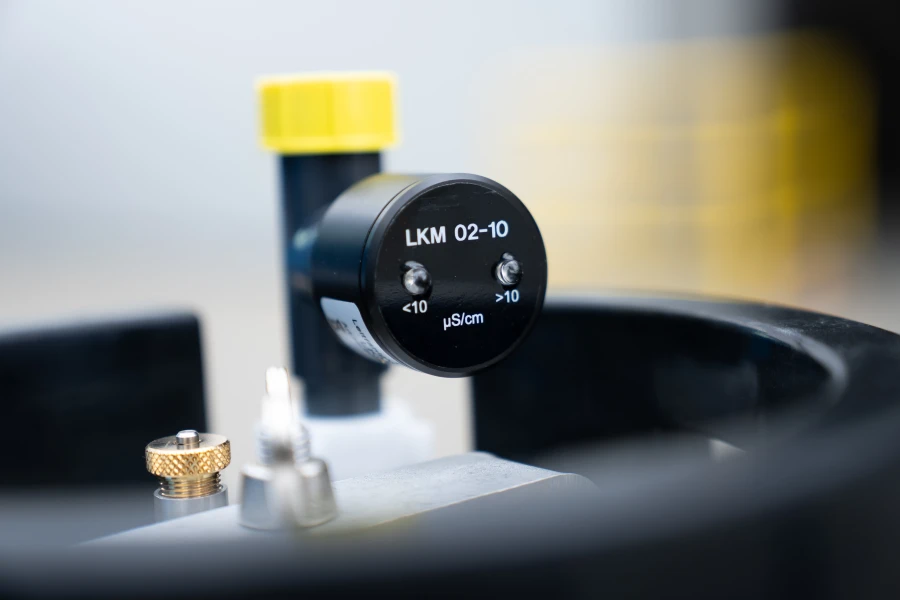
Many measurement errors do not originate in the laboratory or the measuring device, but during sampling. A poorly collected sample can be expertly analyzed and still provide an inaccurate picture of the system.
Proper sampling therefore begins before opening the sampling valve. The operator must know what question the sample is intended to answer. Is it about the general system condition? The effectiveness of bypass treatment? Make-up water? A suspicious section? Laboratory confirmation of an online alarm? Or a dispute following a malfunction?
The more precise the question, the better the sampling.
Industrial facilities in Bavaria often have larger heating circuits, process heat, shift operations, in-house maintenance, external service providers, and high demands on availability. The following step-by-step guide is suitable for operators who want to not only test heating water but also monitor it in a traceable manner.
Step 1: Define the purpose of the sample. Before each sample is taken, it must be clear whether it is for routine control, troubleshooting, commissioning, make-up, laboratory analysis, or proof of effectiveness of a treatment.
Step 2: Define the sampling point. A sample from the main circulation answers different questions than a sample from make-up, return, a heat exchanger, storage, a bypass line, or a critical sub-system. The sampling point must be clearly identified.
Step 3: Document the operating condition. Record the date, time, system condition, temperature, pump operation, current load, last make-up, last maintenance, and any special events.
Step 4: Flush the sampling point. Allow sufficient water to drain until the sample is representative of the area being flowed through. Dead volume and stagnant water can distort measurement values.
Step 5: Perform a visual inspection. Check for color, turbidity, particles, odor, and magnetic residues. The visual findings should be recorded in the log, even if laboratory values later appear unremarkable.
Step 6: Measure on-site values. Conductivity, pH value, and temperature should be measured as immediately as possible. Timely pH measurement is especially crucial, as changes can occur due to gas exchange or temperature.
Step 7: Fill the sample container correctly. Use clean, suitable containers. For certain laboratory parameters, special containers or preservation requirements may be necessary. The laboratory should specify these requirements in advance.
Step 8: Clearly label the sample. Each sample requires system identification, sampling point, date, time, sampler, temperature, purpose of the sample, and relevant operational events.
Step 9: Check measuring devices. Calibration status, calibration solution, device condition, and plausibility check are part of the measurement routine. An uncalibrated device turns a measurement into an estimate.
Step 10: Evaluate results, don't just file them. A report only becomes valuable once it has been evaluated. Is the value within the target range? Does it align with the trend? Is there a cause for deviations? Is action required?
Step 11: Document actions. If a treatment, resin change, make-up water check, filter cleaning, or laboratory analysis is initiated, this decision must be documented.
Step 12: Set a follow-up date. Every unusual sample requires a follow-up. Without a follow-up, monitoring remains reactive.
For industrial companies in Bavaria, it is particularly important that sampling is integrated into existing maintenance processes. This means: dedicated personnel, defined measurement points, clear escalation thresholds, documented calibration, and a connection to maintenance planning, spare parts management, and treatment technology.
In most professional systems, the better method is not either online sensor technology or laboratory analysis. The better method is a smart combination. Online sensor technology is strong when it comes to trends, early warning, and rapid response. It detects continuous conductivity increases, sudden jumps, temperature changes, pressure differences, flow problems, or unusual operating conditions. This is particularly valuable for district heating networks and larger existing systems, because an annual single sample reveals too little about dynamic processes.
Laboratory analysis is strong when it comes to causes, evidence, and complex water chemistry. It can detect parameters that are not reliably measurable in the field or only with greater effort. These include certain ions, metals, corrosion products, inhibitors, detailed hardness and alkalinity assessments, or special analyses after events.
A practical answer for Brandenburg is as follows. An operator of a district heating network, a municipal property, or an industrial site should use online sensor technology to continuously monitor conductivity, temperature, pH (if applicable), pressure, flow, and filter conditions. Laboratory analysis should be used to establish reference conditions, verify online values, clarify causes of deviations, and provide auditable evidence.
Online sensor technology answers the question: “Is something happening right now?” Laboratory analysis answers the question: "What exactly happened and why?"
This leads to a clear recommendation:
So, in Brandenburg, the question is not whether sensor technology or laboratory analysis is "better." What is crucial is whether both methods are organized in such a way that data leads to timely decisions.
A continuous monitoring system for heating water in a district heating network should not start with ordering sensors. It begins with an operating concept.
1. Record the system and network structure. Document producers, storage units, main lines, transfer stations, make-up water supply, degassing, filtration, treatment, critical heat exchangers, and areas with known anomalies.
2. Define target values. Determine the applicable target ranges based on FW 510, VDI 2035, manufacturer specifications, materials, operating mode, and previous analyses. Important: Target values must be system-specific and verifiable.
3. Select measurement points. Typical measurement points include make-up water, fill water, main circulation, return flow, bypass treatment, degassing, critical sub-networks, and locations after renovations or modifications.
4. Define parameters. Particularly suitable parameters for continuous monitoring include conductivity, temperature, flow rate, pressure, differential pressure, and, with suitable technology, pH or oxygen. Laboratory parameters are planned as a supplement.
5. Standardize sampling fittings. Measurement points must be safe, accessible, labeled, and representative. Good sampling requires good connections.
6. Calibrate and maintain measuring instruments. Sensor technology is only as good as its maintenance. Calibration intervals, test equipment, cleaning, spare sensors, and responsibilities must be defined.
7. Collect and evaluate data. Measured values should not only be displayed but also stored, made trend-capable, and linked to operational events. A conductivity increase without information about replenishment is only partially interpretable.
8. Define alarm limits. In addition to absolute limits, trend alarms are useful. A value might still be formally permissible but already show a noticeable increase.
9. Establish escalation logic. Every alarm requires an action. For example: check measuring device, perform comparative measurement, control replenishment, take a sample, commission a laboratory, start bypass treatment, check resin status, inspect filters, or evaluate degassing.
10. Integrate treatment technology. Monitoring becomes particularly effective when combined with treatment. Stationary bypass systems can provide long-term stabilization. Mobile systems assist with commissioning, overhauls, refurbishments, and malfunctions. Trailer systems are relevant for high volumes or short-term project requirements.
11. Make documentation audit-proof. Measured values, alarms, samples, laboratory reports, calibrations, replenishment quantities, and measures must be documented comprehensibly. The goal is not data collection, but provability.
12. Train the operations team. The best system fails if no one interprets the data. Operators should define clear roles: Who checks daily? Who evaluates trends? Who initiates measures? Who communicates with service providers? Who updates the operational logbook?
A continuous monitoring system is successful if it accomplishes three things: it detects deviations early, it leads to clear actions, and it generates reliable evidence.
ORBEN Measurement and Testing Technology fits into this concept as an operational tool for field measurement, documentation, and serviceability. The measuring box is suitable for operators and skilled trades who want to systematically record conductivity, pH value, total hardness, and temperature. The Pro version, with guided operation and digital logging, is particularly interesting when repeatable processes and provability are paramount.
For larger systems, however, measurement and testing technology is only one component. If a system is regularly replenished, has high water content, shows noticeable conductivity trends, or operates in a critical supply environment, an additional treatment concept is required.
This is where mobile and stationary systems come into play. Mobile solutions can be used for filling, refurbishment, existing water treatment, or temporary projects. Stationary bypass systems stabilize system water during ongoing operation. Systems with intelligent control can continuously monitor water quality, initiate treatment when needed, and provide indications for upcoming resin changes.
For asset managers, the added value is not just technology. The added value arises from the combination of Measuring, Evaluating, Treating, Regenerating, and Documenting.
Heating water monitoring requires time, measurement technology, service, and attention. Despite this, it makes economic sense because it reduces unplanned consequential costs.
Damage due to poor water quality rarely happens overnight. They often start with subtle signs: slightly increasing conductivity, frequent top-ups, unstable pH value, increasing filter fouling, darker water, more frequent venting, rising differential pressure, or decreasing heat transfer.
Ignoring these signs saves on measurement effort in the short term but later pays with cleanings, repairs, urgent resin replacements, emergency treatment, inefficient operation, or plant downtime.
Effective monitoring lowers total cost of ownership in several ways:
Especially in energy and process plants, the total cost of ownership is not the price of a measuring device. It is the sum of operational reliability, downtime prevention, documentation capability, service effort, resin consumption, energy efficiency, and the lifespan of water-carrying components.
Sustainability in heating water treatment doesn't mean doing as little as possible. It means, doing exactly the right thing at the right time . Reusable resin and regeneration are key components for this. Instead of treating exhausted resin as a disposable material, it can be circulated, regenerated, and reused. This aligns with modern operational logic: conserving resources, reducing waste, ensuring quality, and making costs more predictable.
Monitoring supports this approach. The better operators know when resin is exhausted, when conductivity values rise, and when treatment is actually required, the more targeted their resource deployment can be. Without monitoring, resins are often changed preventively too early or detected too late. Both are uneconomical.
A sustainable heating water concept therefore combines:
This way, sustainability becomes not just a marketing statement, but a technical operating principle.
In practice, certain errors recur. Avoiding them improves the quality of the entire heating water operation.
Error 1: Only considering individual values. A single conductivity value says little if trend, temperature, top-up, and measuring point are missing.
Mistake 2: Overemphasizing pH too early. After filling, the pH value can only stabilize during operation. Premature chemical interventions can unnecessarily stress the system.
Mistake 3: Not taking make-up water seriously. Frequent refilling is rarely normal. It can indicate leaks, pressure maintenance issues, or oxygen ingress.
Mistake 4: Commissioning a lab analysis without a clear objective. A lab report without an operational question often leads to data, but not to decisions.
Mistake 5: Not calibrating online sensors. Continuous measurement does not replace maintenance. Sensors require care, testing, and plausibility checks.
Mistake 6: Not defining sampling points. If each team measures at a different location, values become incomparable.
Mistake 7: Treating documentation as bureaucracy. Documentation is not an appendix to technology. It is proof that operators fulfill their due diligence obligations.
Mistake 8: Separating treatment and monitoring. Those who measure but lack an action plan only identify problems sooner. However, they don't automatically solve them.
Not every system requires the same depth of monitoring. Key factors are system criticality, volume, operational risk, make-up frequency, and documentation requirements. Manual measurement with a proper maintenance interval may suffice if the system is small to medium-sized, rarely requires make-up water, shows no noticeable trends, contains no critical materials, and is operated with good documentation. An extended measurement concept is advisable if there is recurring make-up water, existing contamination, a mix of materials, larger volumes, frequent modifications, warranty issues, or unclear pH and conductivity trends.
Continuous monitoring becomes relevant when high availability is required, district heating or process systems are involved, large water volumes are moved, there is permanent make-up water, operators need to document for audits, or deviations cause high consequential costs. The simple rule is: The higher the downtime costs, the more monitoring must be automated, documented, and linked to actions.

Modern Heating water treatment doesn't end with the initial filling. It truly begins there. Anyone who wants to safely manage heating water in energy supply systems, district heating networks, industrial buildings, or process plants needs a system comprising sampling, measurement, trend analysis, laboratory testing, treatment, regeneration, service, and documentation.
Conductivity and pH remain central parameters. However, their value is only fully realized in conjunction with top-up water, temperature, materials, operating mode, filter condition, oxygen ingress, and plant history. A single measurement is a snapshot. A documented trend is operational knowledge.
For operators in Thuringia, Brandenburg, Bavaria, and nationwide, this means: The right measurement and testing technology is important, but not sufficient. Crucial is a well-conceived monitoring concept that translates measurement data into decisions. Online sensors provide early warning. Laboratory analysis clarifies causes. Mobile and stationary treatment ensure operational capability. Reusable resin and regeneration improve sustainability and total operating costs.
This ensures heating water is managed not only in compliance with standards, but also safely, auditable, and economically.


.svg)