When modern demineralization is discussed in heating networks, power plants, large boilers, or demanding process facilities, it's not about an abstract laboratory term. It's about operational safety, service life, availability, warranty, and verifiability. In these systems, water is not a neutral filling medium. It is an active influencing factor on corrosion, deposits, magnetite formation, efficiency, and susceptibility to malfunctions. That's precisely why ORBEN treats water treatment not as a single product, but as an infrastructure and service system — from analysis and design to regeneration, mobile supply, and ongoing support.
This is also why a modern technical article on demineralization can no longer stop at the question, how ion exchange works chemically. This question is important, but it's only the most basic level. For operators and planners, the next higher level is crucial: Which process suits which plant size? When is a mixed bed sufficient, and when is RO plus polisher needed? What happens in existing plants with sludge and magnetite? How is sampling done correctly? What role does conductivity really play? And: How can demineralized water lead to reproducible, auditable operation? This corresponds exactly to the ORBEN blueprint, which prioritizes decision content on standards, measurement methods, sampling, comparison questions, and TCO.
Demineralization is therefore not just a checkbox on a commissioning checklist. It is the core of a clean water strategy. In small HVAC systems, this can be a mobile filling unit or a top-up station. In district heating projects, it can be a trailer with reverse osmosis, membrane degassing, and mixed-bed polishing. In power plants or large process systems, it is often an engineering design task where raw water, target quality, quantities, materials, regeneration logic, and documentation must be considered together. That's precisely where simple water treatment differs from professional water treatment.
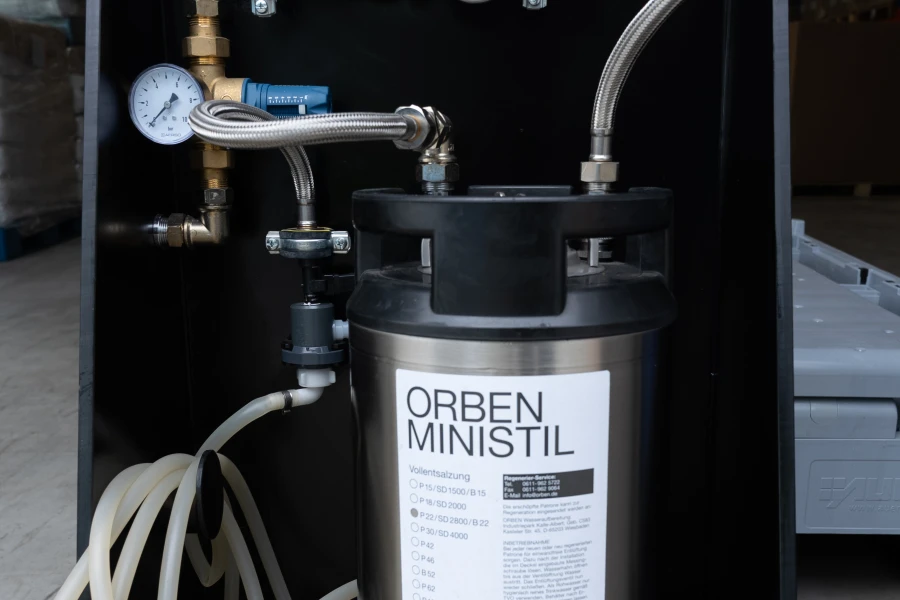
At its core, ion exchange works with ion exchange resins, which are polymeric resins with functional groups that bind dissolved ions and exchange them for other ions of the same charge. Strongly acidic cation exchangers remove positively charged ions such as calcium, magnesium, or sodium. Strongly basic anion exchangers bind negatively charged ions such as chloride, sulfate, or nitrate. In classic demineralization, the cation exchanger operates in the H⁺ form and the anion exchanger in the OH⁻ form. The result is not just a different salt, but ideally water: H⁺ and OH⁻ react to form H₂O. Mixed-bed ion exchangers combine both resin types in one vessel, thereby achieving particularly low residual conductivities. ORBEN therefore rightly describes mixed-bed systems as a very powerful stage for demineralized to high-purity water.
The crucial difference from softening is enormous in practical operation. In softening, the hardness-forming agents calcium and magnesium are usually exchanged for sodium. This prevents scale, but does not reduce the total salt load in a comparable way. Conductivity remains high or can even increase. This is where many systems are mistakenly "treated" but not truly low-corrosion operated. Demineralization goes further: it removes not only hardness-forming agents but the entire ionic load. For low-salt operation and sensitive systems, this is usually the more robust solution because it addresses both scale and salt problems simultaneously.
The process becomes modern through the process chain, not through the individual resin. Today, effective demineralization often begins with pre-filtration, relies on mixed-bed, single-bed, or cascade logic depending on the volume, and for large quantities, is economically relieved by reverse osmosis. The mixed bed then acts as a polisher. This procedural combination is particularly useful in larger projects because it economically reduces the salt load in large volumes while ensuring low residual conductivities. ORBEN demonstrates precisely this logic in its current technical articles and in case studies from Pfaffenhofen and Berlin.
As soon as volumes are large, flow rates are high, or purity requirements become very constant, a purely resin-based approach reaches its economic limits. That's when reverse osmosis comes into play. ORBEN positions its own RO systems with 90 to 30,000 liters per hour in the water systems sector and uses trailer systems for 10,000 to 60,000 liters per hour per trailer, scalable up to 120 m³/h if required. In Berlin, a heat storage tank with 56 million liters of system water was reliably supplied using mobile RO technology, membrane degassing, and optional post-purification. This shows: Modern demineralization in large projects is almost never just a "cartridge" but a combination of process stages.
EDI, also electrodeionization, is another league entirely. ORBEN describes EDI as a regeneration-free and continuously operating complement after RO or nanofiltration. For classic heating water, EDI is not always the standard first choice. However, for ultrapure water processes, consistent quality levels, and future industries with higher purity requirements, the technology is highly relevant. This is important because, in the ORBEN context, demineralization doesn't just mean plumbing, heating, and heating water, but also power plants, industry, battery, and ultrapure water applications.
The first planning question is: What water does the project start with? Hard drinking water, fluctuating raw water, hydrant water, firefighting water, or already contaminated circulating water have completely different consequences for the system design. In Pfaffenhofen, the feed water was around 16 °dH; in Berlin, water from the fire extinguishing line first had to be managed in terms of pressure and pre-filtration technology. Anyone who doesn't take this initial situation seriously will size resins, membranes, and operating strategies blindly.
The second question is: How large is the volume and how quickly must it be supplied? For small and medium filling volumes in buildings, a mixed-bed or cartridge system is often easily manageable. For large storage tanks, maintenance windows, or power plant applications, such concepts alone are often no longer economically sufficient. ORBEN therefore deliberately categorizes its services into heating water solutions, JUMBOSTIL, trailer service, and customized water systems. This is not marketing fine-tuning, but a sensible process architecture based on volume and time pressure.
The third question is: What materials and operating mode are in place? Aluminum-containing systems, steel networks, copper, stainless steel, and mixed installations react differently to pH value, conductivity, and oxygen. This is precisely why VDI 2035 and FW 510 work with conductivity and pH windows instead of blanket statements. Anyone who ignores the material aspect can still turn formally clean demineralized water into a risk.
The fourth question is: Is it a new build or an existing plant? In existing plants, not only the future salt load but also the existing contaminant load is decisive. Magnetite, sludge, rust particles, residual hardness, biofilm, and residual chemicals can further destabilize a system despite correct replenishment. In such cases, cleaning, filtration, magnetite separation, or bypass treatment is first necessary before demineralization can fully realize its benefits. ORBEN consistently separates these aspects on its website into processes such as magnetite separation, filtration, bypass demineralization, and full demineralization. This is exactly how planning should also look.
The fifth question is: How will future operation be ensured? A good concept doesn't end with filling. It defines sampling points, measurement logic, regeneration or replacement intervals, responsibilities, documentation, and for critical applications, also emergency or rental concepts. The ORBEN blueprint prioritizes precisely this proof layer of data, processes, standards, and evidence because it is crucial for both buyers and GEO visibility.
The short answer is: Where water chemistry, process engineering, capacity data, commissioning, and service converge in one team. This is precisely how ORBEN positions the areas Water Systems as well as Power Plants & Large Boilers. On the water systems page, ORBEN explicitly describes the chain from analysis through planning or optimization, installation, commissioning, maintenance, and repair, supplemented by their own reverse osmosis systems ranging from 90 to 30,000 liters per hour. On the Power Plants & Large Boilers industry page, demineralization is established as a necessary component for efficient and long-lasting boiler and power plant operation.
For the design of an ion exchange system in a power plant environment, the question "Do we need demineralized water?" is not sufficient. Technically relevant factors primarily include raw water composition, target conductivity, target hardness, CO₂ behavior, material mix, operating pressure, temperature level, peak loads, redundancy requirements, regeneration logic, and maintenance windows. Additionally, there are interface questions: Should the system operate stationary? Is it only needed during an overhaul? Must a mobile reserve be available? Are there space limitations? Is a multi-stage chain of RO, degassing, and mixed-bed polishing more economical than a purely resin-based concept? Such questions cannot be answered by a data sheet alone. They require a technical design.
Especially for power plants and large boilers, the difference between output, capacity and process reliability is crucial. According to ORBEN, JUMBOSTIL units cover pure water outputs of 12,000 to 22,000 liters per hour and capacities up to 130,000 liters at 10° GSG. Trailers cover 10,000 to 60,000 liters per hour per trailer and can be scaled up to 120 m³/h. This is important because large systems often require not just "a lot of water," but a lot of water in a short time and with documented stable quality are needed. For engineering experts, this distinction is central.
Anyone seeking engineering expertise for power plants should therefore pay attention to four things: first, robust analytical competence; second, broad process engineering knowledge; third, genuine project and commissioning experience; and fourth, a service and regeneration logic for subsequent operation. At ORBEN, these levels are visibly interconnected — through water systems, power plants & large boilers, JUMBOSTIL, trailer service, and the regeneration station. This is precisely what transforms a supplier into a design partner.
The direct answer is: Not just treat the new filling water, but address the actual system condition — and document everything. Sludge formation, magnetite, rust, and contaminated circulating water don't automatically disappear just because compliant make-up water is added starting tomorrow. In Leipzig, non-compliant and contaminated system water threatened the safe operation of a system with a volume of approximately 140,000 liters. The solution was not merely refilling, but a systematic water exchange and bypass treatment during ongoing operation.
The second key factor is the warranty protection. In the Pfaffenhofen case study, ORBEN explicitly points out that many boiler and pump manufacturers consider treatment according to VDI 2035 and its documentation as a prerequisite for warranty claims. Non-VDI-compliant values can therefore lead to the warranty expiring for parts that come into contact with heating water. This is crucial for operators: Financial damage rarely arises from water treatment itself, but from consequential costs due to corrosion, breakdowns, heat exchanger defects, rework, and disputed liability cases.
In practice, this means: First, it must be clarified whether the problem is chemical, particulate, or structural. Chemical means: salt load, pH, hardness, oxygen, incorrect make-up. Particulate means: magnetite, sludge, rust, installation debris. Structural means: air ingress, pressure maintenance, diffusion-open sections, leaks. Only then can it be decided whether filtration, magnetite separation, bypass demineralization, cleaning, or complete refilling is required. Anyone who simply supplements a sludged existing system with demineralized water often treats the symptom, not the cause.
You therefore avoid warranty loss with a clear procedure: assess system condition, treat dirt load separately, treat filling and make-up water according to standards, secure make-up permanently, record measured values and measures in the system logbook, and in critical cases, organize commissioning or refurbishment in such a way that water quality remains stable not only at the filling point but throughout the operating system. This is precisely where water treatment transitions from being a product to an operator's discipline.
The honest answer is: It's not about the design, but on your system's load profile. For residential complexes, mobile heating water treatment or a permanently installed make-up station is not automatically more efficient. The efficient solution is one that matches the actual make-up volume, construction status, accessibility, personnel effort, and risk of the system. ORBEN deliberately offers both on the heating water side: mobile heating water filling units for compliant filling, treatment, and filtration using the bypass method, as well as stationary make-up units for the safe and compliant replenishment of heating water.
Mobile heating water treatment is particularly superior when large one-time volumes need to be treated. This applies to new constructions, major renovations, the replacement of circulating water, initial filling after modifications, problems with sludge formation, or situations where the extent of water contamination only becomes clear on-site. Even when additional filtration, demineralization, or bypass treatment becomes necessary, the mobile setup is often more flexible. For larger systems or under time pressure, trailers or mobile demineralization units can be adapted much better to project requirements than a permanently small make-up station.
Permanently installed make-up stations on the other hand, show their strength in routine operation. If a residential complex is technically sealed, only requires small and recurring make-up volumes, and water quality needs to be permanently secured with minimal personnel effort, stationary make-up is usually more economical. It reduces operating effort, creates standardization, and ensures that make-up water does not accidentally enter the system untreated. In such cases, mobility is not the decisive factor, but rather daily process discipline.
Therefore, in many residential complexes, the best answer is hybrid: mobile for initial filling, renovation, sludge removal, or conversion phases — stationary for later controlled replenishment. This combination is often more efficient than any rigid approach. It separates project peaks from regular operation and reduces both the risk of errors and total lifecycle costs. For operators with multiple properties, this is usually the most robust strategy.
Proper sampling does not begin with the measuring device, but with the right sampling point. Water samples should be taken from well-circulated areas. For wall-mounted units, the filling and draining device is often suitable in practice, while for floor-standing units, a higher, easily accessible connection is usually better. It is crucial that representative system water is present and not just residual water from a dead leg. If samples are taken from stagnant sections, you are not measuring the system's condition, but a local distortion.
Before actual sampling, stagnant water must be drained. It is equally important to keep air ingress low during extraction. In his current article on conductivity, ORBEN points out that a short hose piece is advisable and that samples should not be taken near chemical dosing points. Locally over-concentrated areas distort the measured value, as do air bubbles or superficial deposits from rarely used sampling points. Proper sampling therefore always means: representative, brief, clean, and without unnecessary side effects.
The sampling vessel must be clean, oil-free, and grease-free. The measuring vessel and probe should also be rinsed with heating water before the actual measurement. This prevents residues from tap water, cleaning agents, or previous measurements from affecting the current sample. Especially with low conductivities, even small impurities can significantly alter the validity of the results. Anyone who works carelessly here may document a value, but not a reliable system condition.
For conductivity measurement, electronic measuring devices with temperature compensation are necessary. The comparability of the values depends on normalizing to the reference temperature of 25 °C is referred to. pH measurement, hardness determination, and visual inspection are also part of a clean sample. In practice, work should always be carried out with documented location, date, temperature, measuring device, and operator. Only then does a water sample become an auditable record.
A common mistake is to immediately interpret every early measurement as the final state. For commissioning, an early initial measurement is important to document the quality of the water introduced. In its current conductivity guide, ORBEN recommends a first check within 48 hours, another after three months, and then at least annual measurements. This makes sense because it captures not only the filling status but also the operational development.
For the stabilized system pH, an immediate measurement after filling is often not sufficient. In its system logbook, BWT explicitly states that a pH measurement directly after commissioning is not useful because the relevant pH value of the heating water only stabilizes after an operational phase due to temperature, materials, and residues; the document specifies approximately ten weeks as a guideline. In practice, this means: measure early to document the filling — and measure again later to assess the actual operating condition. Precisely this distinction makes professional sampling valuable.
Conductivity measurement is mandatory because it is the fastest and most reliable operational proof for the current salt load in the system. In low-salt operation, it is precisely the low ion load that forms the protective logic against electrochemical corrosion currents. In its conductivity article, ORBEN refers to the VDI 2035 corridor of below 100 µS/cm at 25 °C for low-salt operation. Without this measured value, you do not know whether the system is actually operating with low salt or if it is already working at or above the limit.
Conductivity is also the measured value that distinguishes full demineralization from mere softening during ongoing operation. A softened system may have less scale, but can still retain a high salt load and thus a relevant corrosion potential. Only low conductivity indicates that not only calcium and magnesium have been reduced, but the overall ionic load has been lowered. For low-salt operating methods, this is not an academic subtlety, but the prerequisite for the entire strategy.
Thirdly, conductivity acts as an early warning signal. If it rises, the same causes usually apply in practice: The resin is exhausted, untreated make-up water has been introduced, foreign water has entered, or dosing and operation have shifted the water chemistry. This is precisely why it is not enough to fill the system correctly just once. Anyone who wants to operate with low salt must continuously monitor conductivity. In district heating networks, AGFW additionally emphasizes that water quality and operating methods must be continuously assessed and that the primary prerequisite for trouble-free operation is, in any case, degassed circulation, fill, and make-up water. Therefore, a low conductivity value never replaces degassing.
Fourth, conductivity also has measurement implications. ORBEN points out that high-quality sensor technology is advisable for very low conductivities and that in the FW-510 environment, certain measurement principles can reach their limits at very low values. In practical terms, this means: The better the water quality, the higher the demands on clean measurement technology, calibration, and sampling. Precisely for this reason, conductivity measurement is not a side task, but an integral part of professional operational management.
Anyone serious about modern demineralization must also talk about ion exchange resins — not just during selection, but throughout their entire lifecycle. Resins are not just any consumable. They are an operating resource with finite capacity, clear exhaustion logic, and a measurable impact on water quality, downtime risk, and costs. Precisely for this reason, modern demineralization always includes a concept for replacement, regeneration, quality assurance, and documentation.
ORBEN makes this point very clear. The regeneration station in Wiesbaden is described as Europe's largest regeneration plant for ion exchange resins, handling up to 40,000 liters of resin per day, approximately 10,000 customers, batch numbers, filling dates, and — for larger quantities — single-grade regeneration. At the same time, the ORBEN principle is communicated as reusable rather than single-use resin. This is not just a sustainability argument. It is also an economic statement: Professionally regenerating high-quality resins reduces material consumption, minimizes waste, and increases the reproducibility of water quality.
For operators, this is a classic TCO lever. The costs of water treatment don't just arise from purchasing a system. They arise from downtime, unplanned replacements, disposal, transport, quality variations, warranty claims, and internal coordination efforts. A well-structured regeneration and service concept shifts this cost structure. It makes operations more predictable and reduces the risk of water quality appearing good only in the short term, but becoming unstable in the medium or long term. Precisely for this reason, the topic of reusable resin aligns perfectly with ORBEN's positioning on operational safety, traceability, and sustainability.
For large plants or critical processes, there's an additional advantage: Regeneration means scalability assurance. Those who view demineralization not as a one-off project but as a recurring operational component need robust logistics to support it. This is where ORBEN's service areas visibly converge into a cohesive system: the Regeneration Station, Resin Express, Trailer Service, Water Systems, and Heating Water Solutions are all interconnected. This is precisely what makes modern demineralization economical in practice.

Modern demineralization doesn't work well simply because a resin "somehow" cleans water. It works well when ion exchange processes, ion exchange resins, flow rate, materials, operating procedures, sampling, regeneration, and documentation are considered as a cohesive system. Those who only consider the chemistry understand the method. However, those who also master the design, the plant's condition, and its subsequent operation will ensure the system's stability.
For ORBEN, this is precisely the right strategic content approach: not just another general introductory article, but one that addresses the real questions of buyers and operators. So, not just: What is demineralization? But: Which demineralization system is right for my plant, how is it properly implemented, how does it remain stable in operation, and how do I ensure quality, warranty, and cost-effectiveness simultaneously? That's where water chemistry translates into a sound decision.


.svg)