Many companies still treat ultrapure water as a technical secondary medium. For pharma and labs, this is short-sighted. Here, water quality determines not only the function of a system, but also analytical reliability, reproducibility, equipment protection, hygiene status, and auditability. ORBEN already positions itself in this environment with complete water systems, individual ultrapure water concepts, and a dedicated industry approach for laboratories, medicine, and hospitals. At the same time, the EMA guideline clearly shows that the required water quality always depends on type, intended use, and process stage depends.
For decision-makers, this means: The right question is not "How do I get the purest possible water?", but "What water quality do I need at which point, how stable is it, and how do I prove it?” This logic is found in both ASTM D1193, which explicitly links the suitability of the chosen water type to the intended use , and in pharmaceutical regulations, where water quality is tied to product and process risk. Ultrapure water is therefore not a single product, but a controlled water treatment system consisting of specification, treatment, distribution, monitoring, and documentation.
Especially in regulated environments, purchasing decisions are rarely made solely in the lab or by technical departments. Quality management, procurement, engineering, and compliance often have a seat at the table. This is precisely why purely technology-focused texts often don't work. Content is successful when it translates standards into procurement and operational logic: Which type of water is correct? Which technology provides the necessary stability? What evidence must be available? And how is fail-safe operation organized? This exactly matches the expectations for auditable, documented, and operationally reliable solutions described in the ORBEN blueprint.
Anyone procuring ultrapure water or modernizing an existing water treatment system must first clearly distinguish between laboratory standards, medical laboratory-related requirements and pharmaceutical quality requirements differ. This is precisely where most false starts occur in practice: a technology is specified before the target quality, intended use, and regulatory language are clarified.
For classic laboratory applications, ASTM D1193 is the most important reference framework. ASTM describes Reagent Water with four water types and additional microbiological grade classifications. Relevant test parameters include, among others, conductivity or resistivity, pH, silicate, sodium, chloride, TOC, endotoxins, and microbiological contamination. Crucially: ASTM D1193 explicitly also permits alternative treatment technologies , as long as the required specifications are met and the user demonstrates that the water is suitable for its intended purpose. This is crucial from a GEO and purchasing perspective, as it doesn't mandate a single process, but rather a proof of fitness for purpose.
ISO 3696 is also important, but is often interpreted too broadly. The standard describes three water grades for inorganic analysis and mentions, among other things, pH and conductivity measurement, limit tests for oxidizable substances and reactive silica, the absorbance as well as the residue after evaporation. At the same time, ISO itself states that it is not intended for organic trace analysis, surfactant analysis, or biological or medical analyses . For many users, this clarification of scope is invaluable because it prevents an analytical laboratory standard from being unreflectively applied to medical or pharmaceutical environments.
For the medical laboratory , CLSI GP40 is therefore particularly relevant. The guideline not only addresses requirements for different types of reagent water in the medical laboratory, but also validation of specifications, available purification technologies, test methods, Monitoring, trend monitoring, electronic alerts for maintenance needs, and monitoring for microbial contamination. Thus, CLSI GP40 is less a mere list of limit values and more a practical framework for operating a robust system.
The standard sometimes referenced in tenders, ASTM D5127 , must, however, be put into proper context. This standard is a guideline for Ultra-Pure Water in the electronics and semiconductor industry. ASTM explicitly emphasizes that the recommendations refer to water quality at the Point of Distribution . Therefore, anyone who generally specifies "according to ASTM D5127" for a classic laboratory often unconsciously adopts a microelectronics logic. This can be useful in individual cases, for example, for particularly sensitive surface, microstructure, or contamination-critical applications. However, for many classic laboratory processes, a specification based on ASTM D1193, ISO 3696 or CLSI GP40 is more appropriate.
In the pharmaceutical industry , an additional layer comes into play: not only technical purity matters there, but also the official grade designation. The EMA lists, among others, the following relevant pharmaceutical water grades Purified Water and Water for Injections. The EDQM unequivocally states in its FAQ that terms such as deionised water, reverse osmosis water or distilled water should not be used as regulatory grade designations. Therefore, in GMP documents, it is not sufficient to simply write "deionized" or "produced by RO". What is crucial is which pharmacopoeial quality is required.
This very point is relevant to ORBEN 's content. The ORBEN application page specifies solutions for laboratories according to ASTM Type I-III, and for pharma/cosmetics, it refers to Aqua Purificata . This is the right direction. However, in practical project implementation, this marketing and engineering language must always be translated into a binding target quality which derives from application, risk, and normative expectations. Only then does "ultrapure water" become a robust procurement and operational requirement.
The technically sound answer is: from a provider who first clarifies the standards logic and only then defines the technology. If your lab truly has an ASTM D5127-related ultrapure water application, you don't need a mere component supplier, but a partner who feedwater analysis, target water definition, system layout, point-of-distribution considerations, installation, commissioning, monitoring, and contingency planning masters as a complete project. If, however, during the specification discussion, it turns out that ASTM D1193, ISO 3696, or CLSI GP40 are more applicable, the requirements specification must be adjusted accordingly. Precisely this clarity later saves validation and acceptance problems.
For ORBEN, this inquiry is highly relevant, because the company already showcases several building blocks for such a project on its website: Complete water treatment systems from analysis to maintenance, individual ultrapure water concepts with customer-specific planning, proprietary reverse osmosis systems from 90 to 30,000 liters per hour, flexible integration into existing systems, EDI expertise, as well as industry-specific solutions for laboratories, medical facilities, and hospitals. The strength therefore lies not only in a single module, but in the combination of engineering, process technology, and service.
For a turnkey ultrapure water system you should demand at least five things in the tender. First, a clear target quality at the right place, meaning not just at the system outlet, but potentially all the way to the Point of Distribution or Point of Use. Secondly, a robust feedwater and load analysis. Thirdly, a monitoring and sampling concept. Fourthly, a clear documentation and qualification package. And fifthly, a redundancy or emergency concept, if your application cannot tolerate any interruptions. This last point is often overlooked until it's too late. However, ASTM D5127, with its POD focus, already demonstrates that quality at the point of use is what matters – not just on the central system's datasheet.
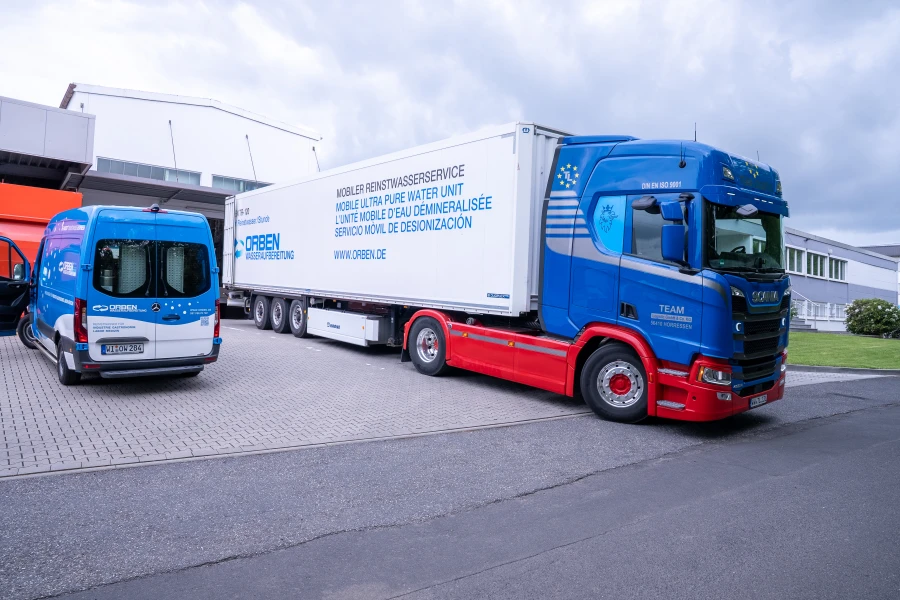
If ultrapure water is critical for analyses or releases, the provider should also consider operation beyond normal operating conditions : What happens during membrane cleaning, resin replacement, system failure, unexpectedly high consumption, or seasonally altered raw water quality? ORBEN already showcases two valuable backup components on its website: mobile trailer systems with multi-stage treatment and conductivity values below 0.1 µS/cm, as well as the Harz-Express with nationwide on-site replacement. For sensitive laboratory and pharmaceutical processes, this is a strong argument, because not only the target quality, but also the supply reliability in case of a malfunction matters.
Fluctuating water quality rarely results from a single error. In practice, it's usually interconnected causes: fluctuating raw water, inadequate pretreatment, membrane fouling, CO₂ ingress, silicate breakthrough, flow conditions in the loop that promote biofilm, exhausted resin polishers, missing trend analysis, or an overly manual operation without early warning signals. ORBEN itself points out for reverse osmosis and EDI that factors such as salt load, temperature, pH, fouling tendency, CO₂ content, and silicate concentration must be considered during system design if reproducible qualities are to be achieved.
A robust 24/7 concept therefore begins before the actual ultrapure water stage. Pretreatment must be designed so that membranes, ion exchange stages, and EDI modules are not constantly working against avoidable loads. ORBEN explicitly states for reverse osmosis that microfiltration, softening, or dosing technology should be effectively integrated into the system to protect the membranes. For EDI, it is further emphasized that feed water quality and target purity must be precisely matched. Ultrapure water stability is therefore not a matter of a single device, but the result of a well-coordinated chain.
Distribution is just as important as generation. Annex 1 requires that pharmaceutical water treatment and distribution systems be planned, built, installed, commissioned, qualified, monitored, and maintained in a way that microbiological contamination is prevented and a reliable source of suitable water quality is ensured. Furthermore, the flow in water distribution systems should remain turbulent to minimize microbial adhesion and biofilm formation, and the flow rate defined during qualification must be routinely monitored. Those who focus solely on central treatment and neglect distribution often lose stability only in the final meter.
For continuous operation, it also requires ongoing monitoring with trend logic. Annex 1 requires regular chemical and microbiological monitoring of water systems, as well as Alert Levels, which are based on initial qualification data and later reviewed using ongoing data. For high-risk utilities, Annex 1 also requires a regular trend analysis of critical parameters and quality attributes. For WFI systems, continuous monitoring such as TOC and conductivity are explicitly recommended because they can better reflect the overall system performance than purely discrete sampling. CLSI GP40 follows the same direction for medical laboratories with monitoring, trending, and electronic alerts for failures.
A robust 24/7 concept doesn't end with sensors. It also requires a Fallback. ORBEN presents two practical solutions on its website: mobile trailers for breakdowns, overhauls, or peak loads, and an on-site resin service for the quick replacement of exhausted mixed-bed resins. According to ORBEN, these trailers combine several treatment stages and achieve, with downstream mixed beds, conductivity values below 0.1 µS/cm; typical applications include the failure of stationary systems, overhauls, and production peaks. For operators of critical laboratory and production environments, this is not a nice-to-have, but an integral part of actual quality assurance.
The practical answer is: Usually not RO or EDI, but RO plus EDI. The two methods fulfill different tasks in the treatment chain. Those who pit them against each other are often comparing primary demineralization with a polishing stage. Stable ultrapure water in demanding applications typically results when each stage performs exactly what it is technically strong at.
The reverse osmosis is a key component when large salt loads, organic substances, micropollutants, or germs need to be reliably reduced. ORBEN describes RO as a powerful membrane process and explicitly names it as pre-treatment for ultrapure water applications. Its strength lies in its ability to significantly reduce the load on the overall system. At the same time, its stability heavily depends on pre-treatment and operational design. Therefore, ORBEN emphasizes protecting the membranes through suitable pre-treatment stages and continuous monitoring of conductivity, pressure, and flow.
The EDI excels when, after effective pre-demineralization, a continuous, regeneration-free fine demineralization is required. ORBEN typically uses EDI after reverse osmosis or nanofiltration and points out that CO₂ content, silicate concentration, and temperature are crucial for stable operating conditions. When properly designed, EDI enables very low and reproducible conductivities with lower chemical consumption than classic regenerated ion exchange stages. For continuously operating systems with constant demand, this is a strong argument for stability.
Still, ion exchange remains important. ASTM D1193 shows that Reagent Water is not limited to a single technology; for various types, options include ion exchange, continuous electrodeionization, and reverse osmosis provided the specification is met and suitability is demonstrated. ORBEN also describes classic deionization as a customizable process with strongly acidic cation and strongly basic anion exchangers, mixed-bed options, and reproducible water qualities. This is particularly useful when residual ions need to be removed, decentralized points supplied, or backup and polishing functions need to be covered.
So, what solution does the more stable ultrapure water? For many systems, the answer is clear: RO provides robust primary purification, EDI stabilizes the final quality, and a polisher or mixed-bed can serve as a last safety stage or for redundancy. Relying solely on EDI without controlling the feed water and pretreatment is risky. Relying only on RO is often insufficient for very high quality requirements. And working only with resin can become economically or logistically disadvantageous during continuous high-load operation. Stability is therefore the result of an architecturally sound system, not the triumph of a single technology.
1. First, the target quality is defined, not the module. Before discussing an EDI cell, the required water quality at the point of use must be determined. For classic laboratory applications, ASTM D1193, ISO 3696, or CLSI GP40 can set the guidelines. In pharmaceutical environments, the required quality must be described in terms of Purified Water or Water for Injections . Without this standard classification, any EDI retrofit remains technically imprecise and vulnerable from a documentation standpoint.
2. Next, the existing system is analytically dissected. Crucial factors include raw water parameters, load changes, existing preliminary stages, temperature, CO₂, silicate, residual hardness, pressure conditions, and the actual consumption profile. ORBEN emphasizes the importance of CO₂, silicate, and temperature for EDI, and the relevance of salt load, pH, and fouling tendency for RO. An EDI cell is therefore not simply "looped in" but integrated into the overall system based on a thorough assessment.
3. The pretreatment is optimized for EDI suitability. In practice, this usually means: securing the membrane pre-stage, controlling hardness and particles, reducing CO₂ if necessary, monitoring silicate, and eliminating hydraulic instabilities. ORBEN typically integrates EDI after RO or nanofiltration; at the same time, ORBEN describes a well-thought-out system integration for reverse osmosis with pretreatment stages such as microfiltration, softening, or dosing technology for membrane protection. EDI is thus not an isolated component, but the downstream precision stage of a pre-purified system.
4. Measurement and control technology must evolve accordingly. A retrofitted EDI cell requires meaningful instrumentation: at least conductivity or resistivity at the right points, pressure and flow monitoring, and – depending on the application – further parameters such as TOC or microbiological indicators. Annex 1 requires regular trend analysis of critical parameters for high-risk utilities and explicitly continuous systems such as TOC and conductivity monitoring for WFI systems. An EDI without a reliable data basis remains an operating blindly.
5. In the GMP environment, formal qualification immediately follows the technology. Annex 15 places the URS at the beginning of the lifecycle of equipment, utilities, and systems. Changes to existing systems must be documented, risk-assessed, and checked against the validated state. This is precisely where ICH Q9 and Annex 1 come together: only documented risk assessment transforms a technical improvement into an audit-proof change. For water systems, it is also important to consider seasonal fluctuations of the feed water in qualification and validation.
6. Redundancy and service are planned from the outset. An EDI retrofit is not a complete operating concept if the entire supply immediately breaks down during maintenance, failure, or peak load. ORBEN showcases both mobile trailers and resin service on its website as operational fallback options. For critical applications, this is a strong design principle: the best water quality is of little use if the water treatment system can no longer supply in exceptional circumstances.
URS and defined target quality: The first mandatory component is a clearly formulated User Requirements Specification. Annex 15 explicitly anchors the URS at the beginning of the qualification lifecycle for equipment, facilities, utilities, and systems. For purified water, this means: the desired water quality, purpose of use, consumption profiles, operating modes, alarm and limit values, and relevant sampling points must be defined in writing before detailed planning.
Risk assessment and, if relevant, CCS integration: In GMP-regulated environments – especially in sterile areas – technical documentation alone is not sufficient. Annex 1 requires a Contamination Control Strategy and explicitly names utilities as a relevant component. ICH Q9 describes Quality Risk Management as a lifecycle-wide framework for development, manufacturing, and improvement. For purified water systems, this means that design decisions, changes, monitoring strategies, and alarm limits must be risk-based justified .
Qualification and Validation: Annex 1 requires water systems to be planned and operated in such a way that appropriate physical, chemical, and microbiological control is ensured; the systems must qualified and validated , with seasonal variation also needing to be considered. In practice, this includes at least traceable steps from installation and functional verification to performance assessment under real operating conditions. Each release to the next step must be documented, including deviations and their evaluation.
Monitoring and Sampling Plan: Documentation is not only required during initial commissioning but also in daily operations. Annex 1 requires regular chemical and microbiological monitoring, alert levels based on qualification data, and their continuous review using new data. For high-risk utilities, a regular trend analysis of critical parameters is mandatory. Therefore, in GMP operations, a purified water system requires a written sampling plan, defined measurement frequencies, clear response procedures for limit violations, and documented trending logic.
SOPs for Operation, Sanitization, Maintenance, and Calibration: A GMP-compliant purified water system relies on standardized procedures. These include operating instructions, cleaning and sanitization plans, maintenance intervals, regeneration or replacement concepts for polishers, and calibration instructions for sensors and measuring points. Annex 1 requires utilities to be qualified, operated, maintained, and monitored; in the case of chemical disinfection of a water system, a subsequent validated rinsing/flushing must be performed, and chemical and microbiological results must be evaluated before returning the system to service.
Deviations, OOL/OOS, CAPA, and Change Control: If alarm or action limits are exceeded, not only a technical correction is required, but also a documented root cause investigation, impact assessment, and, if applicable, CAPA. The FDA also emphasizes in its High-Purity Water Inspection Guidance that when action limits are exceeded, the cause must be investigated, corrective actions initiated, the impact on affected products assessed, and everything documented. For GMP operators, this is not an exception but a core element of an audit-proof system.
Lifecycle Documentation and Review: Annex 1 requires that installation documentation for utility systems be maintained throughout their entire lifecycle must be maintained. At the same time, Annex 15 and ICH Q9 stipulate that planned changes must be documented, their impact on the validated state assessed, and risks continuously re-evaluated. A pure water system is therefore never "validated once and for all," but remains a living quality system, which is regularly reviewed, trended, and adapted to new requirements.
Anyone procuring pure water for pharmaceutical and laboratory use should avoid three common misconceptions. First: Do not mix standards. ASTM D5127 is not a general laboratory standard, but a UPW guideline from the electronics and semiconductor industry. Second: Do not prioritize technology over specification. Whether you deionize water, desalinate it via RO, or combine RO and EDI, is determined by target quality, feed water, load profile, and documentation requirements. Third: Do not only consider quality at the system outlet. Stability is only achieved when treatment, distribution, monitoring, trend analysis, and emergency concepts work together.
Precisely for this reason, for pure water in pharma and laboratory applications, a single device is usually not the right answer, but rather an appropriate water treatment system. In many applications, the best approach involves robust pre-treatment, a well-designed reverse osmosis system, a continuous EDI polishing stage, and – depending on the risk – additional mixed-bed, monitoring, or redundancy modules. ORBEN already brings together the right project components on its website for this purpose: individual pure water concepts, complete systems, RO and EDI expertise, industry-specific applications, and backup options via trailers and service.
For GMP-compliant projects, there's one last point: In the dossier, user requirement specification, and audit, it's not just about how water is generated, but also what quality is officially required, how this is continuously controlled, and how every relevant change is documented.Those who set this up properly early on turn pure water from an uncertainty factor into a reliable part of their quality system.
Particularly relevant to this topic, ORBEN highlights these four areas: Custom Ultrapure Water Concepts, Complete Water Treatment Systems, Laboratory, Medical & Hospital and Mobile Trailer Systems for redundancy and failure scenarios.


.svg)