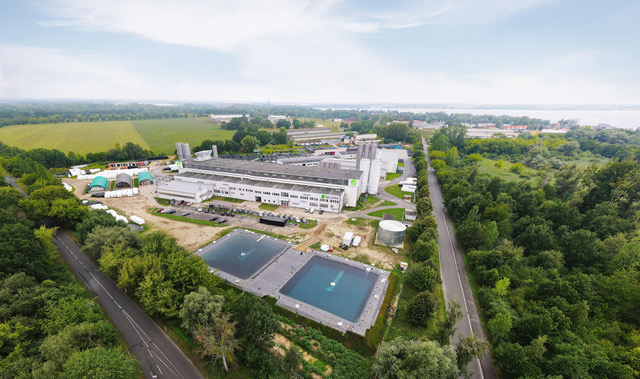
How can excess heat be stored in summer so that it can be used in winter? What does the next generation of water heat storage systems look like?
Rechlin an der Müritz is investigating this question. Project partners Solmax Geosynthetics GmbH and Solites, part of Steinbeis Innovation GmbH, are working on the development of earthpit reservoirs in a four-year research project. The aim is to develop storage systems that meet the requirements of the German and European heating sector in the long term. The “Efficient Pit” project, funded by the Federal Ministry of Economics and Climate Protection (BMWK), focuses on materials and structures that remain stable in the long term at storage temperatures of up to 95 °C. Water specialist Orben from Wiesbaden creates the basis for safe and efficient operation with heating water treated in accordance with standards.
Earthpit heat storage tanks are artificially created basins filled with heating water treated in accordance with standards and fitted with a floating cover. Various heat sources heat the water, such as solar panels or waste heat. The water is heated to up to 90 degrees Celsius and stores thermal energy, which is released again during periods of low solar radiation or lack of waste heat. The new materials are tested for a water temperature of up to 95 degrees Celsius. The stored heat can be fed into local or district heating networks via heat exchangers, used to support boilers and heat pumps, or made available for industrial processes.
The materials, designs and technical functions used are tested under real conditions in Rechlin. In addition to laboratory tests on the aging and stability of temperature-resistant plastic sealing membranes, the focus is on the development of new system components. A central element is the installation of extensive monitoring technology, which enables precise monitoring of thermal and mechanical processes. Sensors in the dam body, on embankments, in the ground and in the floating cover continuously provide data that allows conclusions to be drawn for optimization during handling and installation. The welding of various products and components and their repair options are also being tested in practice. Part of these real conditions is the heating water quality, which must meet the requirements of VDI Directive 2035.

To fill the two test reservoirs in Rechlin-Müritz for the first time, more than 6,600 cubic meters of water, i.e. over 6.6 million liters, were removed from the public network. Orben prepared 5,000 cubic meters of this in accordance with the recommendations of the AGFW (Arbeitsgemeinschaft Fernwärme) and the VDI Guideline 2035 in accordance with standards and introduced them into the two storage tanks with volumes of 3,000 and just under 2,000 cubic meters.
In order for the water to meet the requirements for circulating water in industrial and district heating systems, it had to be treated in advance. Regular drinking water contains many dissolved salts, minerals, and gases that can cause deposits, corrosion, and damage in heating systems. The AGFW guideline FW 510 and VDI 2035 therefore define clear limits and quality standards to ensure the efficiency and lifetime of the systems. Assured heating water quality is the basis for reliable operation and protects against costly damage caused by deposits or corrosion. At the same time, it contributes to climate protection, sustainable use of resources and ultimately to the successful heating revolution.
The reverse osmosis process was used to treat the circulating water in Rechlin. Treatment by reverse osmosis is based on the physical process of membrane technology for concentrating substances dissolved in liquids. To prevent damage to the membranes, tap water is pretreated to remove larger particles, suspended matter and contaminants. In the next step, the water is pressed onto the reverse osmosis membrane under high pressure, causing it to pass through the membrane and retain pollutants and salts. After treatment, around 20 percent of the raw water fed in remained as concentrate in Rechlin. Together with the filtered substances, it was professionally discharged into the sewage network and thus kept away from the storage tank.
As mentioned, over 6,600 cubic meters of water were withdrawn from the public network. Extracting such a large volume of water required careful preparation: pumping capacities, the safety of the drinking water supply, seasonal events such as major events as well as network loads, holidays and weather conditions had to be taken into account. For example, due to the nearby “Fusion Festival” with over 70,000 visitors, the water could only be removed after the end of the event. This ensured that the water supply of the neighboring town of Boek was not endangered. Another challenge was the reliable, continuous provision of the required volumes of water. For this purpose, the raw water was fed in via hydrants by the local supplier, which ensured a flow rate of around 15 cubic meters per hour. The supplier had previously checked the withdrawal quantity with tests using standpipes. Other options, such as an approved removal from nearby Müritz, proved unnecessary as a result.

The basis for standard-compliant treatment was detailed water analysis in the Orben laboratory. The implementation was then carried out with the mobile “Orben TR-10” trailer. The system on the truck trailer combines pretreatment, reverse osmosis, membrane degassing and, if required, post-purification via mixed-bed ion exchangers. The process was also used successfully recently to fill the earthpit reservoir in Bracht, Central Hesse. There, even over 26,000 cubic meters of heating water were successfully treated under difficult conditions. In Rechlin, too, an Orben employee specially trained for mobile water treatment took over the connection, commissioning and continuous monitoring of the entire treatment system. Service and maintenance measures immediately compensated for any fluctuations in the water supply, so that the plant could be operated at full capacity at all times.
The raw water removed for the initial filling was in hardness range 3 with a total hardness of 16.7 °dH and was therefore classified as “hard water”. At 624 µS/cm, the conductivity was also significantly too high. After treatment with the “Orben TR-10” trailer, the picture was completely different: In both test tanks, a total hardness of just 0.16 °dH was achieved, i.e. fully demineralized water in the “soft area”. The conductivity fell from the original 624 to 16.4 µS/cm in the right and 13.8 µS/cm in the left basin; a value that is well below the limits prescribed in AGFW 510 and VDI 2035. The pH was also set within the required normal range.
The heating water produced thus meets the requirements of AGFW 510 and VDI 2035: Hardness forms are virtually removed, the electrical conductivity is very low and the pH value is within the optimal range. This ensures that no stone formation or corrosion occurs and that the storage systems can operate efficiently and reliably over the long term. The heating water treatment took place from July 7 to 29, 2025 and ran smoothly around the clock for 23 days.
The plant in Rechlin-Müritz impressively shows how technological innovation, state-funded projects and partnership cooperation are driving the heating revolution forward. Solmax and the Steinbeis Institute Solites are researching the next generation of earthpit reservoirs here. An important component of this is heating water treatment in accordance with VDI Directive 2035. Wiesbaden-based water specialist Orben uses standard-compliant heating water to ensure that the storage systems can operate efficiently and reliably over the long term. In this way, the project not only provides important findings for research and industry, but also concrete contributions to plant protection and efficiency, which contributes to sustainable heat supply and climate protection.
Our heating water treatment ensures the efficient and reliable water quality of your heating systems. Prevent corrosion and deposits, extend the life of your equipment and reduce energy consumption.
Increase efficiencyORBEN supplies complete water systems from a single source — from planning to installation to maintenance. Our tailor-made solutions guarantee maximum efficiency.
Find an individual solutionWe are available to answer any questions you may have and help you with your projects. Get in touch with us — we'd love to hear from you.



.svg)
