
A pioneering heating project is being built in the Central Hessian town of Bracht, a district of Rauschenberg near Marburg. The goal is to be climate-neutral by 2025. A seasonal earthpit storage tank with a storage volume of around 26,600 m³, together with a large-scale solar thermal field and a highly efficient local heating network, is at the heart of the ambitious energy concept. Around 70% of the annual heat requirement is met by renewable solar energy, supplemented by heat pumps and a biomass boiler. The plant brings together technical innovation and the municipal energy revolution.
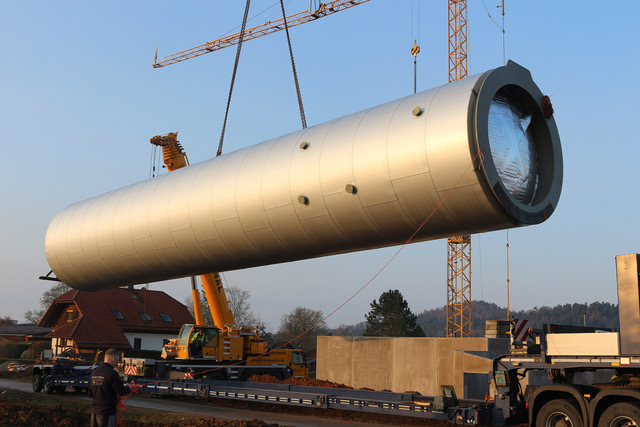
The storage system is being built right on the outskirts of Bracht-Siedlung. For this purpose, a 14-meter deep pool was excavated and lined with a waterproof plastic sealing membrane. The storage tank is covered with floating insulation to reduce cooling. The earthpit storage tank holds 26,600 m³ of water, which is over 26 million liters, almost eleven 50-meter Olympic swimming pools. Planning and implementation are carried out in close cooperation with municipal partners, contractors and technology providers.

A collector array with 855 modules on a collector area of around 12,900 m² feeds thermal energy into the storage tank. In the summer months, water is heated by solar energy and stored for weeks so that it is available in winter. Two heat pumps, each with 220 kW electrical connection capacity, supplement the supply, and a 700 kW biomass boiler takes on peak loads. Overall, this results in around 98% fewer CO₂ emissions compared to fossil heating systems.
Modern, highly efficient systems place particular demands on the interaction of the components and on the quality of the heating water used. Lime, oxygen and dissolved salts in raw water can lead to deposits, corrosion and damage, particularly on modern high-performance pumps, heat exchangers and on all water-carrying pipes and valves. Standard-compliant treatment in accordance with VDI 2035 is essential for the longevity and efficiency of the system and forms the basis for any warranty claims.
A preliminary water analysis, carried out by Orben's in-house water analysis laboratory, forms the basis for subsequent action planning. Two buffer containers, each with a volume of 30 m³, were purchased and converted as a required raw water supply for drinking water before the heating water treatment plant was put into operation. The containers were filled via several routes: Water was fed in from a part of the settlement via fire hoses. Two pumping stations have been set up for water directly from the village of Bracht. In addition, more than a kilometer of fire hose was installed and the existing main line was used. The pumping station of the Brachter drinking water supply feeds the elevated tank above the village via a fixed pipeline. From there, excess water is directed via an overflow into an intermediate tank. From this, the water flows via a coupling into the main transport line, which connects the future heating center to the town of Bracht. Self-installed fire hoses were used for the first section. A pump in the buffer tank provided the necessary pressure. Another tank was installed in the village, in which the incoming water was temporarily stored. The raw water arriving there and additional, smaller quantities of water from the Bracht settlement area were then directed to two large reservoirs. From these, they were forwarded to the actual heating water treatment system. The entire transport route covered around 2.5 kilometers. Around 1.1 kilometers of this via fire hoses, the remaining section via the fixed main transport line. With professional support from Orben, the entire filling plant was built in-house by the cooperative working group.
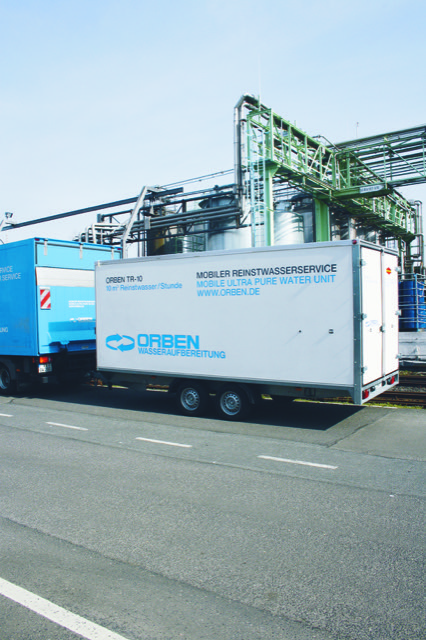
The Brachter planners relied on water specialist Orben from Wiesbaden. It put a TR-10 trailer, tailored to a lower flow of raw water, into operation for mobile heating water treatment at the earthpit tank. The trailer offers a unit with pretreatment, reverse osmosis, membrane degassing and, if required, subsequent cleaning using mixed-bed ion exchangers. An employee specially trained to use mobile water treatment systems took over the hydraulic and electrical connection of the system as well as the commissioning and supervised the complete treatment. The interplay between sufficient water, different pumping capacities and fluctuating backpressure was a challenge. Measurement, control and regulation were carried out constantly.
The drinking water, which was heavily contaminated with particles, was treated by coordinated pre-filtration with different filter fineness, reverse osmosis and residual desalination in accordance with the VDI 2035 guideline and ensured a pH value that complies with the regulations. Treatment by reverse osmosis is based on the principle of selective permeability of a membrane, which only allows certain substances to pass through while retaining others. First, tap water is pretreated to remove larger particles, suspended matter and contaminants. In the next step, the water is pressed onto the reverse osmosis membrane under high pressure, causing it to pass through the membrane and retain pollutants and salts. The CO2 still contained after reverse osmosis is almost removed via membrane degassing. Without this process step, the low pH value of the treated water due to the carbonic acid gas impairs the adjustment of the pH value required by the guidelines for treated water of 8.5 — 9.5 due to its buffering effect. The capacity of the downstream residual desalination filter also loses around 35% of its usable capacity when the gas is present. In the end, the entire planning was successfully implemented and the earthpit storage tank only contains VDI-compliant heating water.
The average water consumption in the village of Bracht is around 113,400 liters per day. The amount of water required to fill the earthpit reservoir for the first time corresponds to the water consumption of the entire village of 208 days, that is just under seven months. In order to avoid a shortage of drinking water, this exceptionally large water requirement required a close combination of technical planning, coordination with the supplier and flexible treatment. Timing plans offer a practical solution to avoid or alleviate water shortages. During low-consumption times of the day, for example at night or early in the morning, when the pressure in the network is higher and fewer households use water, water can be extracted in a targeted manner. The removal of the total quantity is spread over several days and weeks so as not to overload the network and to take into account special requirements, such as holidays or warm weather conditions. Together with planners and Orben's water specialists, a treatment schedule was drawn up that took into account the needs of all parties involved. At no time was there a shortage of water and yet the water treatment with a volume of just under 11 Olympic 50-meter swimming pools, in parallel with the remaining construction measures, was successfully carried out in around 16 weeks.
Bracht impressively shows how municipalities can achieve concrete climate goals with joint concepts. By winter 2025, all houses should be connected to the local heating network. Central storage enables the seasonal use of solar surpluses, and the local heating network replaces many individual heating systems with an efficient, communal system. With scientific support and intelligent control technology, the project is becoming a role model for other regions.
For more information, see:
https://www.solarwaerme-bracht.de/aktueller-stand-und-historie-solarwärme-bracht/
Our heating water treatment ensures the efficient and reliable water quality of your heating systems. Prevent corrosion and deposits, extend the life of your equipment and reduce energy consumption.
Increase efficiencyORBEN supplies complete water systems from a single source — from planning to installation to maintenance. Our tailor-made solutions guarantee maximum efficiency.
Find an individual solutionWe are available to answer any questions you may have and help you with your projects. Get in touch with us — we'd love to hear from you.



.svg)
