In modern heating networks, energy and process plants, and the district heating sector, water quality significantly determines the lifespan and efficiency of components. Stricter efficiency requirements and the trend towards highly efficient heat generators make heating and district heating water a strategic lever for operators and planners. Incorrect filling with hard, saline, or oxygen-rich water leads to limescale deposits, corrosion, magnetite sludge, and thus premature wear of boilers, heat exchangers, pumps, or pipes. The consequences are high repair costs, production downtime, and warranty losses. Guidelines such as VDI Guideline 2035 and AGFW Worksheet FW 510 therefore specify clear limit values for the conductivity, pH value, hardness, and oxygen content of heating water. In addition to the initial filling after system installation, replenishment during operation is crucial, because even minor additions of unsuitable water can upset the balance.
Awareness of drinking water protection and the responsibility of operators is increasing. DIN EN 1717 requires a safe separation between drinking water and non-drinking water to prevent backflow and contamination. While heating systems used to be filled with a temporary garden hose, the standard now stipulates that filling and replenishment connections are permanently considered part of the drinking water installation. Only standard-compliant filling stations with a system disconnector (Type BA) protect the drinking water supply and meet the requirements of hazard class 4 for heating water containing corrosion inhibitors. Thus, filling stations become a mandatory component of heating water treatment – and an important tool for asset managers, HVAC professionals, and building services planners.
This technical article explains the legal framework for filling stations in the heating sector, describes the technology of mobile and stationary systems, and provides decision-making aids for selection and use. The goal is to provide you with sound knowledge so that you can achieve maximum operational safety and sustainability with minimal effort.
VDI Guideline 2035 defines the limit values for circulating and filling water in closed hot water heating systems. It distinguishes between low-salt operation (demineralization) and saline operation. For low-salt operation, VDI 2035 requires an electrical conductivity of the heating water between 10 µS/cm and a maximum of 100 µS/cm. The pH value should range between 8.2 and 10, depending on the material; for aluminum components, the range is restricted to 8.2 to 9. The oxygen content should not exceed 0.1 mg/l, as dissolved oxygen accelerates corrosion. For saline operation, VDI 2035 allows higher conductivity values up to 1,500 µS/cm, but the risk of corrosion and scale formation increases drastically, so this mode of operation is only recommended in exceptional cases. The guideline also points out the importance of total water hardness: for low-salt operation, it should be below 0.11 °dH (≈ 0.02 mmol/l). Comprehensive documentation of water parameters is explicitly required, as it forms the basis for liability issues and warranty claims.
VDI 2035 emphasizes that the choice of filling method – softening, demineralization, or mixed bed – depends on the material mix, system performance, and structural configuration. Fully demineralized water offers the highest operational reliability because only the pH value and conductivity need to be monitored. However, very low conductivity values below 20 µS/cm can lead to measurement uncertainties, which is why the standard recommends a conductivity value between 10 and 100 µS/cm. For aluminum materials, the upper pH limit is lower to prevent intergranular corrosion. Filling stations must therefore be able to supply water with controlled conductivity and pH stability.
For local and district heating networks, AGFW Worksheet FW 510 applies, which is closely based on VDI 2035 but specifies stricter limit values for low-salt systems. For low-salt operation, FW 510 requires conductivity between 10 and 30 µS/cm and a pH value between 9.0 and 10.0. The alkaline earth hardness (sum of calcium and magnesium ions) must not exceed 0.02 mmol/l. The oxygen content must be below 0.1 mg/l, because oxygen is difficult to remove from large network volumes and can lead to massive corrosion. For saline operating modes, conductivity values up to 100 µS/cm and pH values up to 10.5 are permissible; the oxygen content must then not exceed 0.05 mg/l. AGFW FW 510 points out that for conductivity values below 20 µS/cm, measurement with conventional conductivity sensors can be difficult. Operators of district heating networks must therefore maintain a measurement concept that provides reliable values even at very low conductivity, for example, through temperature compensation and regular calibration.
DIN EN 1717 is titled "Protection of drinking water from contamination in drinking water installations and general requirements for devices to prevent pollution of drinking water by backflow". It requires a physical separation between drinking water installations and non-drinking water systems to prevent backflow due to pressure changes. The aim is to exclude health hazards from the backflow of contaminated water into the public network. The standard defines various fluid categories according to their hazard level: Category 4 water – which includes heating water with corrosion inhibitors – can pose a health hazard due to toxic substances. For this category, DIN EN 1717 requires the use of a controllable backflow preventer of type BA. This component has three chambers with check valves that form a safe separation zone. In the event of a pressure drop, the check valves open, and the middle chamber is emptied via a drain valve, making backflow impossible. For heating systems without additives (hazard class 3), a type CA backflow preventer would also be permissible; however, if inhibitors or other additives are used, a type BA backflow preventer is mandatory. Filling stations must therefore be equipped with a BA backflow preventer if they are permanently connected to the drinking water line.
The European standard DIN EN 14336 describes the installation and commissioning of hot water heating systems in buildings. It requires that the piping system be cleaned and flushed before filling to remove dirt, corrosion residues, and foreign matter. If contamination is expected during installation, the standard recommends chemical or mechanical pre-cleaning and thorough flushing with water before the system is filled with demineralized water. External sources indicate that for new buildings, the heating circuit should first be flushed according to DIN EN 14336, and the system should only be filled after a successful pressure test. These requirements are important because even the best filling station cannot guarantee the quality of the filling water if the system is internally contaminated.
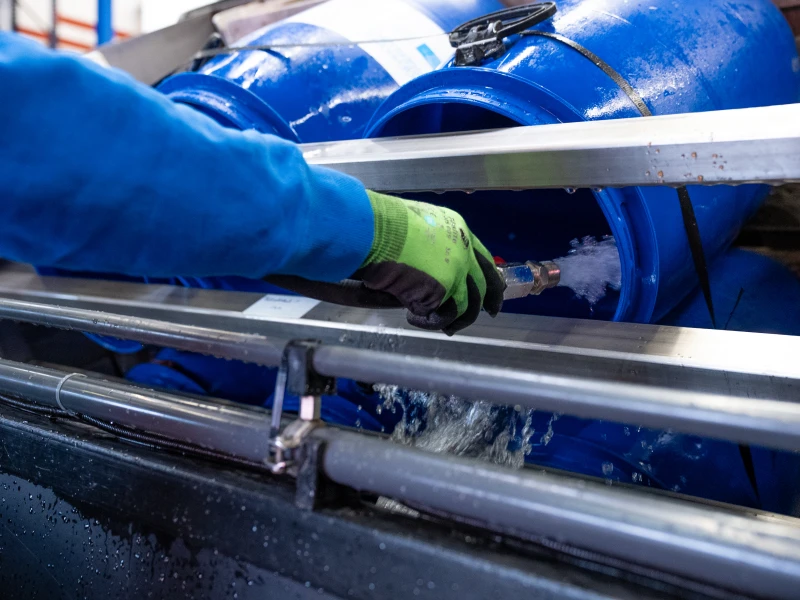
Filling stations combine several components that work together to ensure standard-compliant filling and replenishment. Essentially, three types can be distinguished: mobile filling stations for one-time or temporary filling, stationary replenishment stations for permanent topping up of circulating water, and combined systems for emergencies and large installations. Common to all of them are the connection to the drinking water network via a system disconnector, water treatment using ion exchange or mixed bed, and measurement and documentation technology.
The system disconnector forms the interface between drinking water and heating water. It belongs to safety device family B ("controllable separation") of DIN EN 1717 and is designated as Type BA. The system disconnector consists of three chambers (inlet, intermediate pressure zone, outlet), each with a check valve. If the pressure in the intermediate pressure zone drops below a certain value (approx. 0.14 bar), the valve to the heating network closes, the valve to the drinking water side opens, and the middle chamber is emptied via a drain valve, preventing any backflow. For heating water with inhibitors or other additives, this BA type is mandatory. The housing is made of corrosion-resistant metals such as dezincification-resistant brass, gunmetal, or stainless steel; the seals must be approved for drinking water use.
In many filling stations, the system disconnector is integrated into the fitting and additionally insulated to prevent heat loss and condensation. Some manufacturers rely on modular units where the system disconnector can be replaced with a few simple steps to facilitate maintenance. For the operator, it is important that the system disconnector is regularly maintained (annually or according to manufacturer's instructions), as a malfunction endangers drinking water hygiene. DIN EN 1717 also requires that Type BA system disconnectors must not be installed in shafts where there is a risk of flooding or where toxic fumes may occur.
Heating systems operate at pressures of a few bar. However, the potable water network can have pressures ranging from 4 to 10 bar. Filling stations therefore include a pressure reducer that continuously adjusts the potable water pressure to the permissible filling pressure. An integrated safety valve or overpressure cut-off prevents the circuit from being overfilled and components from being stressed. Modern filling stations feature two pressure gauges: one before the pressure reducer to check the line pressure, and one after to monitor the filling pressure. A valve combination with shut-off valves at the inlet and outlet allows for safe isolation of the filling station for maintenance.
The primary function of a filling station is to convert raw water from the potable water line into fully demineralized or partially demineralized water. This is where ion exchange cartridges come into play. Depending on the application, cationic softening resins (for softening), mixed-bed resins (for full demineralization), or anion/cation filters in combination are used. In mobile filling stations, the resin is contained in replaceable cartridges that are regenerated or replaced once exhausted. Stationary systems feature larger resin volumes and sometimes multiple cartridges to ensure higher capacities and redundancy. Cartridge replacement is indicated by color-changing resins or conductivity probes. ORBEN emphasizes on the product page for the „Thermostil mobil“ series that the THERMION 2035 resin cartridge is designed to be pH-compliant and features an integrated conductivity meter for process control. The devices operate with a magnetic fine filter for particle separation, a circulation pump, and a mixed-bed cartridge to purify water cleanly using the bypass method in accordance with DIN EN 14336 and VDI 2035.
Mixed-bed filters consist of a mixture of strongly acidic cation exchange resins and strongly basic anion exchange resins. They remove almost all dissolved salts, resulting in water with a conductivity of a few microsiemens per centimeter. For heating technology, the multi-use resin option is recommended, where the resins are reprocessed in a regeneration station. According to ORBEN's „Heizwasser“ (Heating Water) page, mobile filling devices and replenishment units are offered with multi-use resin, which are returned to the regeneration plant once exhausted. Regeneration reduces waste, lowers overall costs, and is an important component of the sustainability strategy.
A filling station should not only treat water but also monitor it. Measuring devices for conductivity and pH value provide immediate information about water quality. Many modern stations feature digital sensors with displays and data loggers that document the measured values. Some systems can be connected via interfaces to building management systems, so that alarm messages for exceeding limit values (e.g., conductivity > 100 µS/cm) are automatically sent to operations management. Water meters record the amount of replenished water – an important documentation tool for operators and for demonstrating compliance to regulators. ORBEN's stationary replenishment unit „Serastil NKS ready“ integrates a water meter, a pressure reducer, two pressure gauges, and an ion exchange filter alongside the BA system disconnector. The system is DVGW-certified, complies with DIN EN 1717, and, depending on the version, delivers 60 to 240 l/h of treated water. The resin cartridge changes color when exhausted, and a germ barrier prevents microbiological growth.
While small filling stations operate passively, guiding water through the ion exchanger using existing line pressure, larger systems require an integrated pump. The pump ensures a constant volume flow through the ion exchange filter and stabilizes the filling pressure. A bypass switch allows the heating network to be flushed during operation and simultaneously supplied with treatedtfhzdrghztd water. Fine pre-filters remove particles, while magnetic separators retain magnetite and iron oxides. A flange connection simplifies connection to the heating network. In combination with magnetic dirt separators and fine filters, the filling station can also serve as temporary bypass filtration to remove suspended solids from the circuit during operation.
Mobile filling stations are compact, easy to transport, and ideal for initial filling or small to medium-sized projects. They are temporarily connected to the heating circuit to fill the system with fully demineralized water. Their design includes a system disconnector, resin cartridge, conductivity meter, and usually a small circulation pump. ORBEN's „Thermostil mobil“ series combines a mixed-bed cartridge with a magnetic fine filter, circulation pump, and conductivity measurement. These devices are designed for bypass operation, which continuously circulates the water through the resin cartridge during the filling process. Depending on the cartridge size, the capacity is sufficient for several hundred liters of fully demineralized water. For very large systems, the cartridges can be changed multiple times or supplemented by mobile trailers.
Mobile filling stations offer flexibility: They can be transported from one construction site to another, support the commissioning of multiple projects consecutively, and are suitable for short-term use, for example, when a system needs to be refilled after repair or retrofit. They offer a good cost-performance ratio and are particularly attractive for the HVAC trade. When making your selection, you should pay attention to ergonomics (trolley, hose routing), cartridge type (multi-use resin vs. single-use resin), and the available measurement functions.
While initial filling is often considered a single event, replenishment during operation is a continuous process. Pressure loss due to leaks, venting procedures, maintenance work, and system-related water losses mean that water must be regularly topped up. In the past, a simple hose connection with a backflow preventer was often used for this purpose. DIN EN 1717 has put an end to this provisional approach: every connection to the potable water network is considered permanent and must be equipped with a suitable system disconnector. Stationary replenishment units meet this requirement. They are permanently installed in the technical room, continuously connected to the potable water line, and feature BA system disconnectors, pressure reducers, measuring devices, and ion exchange filters.
The advantage of stationary filling stations lies in automation: An integrated automatic filling device maintains constant system pressure. If the pressure in the heating circuit drops below a set value, the filling valve opens, and replenished water passes through the ion exchange filter before entering the heating circuit. This prevents unsuitable tap water from being fed in and reduces the risk of corrosion. According to a HeizungsJournal report, ORBEN's „Serastil NKS ready“ model combines an automatic filling device with a BA system disconnector, full demineralization cartridge, water meter, pressure reducer, and dual pressure gauge. The series is available in versions with one, two, or four cartridges, allowing 60, 120, or 240 liters per hour of treated water, depending on water demand. A color indicator system shows when the resin is exhausted, and a germ barrier prevents microbiological growth, ensuring the system operates safely even after extended periods of inactivity.
Stationary filling stations are particularly suitable for medium-sized and large systems where regular replenishment occurs. They offer high safety because they automatically comply with standards and simplify documentation. For operators of heating networks, district heating power plants, and industrial process plants, they enable proof of compliance to inspection authorities and insurers. The use of multi-use resin reduces running costs, and regeneration logistics can be integrated into daily operations.
In very large heating systems, district heating networks, or in emergencies like pipe bursts, more capacity is needed than a compact filling station can provide. This is where mobile trailer systems and container solutions come into play. These systems are capable of delivering several cubic meters of demineralized water per hour. According to ORBEN's services, the "Trailer Service" includes mobile water treatment for applications from 10,000 to 60,000 l/h, designed as demineralization or mixed-bed containers. They are equipped with power generators, pumps, ion exchangers, and measurement/control technology, and can be flanged to the heating system to quickly supply large volumes of demineralized water – for example, during flushing, large-scale fillings, or in preparation for boiler overhauls. The same standards apply regarding conductivity, pH value, and system separation. The trailer can either operate independently or be coupled with stationary filling stations to handle peak loads. For emergencies, ORBEN, according to HeizungsJournal, also provides versions with trailer connections in the "Serastil NKS ready" series, allowing for modular capacity expansion.
Trailer systems are an investment for operators of large networks, offering high supply security in emergencies and enabling planned overhauls by relieving existing filling stations. They also bridge into future industries such as hydrogen and battery production, where vast quantities of ultrapure water are required for cooling and process needs. The modular design allows for switching between different resin types or pre-installing supplementary treatment steps such as degassing, pH regulation, or filtration.
Before selecting or installing a filling station, the operator should analyze the requirements of their system. This includes heating or district heating capacity, the overall system (materials, volumes, operating pressures), and anticipated water losses. Together with the specialist planner, the operating mode (low-salt or salt-containing) is determined. Standards VDI 2035 and AGFW FW 510 provide clear guidelines for this. For low-salt operation, demineralization or mixed-bed cartridges are necessary, while for salt-containing systems, softening filters are sufficient. It is important to consider during the planning phase whether the installation of aluminum heat exchangers is intended, as these restrict the pH range to 8.2 to 9. Based on these parameters, the required capacity of the filling station and the regeneration frequency of the resin can be estimated.
Before the initial filling, the system must be flushed. This involves flushing pipes and components with water to remove dirt, chips, and assembly aids. If oily residues or stubborn deposits are present in the system, chemical cleaning may be necessary. DIN EN 14336 stipulates that flushing must be carried out after the leak test and only then should the system be filled. Some specialized companies use mobile filter units to separate the dirt generated during flushing. Documentation of the flushing process (date, flushing volume, cleaning agent used) is part of the quality assurance.
Installation begins with connecting the BA system disconnector to the potable water line. It must be ensured that the connection complies with Category 4 and is installed in a flood-proof location. The pressure reducer is installed behind the system disconnector; this is followed by water meters, pressure gauges, and shut-off valves. The ion exchange filter is integrated into the piping system, with a bypass provided for easy cartridge replacement. For stationary filling stations, installation is on the wall or a support frame; mobile units are connected with hoses. Subsequently, the filling station is flushed and the conductivity is checked. Only when the conductivity at the cartridge outlet is below the specified limit (e.g., < 100 µS/cm) can the actual filling begin.
During filling, water should flow slowly into the heating circuit to avoid turbulence and oxygen ingress. The ion exchange filter ensures that conductivity and hardness remain below standard limits. The pH value, if necessary, is stabilized by pH-regulating cartridges. For systems with pH-sensitive materials (e.g., aluminum), measurement values must be closely monitored. After reaching system pressure, the system is vented until all air bubbles are removed. Subsequently, the conductivity is checked again to ensure that no contaminants were introduced during venting. Operators should take a sample and have it analyzed in a certified laboratory or with suitable test kits to fulfill the documentation requirements according to VDI 2035.
For replenishment: As soon as the filling pressure drops, the automatic filling unit opens and feeds in fresh, treated water. The cartridge capacity is continuously monitored. If the conductivity at the outlet drops, this indicates resin saturation, and the cartridge must be regenerated. A color indicator or a digital sensor can assist here. After each change, the filling station should be flushed again to remove resin particles.
Standard-compliant filling and replenishment doesn't end with the technology; it also requires comprehensive documentation. Operators should record all relevant data: date and time of filling, resin cartridges used, conductivity, pH value, total hardness, oxygen content, flushing protocol, and resin capacity trends. This information is of great importance in the event of damage or warranty claims. Standards like VDI 2035 require regular inspections and a maintenance plan that specifies the measurement intervals for conductivity and pH value. According to the Elysator overview, measurements and analyses must be carried out and documented at least once a year. Some operators implement a digital maintenance management system that automatically records measurement values and schedules resin regeneration dates. The combination of a filling station and cloud-based data acquisition enables auditability and facilitates communication with insurers or certification bodies.

The acquisition of a filling station initially incurs higher costs than provisional filling via a hose. However, the investment quickly pays for itself. Insufficiently treated heating water leads to corrosion, sludge formation, and scaling. The consequential damages can run into the tens of thousands: failures of heat exchangers, pumps, or boilers, increased energy costs due to poorer heat transfer, and expensive repairs or replacement measures. Furthermore, warranty claims become void if the operator does not comply with the limit values of VDI 2035. Filling stations avoid these risks by ensuring consistent water quality. Operating costs primarily consist of the regeneration or replacement of resin cartridges, maintenance of the system disconnector, and monitoring of measuring devices.
The choice between single-use and reusable resin significantly impacts costs. Single-use cartridges are cheaper to purchase but must be completely disposed of and replaced once exhausted. Reusable resin cartridges, on the other hand, are reprocessed and reused in a regeneration station. ORBEN offers a service with its "Regeneration Station" that regenerates resins in a resource-efficient manner. Reusable resin not only reduces waste but also lowers ongoing costs because only the regeneration is paid for. Another economic factor is the capacity of the cartridges: larger cartridges reduce the frequency of regeneration but tie up more capital. Here, the operator must find a balance between investment and operating expenses.
Filling stations are not just technical devices, but strategic investments. They increase operational reliability by keeping parameters such as conductivity, hardness, pH value, and oxygen within the permissible range. In district heating networks, corrosion damage can cripple large sections of piping. The use of low-salt water (≤ 100 µS/cm) significantly reduces the corrosion rate, as demonstrated by VDI 2035 and AGFW FW 510. Systems with aluminum components also benefit because a controlled pH value prevents intergranular corrosion. Filling stations with integrated monitoring detect deviations immediately and protect the system from damage. This reduces total operating costs and increases the system's lifespan.
The sustainability of a filling station heavily depends on the choice of resin system. Reusable resin and modular, regenerable systems reduce waste and CO₂ emissions because less resin needs to be produced and disposed of. ORBEN places great emphasis on sustainable solutions: According to the "Heating Water" page, their product range includes mobile filling devices and top-up units with regenerable resin and a sophisticated regeneration concept. Trailer systems can be used in future industries such as hydrogen and battery production to supply ultrapure water, thereby supporting the energy transition. Operators benefit from a better environmental footprint and meet stricter sustainability requirements, which is an important criterion in public tenders.
A major advantage of modern filling stations lies in their scalability and emergency suitability. High-capacity trailer systems and autonomous mobile filling stations can be flexibly deployed for projects or in case of disruptions. If a major repair is due in a district heating network or a pipe burst occurs, a mobile trailer unit can cover the demand for demineralized water while the stationary system is being recommissioned or serviced. This ensures supply security even in exceptional situations. Asset managers can incorporate emergency capability into their risk analysis, thereby improving insurance coverage.
When selecting a filling station, asset managers and planners should consider the following criteria:
Imagine a medium-sized district heating network consisting of a biomass combined heat and power plant and several transfer stations. The operator opts for low-salt operation to minimize corrosion and deposits. During the planning phase, the operator analyzes the total volume of the network (e.g., 100 m³), the materials (steel, copper, aluminum plate heat exchangers), and the expected water losses (0.5% per year). They choose a stationary filling station with a BA backflow preventer, pressure reducer, two manometers, digital conductivity measurement, and two mixed-bed cartridges, each rated at 60 l/h. A water meter records the refill volumes. Additionally, the operator keeps a mobile trailer unit with a capacity of 10,000 l/h ready to completely refill the network quickly during revisions.
Before initial filling, the system is flushed and cleaned according to DIN EN 14336. Subsequently, the network is filled with demineralized water via the stationary filling station. During operation, the measurement and control technology monitors conductivity; a warning is automatically issued at 90 µS/cm, and a cartridge change occurs at 100 µS/cm. The operator digitally documents all measured values and generates annual inspection reports, which serve as proof for insurers and network operators. The reusable resin cartridges are sent for regeneration every six months. In the event of a malfunction at a transfer station, the mobile trailer unit is deployed. This example demonstrates how the systematic use of filling stations increases operational safety, complies with standards, and simultaneously reduces overall costs.
The world of heating water treatment continues to evolve. Digitalization, sensor technology, and remote monitoring are increasingly penetrating utility technology. In the future, intelligent filling stations will feature IoT interfaces that transmit real-time measurements to a central dashboard. Predictive maintenance will forecast resin consumption and plan the next regeneration before critical thresholds are reached. Cloud-based databases will store the history of all fillings, allowing operators to provide information even years later. This facilitates audits and improves process reliability.
Furthermore, the demand for ultrapure water is growing in future-oriented industries such as hydrogen electrolysis, battery cell production, and semiconductor manufacturing. These industries operate with extremely low conductivity values (sometimes < 1 µS/cm) and require complex treatment steps such as reverse osmosis, electrodeionization, and ultrafiltration. ORBEN already offers ultrapure water systems that combine ion exchange with electrical demineralization. Trailer systems are also a viable solution here because they can be deployed flexibly. The energy transition is creating many new applications for ultrapure water, including in Power-to-X technology, fuel cell manufacturing, and carbon capture technology.
The sustainability discussion will continue to shape water treatment. Reusable resin and mobile regeneration services reduce the ecological footprint. Another trend is the circular economy: in the future, resins could be regenerated on-site or recycled in modular containers, shortening transport routes. Additionally, manufacturers are working on resource-efficient resin formulations and biodegradable components.
.webp)
Filling stations have evolved from a 'nice to have' to an indispensable component of modern heating and district heating systems. Standards VDI 2035 and AGFW FW 510 set strict limits for conductivity, pH value, hardness, and oxygen content. DIN EN 1717 stipulates that heating systems may only be connected to drinking water via a suitable backflow preventer. Filling stations combine these requirements by ensuring drinking water protection, demineralizing the water through ion exchange, and supporting the operator with documentation. For asset managers, operations managers, and the HVAC trade, filling stations are therefore a cornerstone for operational safety, economic efficiency, and sustainability. Mobile units are suitable for initial filling and small systems, stationary refill units ensure continuous replenishment, and trailer systems provide capacity for large-scale plants and emergencies. Reusable resin and modular regeneration concepts minimize environmental impact and reduce total operating costs . With a view to digitalization and the energy transition, filling stations will become even more intelligent, networked, and powerful in the future. Operators who invest in standard-compliant technology today secure long-term advantages and contribute to a sustainable heating transition.


.svg)