Modern heating and district heating systems are highly developed systems in which heat is transferred via the medium water. Unlike in the past, today's heating systems can no longer be operated with just any tap water. Pipelines, heat generators, plate heat exchangers and circulation pumps consist of various materials such as steel, copper, aluminum or stainless steel. In combination with high temperatures and continuous load cycles, unsuitable water qualities lead to stone formation, corrosion, magnetic sludge and thus to energy losses or even plant failure. Experts have therefore developed detailed standards to give operators and planners clear rules. The VDI Directive 2035 (parts 1 and 2) for hot water heating systems and the AGFW worksheet FW 510 for circulating water in local and district heating networks are particularly relevant. Both regulations define limit values for electrical conductivity, pH value, water hardness and oxygen content of heating water. Anyone who complies with these parameters minimizes the risk of damage and benefits from trouble-free operation — an aspect that is essential for asset and operational managers in heating networks, energy and process plants as well as for HVAC specialists and technical planning.

The pH value indicates whether the water is acidic or alkaline. In heating water that is too acidic, metal ions are released from pipes; in water that is too alkaline, aluminum materials in particular can corrode. At the same time, electrical conductivity (conductance) influences the corrosion rate: the lower the salt content and therefore the conductivity, the lower the electrochemical corrosion current. Another factor is water hardness — dissolved calcium and magnesium ions form boilers at high temperatures, which hinder heat transfer. All these variables interact with each other. VDI 2035 therefore requires an electrical conductivity of the circulating water of less than 100 µS/cm when operating with low salt levels and recommends a pH value of between 8.2 and 10 for systems without aluminum and 8.2 to 9 for aluminum components. For local and district heating networks, the AGFW 510 worksheet requires even stricter values: When operating with low salt levels, the guide value is between 10 and 30 µS/cm, the pH value is 9.0 to 10.0; in saline systems, guide values of up to 1,500 µS/cm and pH values of up to 10.5 may occur. These guidelines form the basis for any professional heating water treatment.
The following article discusses these standards in detail, explains the physico-chemical background and shows how standard-compliant heating water can be produced and monitored. It is aimed at decision makers in technical systems as well as at planners and installers who strive for long-term operational reliability, low total cost of ownership (TCO) and sustainable solutions.
The VDI 2035 guideline is considered a standard work for hot water heating systems. It currently consists of two sheets. Sheet 1 deals with preventing calcium deposits and sets limits for water hardness (sum of alkaline earth) and conductivity depending on the size of the system. Sheet 2 deals with corrosion on the heating water side in closed heating systems and provides requirements for pH value, oxygen content and material selection. Key points:
For larger networks in the district heating sector, the FW 510 worksheet from the Energy Efficiency Association AGFW is decisive. It harmonises with the VDI rules and supplements them with stricter pH and conductivity limits. The most important requirements:
These requirements explain why simply extracting tap water and pumping it into heating systems is not enough. Targeted treatment measures are necessary to meet and permanently comply with the limits. The following section explains the chemical background to pH value and guide value and how they are interrelated.
The pH value is a measure of the acid or base content of a solution. The scale ranges from 0 (highly acidic) to 7 (neutral) to 14 (strongly alkaline). A shift of one point corresponds to a tenfold increase in the acid or base concentration. In heating water, the pH value has direct effects on corrosion processes:
Conductivity describes the ability of water to conduct electricity. It depends directly on the concentration of dissolved ions. The more salts (cations such as sodium, calcium, magnesium and anions such as chloride, sulfate, hydrogen carbonate) there are, the higher the guide value. Conductivity has several effects in heating water:
Water hardness is the concentration of alkaline earth metals (calcium and magnesium). It is specified in the VDI 2035 guideline as the sum of alkaline earths (in mol/m³) or as German degrees of hardness (°dH). Hard water causes calcium carbonate (lime) and other minerals to precipitate when heated, resulting in cauldron. Depending on heating output and specific water volume, VDI 2035 defines hardness limits. For large systems (> 600 kW), only 0.02 mol/m³ or 0.11 °dH are permitted — virtually demineralized water. Regardless of conductivity, a hardness level of > 0.1 °dH is critical in modern heating circuits, as boiler stone forms at high temperatures.
Oxygen enters the circuit through replenishment, permeable plastics, leaky fittings or incorrectly adjusted expansion vessels. Galvanic corrosion occurs in combination with metals and ions. VDI 2035 no longer provides a fixed limit, but values < 0.1 mg/l are considered a good guideline. FW 510 differentiates: < 0.1 mg/l in low-salt networks, < 0.02 mg/l in saline networks.
Standard-compliant heating water treatment consists of several steps. It starts with a careful analysis of the raw water, leads to the physical removal of unwanted components and ends with the adjustment of the chemical parameters. The following methods are particularly relevant for asset and operational managers:
Before filling or replenishing, a water analysis should be carried out to determine hardness, conductivity, pH and oxygen content. This analysis forms the basis for choosing the treatment process. In district heating projects, additional parameters such as silicate and chloride contents and CO₂ content are measured. It is necessary to calculate the system volume and refill quantities in order to size the capacity of the treatment units and to avoid overloading the ion exchange resin.
Suspended matter, rust and magnetite particles cause flow losses and clog heat exchangers. The circulating water should be filtered before chemical treatment. In the case study of the Evangelical Deaconess Hospital in Leipzig, bag filters were used to remove magnetite and suspended matter from the plant water before bypass desalination took place. Magnetite separators and sludge separators complement this measure and protect against new sludge formation.
Full desalination often automatically brings the filling water to the desired pH range. In special cases or when replenishing supplies, an active pH adjustment may be required. Suitable alkalization filters (e.g. lime water plants) or dosing stations for pH buffers are used to stabilize the pH value. According to UWS technical information, pH regulation only works in clean systems without residual hardness or biofilm. For systems with aluminum alloys, it is advisable to use specially configured mixed-bed resins so as not to exceed the pH value. Oxygen binders and corrosion inhibitors may only be used if they do not significantly increase conductivity.
Even when operating with low salt levels, excess oxygen leads to hole corrosion. Thermal degassing, vacuum degassing, or membrane degassing reduce dissolved oxygen. In local heating networks, partial flow degassing systems can be operated in a bypass to continuously remove gases. In Pfaffenhofen, Orben used a combination of reverse osmosis, conditioning and membrane degassing directly on a trailer. Modern degassing modules can be coupled with conductivity sensors so that automatic dessert systems only refill when limits are not met.
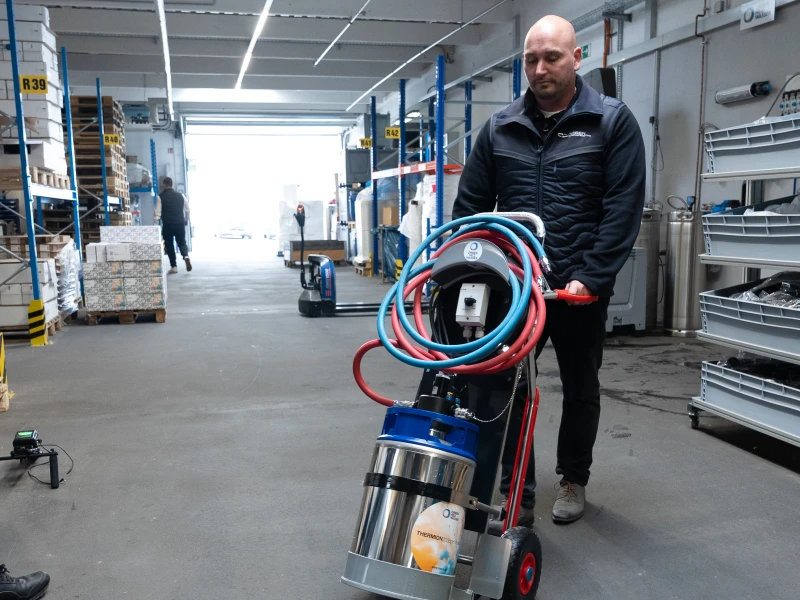
Large quantities of heating water must be treated for new buildings, renovations or emergencies. Mobile systems such as Orben‑Trailers deliver demineralized water in sizes of 10,000 to 120,000 liters per hour and meet the VDI limits. They are particularly suitable for major projects such as district heating storage systems, hospitals or biogas plants. Stationary refill units ensure that supplementary water is automatically demineralized during operation. District heating networks use partial flow treatment systems such as BerkeSelect IQ+, which combine desalination, alkalization, filtration and degassing. These systems can be controlled and documented remotely.
Compliance with the limits is not a one-time task, but an ongoing process. Standards such as VDI 2035 and FW 510 require regular monitoring and documentation of water parameters. For asset and operational managers as well as for HVAC specialists, the following aspects are decisive:
VDI 2035 requires keeping an investment book. All measurement values, treatment measures, resin changes and faults must be documented. In the case of warranty claims, manufacturers require proof that the heating water meets the requirements. Modern measurement and processing systems therefore integrate data storage or cloud connections. Operational managers can export protocols and present them during audits. Verification of heating water quality is also relevant for certifications (e.g. ISO 50001).
The lifespan of ion exchangers and filters depends on the load. Resin cartridges must be changed or regenerated as soon as the permeate's conductivity increases. Some systems are equipped with color change indicators, which indicate the resin change in good time. The VDI recommends that the pH value of heating water be checked at least once a year. Conductivity in district heating networks should be monitored monthly. Training is required for building technicians and HVAC contractors to operate measurement devices correctly and interpret the data correctly. Orben, for example, offers express resin exchange services and training so that specialists can carry out the preparation themselves.
The choice of materials and the system design have a direct influence on water quality. Modern heating systems often use mixed materials; this places particular demands on pH and conductance.
Aluminum alloys are common in condensing boilers because they offer good thermal conductivity. However, they are sensitive to high pH values. At pH > 9.5, aluminum can lose and corrode passivating oxide layers. VDI 2035 therefore recommends a pH range of 8.2 to 9 for systems with aluminum; some manufacturers limit the upper value to 8.5. The conductivity should also be below 100 µS/cm if possible for aluminum components. In case of doubt, the use of alkaline stable materials (stainless steel, copper) should be tested in order to be able to use higher pH values.
At a slightly alkaline pH (9-10), steel and cast iron are well protected against corrosion when conductivity is low. In saline systems with guide values of up to 1,500 µS/cm, the pH value must be higher (9—10.5) to ensure a sufficient base excess. Mixed installations made of steel and copper also require alkaline conditions so that no galvanic currents occur. There are special requirements for galvanized steel pipes; zinc dissolves more easily at low pH values.
District heating systems are more sensitive due to their size and range of materials. High temperatures and long residence times reinforce chemical processes. FW 510 therefore requires stricter guidelines and pH ranges. In networks with copper-soldered plate heat exchangers, guide values of up to 30 µS/cm and pH 9-10 must not be exceeded, as copper corrodes at higher salt contents. Operators must also pay attention to components that are open to diffusion: plastic pipes can introduce gases into the water and increase the oxygen content.
Whether a heating system is operated with a low or high salt content depends not only on the standard but also on economic considerations. Low-salt operation requires higher investments in full desalination plants, but reduces maintenance costs in the long term, extends the service life and allows higher oxygen levels without damage. Saline operation is cheaper to make as an initial investment, but requires frequent checks, degassing and possibly corrosion inhibitors. For reasons of operational safety, district heating networks mainly use low-salt mode of operation. Operators should conduct a life cycle assessment (TCO) to identify the most cost-effective solution.

Sustainability is a key decision factor for many operators. The treatment of heating water produces waste products such as spent resins and concentrates from reverse osmosis systems. One ecological approach is the use of reusable resins, which are reprocessed in central regeneration plants after exhaustion. ORBEN operates Europe's largest regeneration station for ion exchange resins and uses environmentally friendly recovery systems. In contrast to single-use resins, which are discarded after a single use, reusable resins can be regenerated many times. This reduces resource consumption, reduces transportation costs and waste volumes, and increases profitability.
Mobile water treatment is another aspect of sustainability. With trailer systems, large quantities of heating water can be produced directly on site and fed into buffer tanks. This eliminates the need to transport water in tank trucks. Mobile systems are also operated in an energy-efficient manner and equipped with digital sensors that avoid unnecessary consumption of water and chemicals. Sustainable concepts also include the use of low-carbon energy sources (e.g. biogas or waste heat) to heat membrane plants and the use of renewable electricity.
Unplanned outages or time-critical projects require a quick response. Trailer systems and mobile full desalination plants ensure the supply of standards-compliant heating water in the shortest possible time. In the case of the Evangelical Deaconess Hospital in Leipzig, a bypass procedure was necessary to replace the heating water during ongoing hospital operation. With mobile ion exchangers and partial flow treatment, the old plant water could be removed while operations continued. Hospital staff were trained to use the filtration units, and Orben supervised the process. This project capability is a decisive factor for many operators, because downtimes mean not only a loss of comfort, but also economic losses.
Emergency preparedness also plays a role in district heating networks. Sudden leaks or contamination can suddenly worsen water quality. Mobile systems can be brought to any location within a short period of time and can both filter, desalinate and degas water. Thanks to the modular design, several trailers can be connected together to fill large storage volumes. Mobile ultrapure water units offer a quick remedy for energy transition industries such as hydrogen and battery production, which require extremely pure water. The focus is always on compliance with applicable standards.
In addition to traditional heating water treatment, the production of pure and ultrapure water is becoming increasingly important in industries of the future. The production of green hydrogen, electrolysis in power‑to‑gas plants and battery cell production require water qualities that go far beyond the requirements of VDI 2035. In these applications, guide values < 0.5 µS/cm and pH values in the neutral range are common. Ion exchange, reverse osmosis and electrical desalination (EDI) are combined to form multi-stage treatment chains. ORBEN develops individual ultrapure water concepts for such industries of the future and supplies mobile systems for temporary supply. Asset and operational managers should understand the interfaces between heating water treatment and ultrapure water production, as both areas use similar technologies. Digitalization — for example through cloud-based monitoring and AI‑based forecasting — makes it possible to plan maintenance in advance, make optimal use of resin capacities and increase operational safety.
Heating water treatment is a complex combination of chemistry, technology and standardization. The VDI Directive 2035 and the AGFW worksheet FW 510 provide clear limits for conductivity, pH value, hardness and oxygen content. Compliance protects against calcification, corrosion and loss of efficiency. The pH value should be between 8.2 and 10 in steel and copper plants; with aluminum, it should not exceed 8.2 to 9. The guide value should be set below 100 µS/cm when operating with low salt levels, and even to 10-30 µS/cm in district heating networks. Low water hardness (≤ 0.11 °dH) and low oxygen content complete the requirement profile.
To achieve these goals, operators must know the chemical parameters of raw water, choose appropriate treatment methods, and continuously monitor water quality. Softening, full desalination, reverse osmosis, pH regulation and degassing form the most important components. Mobile and stationary systems enable flexible adaptation to project and emergency situations. Sustainable reusable resin systems and digital monitoring reduce environmental impact and total cost of ownership. Who is guided by the standards and competent partners such as ORBEN integrates, ensures the operational safety and efficiency of its heating or heating network system in the long term.


.svg)