Heating and thermal network systems repeatedly lose small amounts of water during operation: leaky fittings, expansion vessels, hydraulic vents, or repairs cause the system volume to shrink. This lowers the system pressure, the system control reports a fault, and attention turns to the filling tap. For many operators and HVAC professionals, it used to be common practice to simply top up heating water with tap drinking water. However, this practice contradicts current regulations: tap water contains hardness-forming substances, salts, and oxygen, promotes corrosion, scale formation, and sludge deposits, and poses a hygienic risk. The VDI 2035 guideline and the AGFW FW 510 district heating guideline therefore define strict limit values for filling and make-up water. DIN EN 1717 also prohibits the direct connection of the heating system to the drinking water network and mandates a system disconnector – a central aspect when refilling.
This article provides comprehensive guidance on how to refill heating water in a compliant and sustainable manner. It is aimed at asset and operations managers of thermal networks, energy and process plants, as well as HVAC professionals and building services planners. We illuminate the regulatory foundations, explain the physical and chemical relationships between pH value, conductivity, hardness, and oxygen, and demonstrate how modern refilling systems and mobile units offer a safe and economical solution. Sustainability and Total Cost of Ownership (TCO) play an important role – from regenerable ion exchange resin to trailer systems for large-scale projects.
Every heating system is a hydraulic circulatory system. Pumps and valves operate daily, temperature fluctuations lead to volume changes, and small leaks can occur over the years. Repairs, valve replacement, and venting also cause water to escape. This make-up water must be replaced to maintain operating pressure.
However, every refill introduces substances into the system. Tap water contains hardness-forming substances such as calcium and magnesium ions, as well as bicarbonates. At high operating temperatures, these substances form limescale, which can clog heat exchangers. Furthermore, drinking water introduces oxygen into the closed heating system. Oxygen promotes corrosion: iron and steel components rust, while pitting corrosion can occur in stainless steels. The VDI guideline explicitly warns against excessively high conductivity and high oxygen content: for low-salt operation, conductivity should be below 100 µS/cm, and oxygen content below 0.1 mg/L. If tap water is refilled without treatment, conductivity quickly rises to values in the range of several hundred µS/cm – an invitation to corrosion.
In addition, hardness increases the risk of scale formation. VDI 2035 stipulates that for low-salt operation, the total hardness must be less than 0.11 °dH. Therefore, the more often unsuitable water is refilled, the more the hardness and salt content in the system increase. The consequences are scaled heat exchangers, reduced efficiency, and expensive repairs.
Many older systems still have a fixed connection solution: a valve permanently connects the heating system to the drinking water network. In case of pressure drop, the system is automatically refilled via the domestic water connection. This design has no longer been permissible since the introduction of DIN EN 1717. The standard obliges operators to protect the drinking water network from contamination by heating water. Heating water contains corrosion products, sludge, and chemical additives; it must not re-enter the drinking water network. Therefore, the standard requires a system disconnector or suitable network isolation. The Heizungsjournal summarizes the consequence: "Direct connections between drinking water and the heating system are impermissible; a system disconnector must be used".
VDI 2035 (Parts 1 and 2) also emphasizes that filling and make-up water must meet quality requirements. Thus, untreated drinking water may only be used if the heat generator manufacturers explicitly permit it – and even then, only if the total hardness and conductivity are below the required limit values. This is usually not the case. Therefore, more and more operators are opting for demineralization solutions.
The most important standards and guidelines for refilling heating water are:
The specified limit values are defined in Table 1 of VDI 2035. For low-salt heating water, the oxygen content must not exceed 0.1 mg/L, while conductivity must be below 100 µS/cm. Higher limit values apply to high-salt operation, but the risk of corrosion and scale formation also increases. Systems with aluminum alloys must also maintain a lower pH value (6.5–8.5), as aluminum passivates at excessively high pH values.
The pH value is the central control parameter for heating water chemistry. If the pH value is too low (acidic), pitting and acid corrosion occur; if the pH value is too high (strongly alkaline), deposits easily form, and aluminum materials are attacked. VDI 2035 therefore recommends a pH range of 8.2 to 10 for low-salt operation and a range of 8.2 to 9 for aluminum components (some manufacturers require 6.5–8.5). Orben explains in his guide that a pH value above 10 removes the protective passive layer from aluminum and that excessively low values promote iron corrosion. Therefore, precise adjustment using additives (pH stabilizers) and regular monitoring are necessary.
Conductivity provides information about the number of dissolved ions in the water. The higher the conductivity, the more salts are present in the water, and the higher the risk of corrosion or scale formation. For low-salt heating water, VDI 2035 specifies a conductivity below 100 µS/cm, while AGFW FW 510 permits 100–1,500 µS/cm for high-salt water. ORBEN explains that a high conductivity value increases the electrical conductivity of the water, promotes galvanic elements, and thus accelerates corrosion. By using demineralization plants, conductivity drops to values between 10 and 30 µS/cm – ideal for sensitive systems such as high-performance boilers or process heat.
“Hardness” refers to the concentration of alkaline earth metals calcium and magnesium. While total hardness does not cause direct health problems according to the Drinking Water Ordinance, it is problematic in heating systems. At temperatures above 60 °C, calcium carbonate precipitates and forms stubborn boiler scale deposits. Therefore, VDI 2035 requires a total hardness of < 0.11 °dH for low-salt operation. Higher hardness levels may occur in high-salt operation, but the risk of scale formation increases. Softening by cation exchange reduces hardness but leaves sodium bicarbonate in the water; therefore, softening alone is only sufficient in individual cases – for large boilers with uncritical requirements. For modern condensing boilers and district heating systems, demineralization is the safer choice.
Oxygen is a crucial corrosion accelerator. Even small amounts can lead to widespread and localized corrosion. VDI 2035 specifies a maximum permissible oxygen content of 0.1 mg/L. Every refilling process introduces new oxygen into the system. This oxygen is initially 'consumed' by corrosion processes until the water is oxygen-free. However, oxygen consumption leads to pitting and the removal of passive layers. Therefore: The amount of make-up water should be kept as low as possible, the make-up water should be deoxygenated (by degassing plants), and the feed device should minimize oxygen ingress.
During initial filling (fill water), very large quantities of demineralized water are introduced into the system. This fill water should always comply with VDI limit values. Make-up water refers to the amount of water that must be replaced due to losses during ongoing operation. Although this amount is significantly smaller, its chemical quality must not be inferior to that of the fill water – otherwise, the overall quality in the circuit will deteriorate. Some regulations state as a guideline that make-up water should amount to a maximum of a few percent of the system volume per year. In the event of frequent refilling, the cause (leakage, defective membrane, incorrect pressure setting) must be rectified.
The criteria can be derived from the limit values of VDI 2035:
Whether the make-up water should be softened or demineralized depends on the system design, materials, and operating mode. Softening (cation exchange) removes calcium and magnesium ions but replaces them with sodium ions. This reduces total hardness, but the electrical conductivity remains high. SYR states that conductivity values of 500–1,000 µS/cm are not uncommon with softened water, which poses a risk of corrosion. VDI 2035 permits saline operation only if the manufacturers of the system components allow it and the conductivity remains within a tolerable range. Demineralization is recommended for modern, highly efficient boilers and systems with aluminum.
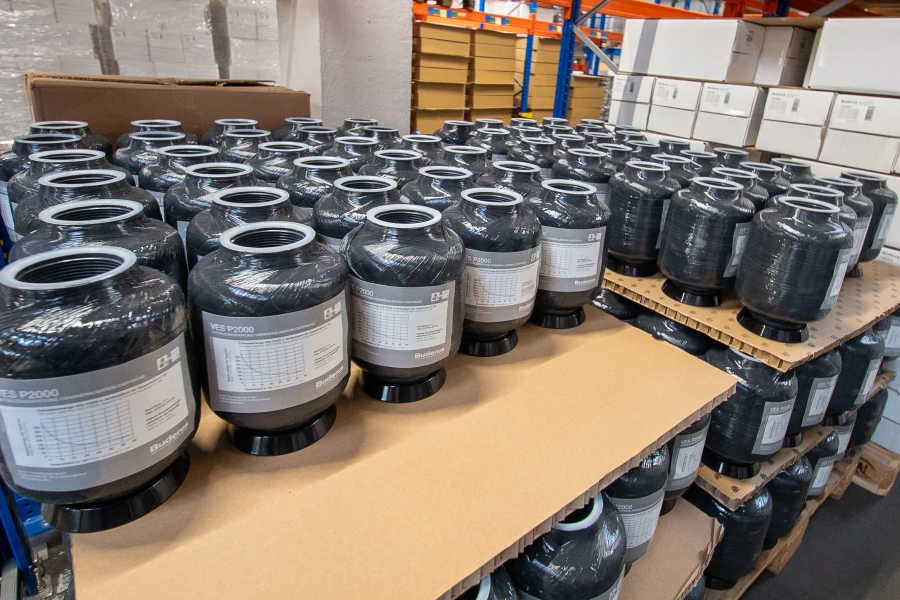
In demineralization, all dissolved salts are removed via a mixed bed (cation and anion exchanger) or by reverse osmosis. This reduces conductivity to values in the range of 10–30 µS/cm. A pH stabilizer (e.g., Thermion 2035 pH conform) ensures that the water remains in the alkaline range. The ORBEN-MINISTIL cartridges are based precisely on this principle: they use a mixed-bed resin that changes color from blue to brown at the end of its capacity, indicating an exhausted cartridge.
Before each replenishment, operators should analyze the existing heating water. This includes measurements of conductivity, pH value, total hardness, and oxygen content. Modern combination measuring devices enable these measurements directly in the circuit. ORBEN offers, for example, handheld measuring devices and sensors for continuous monitoring. The analysis shows whether the circuit is within an acceptable range or if a partial flow treatment is required (e.g., via a bypass ion exchange system).
If an elevated conductivity value (> 100 µS/cm) or a pH value that is too low is detected, the existing heating water must first be treated before makeup water is added. In the event of frost damage, an ORBEN project in Zweibrücken demonstrated how this works: The existing circuit water was treated with an Inline Select 62 in a bypass process to achieve conductivity values below 100 µS. Only after that was supplementary water added and the buffer tanks filled.
The treatment of replenishment water depends on the raw water quality. In many regions, tap water is very hard (German hardness > 10 °dH) and has high conductivity. In the project mentioned, the total hardness of the tap water was over 3.8 mmol/L (≈ 22 °dH). Therefore, the refill water was completely demineralized using four ORBEN MINISTIL P102 cartridges. After refilling, the conductivity of the system water was 58 µS/cm – well below the limit value.
Common methods include:
A system disconnector is a device that decouples the heating network from the drinking water network. Type BA hydraulically separates the two networks and prevents the backflow of heating water. According to DIN EN 1717, the installation of such a system disconnector is mandatory for every replenishment system. Modern replenishment systems like ORBEN SERASTIL NKS ready combine the system disconnector and the demineralization cartridge in one compact device: the filling valve, the disconnector, and the cartridge form a closed system.
For stationary use, there are plug-in systems with automatic replenishment. In the previously described project, a plug-in replenishment system was installed in a separate hall. It consists of a system disconnector according to TVO/DVGW, a conductivity monitoring system with counter-ion effect suppression, and a solenoid valve for water flow control. If the conductivity of the replenishment water exceeds the set limit, the valve closes and prevents the feeding of substandard water. At the same time, the system indicates that the mixed-bed resin is exhausted, allowing an ORBEN employee to replace the cartridge in good time. Such systems meet the requirements of VDI 2035 for monitoring and documentation.
The process of a standard-compliant replenishment can be divided into five steps:
Refilling is not a one-time event, but a continuous process. Therefore, refill systems must be regularly inspected and maintained:
Compact cartridge systems are the ideal solution for single-family homes, residential buildings, and smaller commercial facilities. ORBEN SERASTIL NKS, C, and S are refillable cartridge systems available in various sizes, with or without a system disconnector. They supply demineralized water in accordance with VDI 2035, ÖNORM H 5195‑1, and SWKI BT 102‑1. The "ready" versions integrate an automatic filling valve and a Type BA system disconnector in a compact unit. This ensures compliance with DIN EN 1717, even with permanent connection.
Key features:
Stationary make-up water systems are recommended for medium to large heating systems in industrial, commercial, or district heating networks. These consist of a steel frame with a system disconnector, mixed-bed resin filter, conductivity sensor, and solenoid valve. An example is the plug-in system from the Zweibrücken project: It operates fully automatically, monitors conductivity with counter-ion effect suppression, and stops the make-up process if the limit value is exceeded. Such systems are integrated into building services as a "filling station" and feature a user interface or an interface to the building management system.
The advantages of these systems:
For large-scale plants, industrial power plants, or district heating networks, the water demand during initial filling or renovations is enormous. ORBEN offers mobile trailer systems such as "THERMOSTIL MOBIL" and "JUMBOSTIL". These trailers are equipped with demineralization-capable ion exchangers and deliver pure water capacities of 10,000 to 60,000 L/h.
Advantages of Mobile Systems:
VDI 2035 requires a plant logbook with documented measured values, fill volumes, and maintenance records. Modern top-up systems support this requirement through digital interfaces. Conductivity values, pH values, and flow rates can be automatically recorded. With the help of cloud platforms, operators can identify trends: an unusual increase in make-up water volume indicates leaks. Simultaneously, resin consumption can be predicted, allowing the Resin Express service to be scheduled in advance.
.webp)
Some operators shy away from investing in a top-up system and continue to fill their systems with tap water. However, this seemingly inexpensive approach can turn into a costly mistake. Limescale deposits on heat exchangers increase energy consumption and can bring boilers to a standstill; corrosion leads to pitting in pipelines and heating surfaces. According to a study, a 1 mm thick layer of boiler scale causes an efficiency loss of 10–15%. The costs for repairs and production downtime far exceed the investment in a top-up system. Furthermore, warranty risks increase: boiler manufacturers require system water that complies with standards; if this is not met, the warranty becomes void.
ORBEN relies on reusable resin: Once exhausted, the mixed-bed resin is not disposed of but chemically reprocessed in the company's own regeneration station. This saves resources and reduces waste. The Resin Express collects used resins and provides regenerated resin – operations don't have to stop. This circular solution reduces overall resource consumption and supports the sustainability goals of many companies.
Demineralized heating water reduces corrosion and scale formation, keeping the heat exchanger efficient and lowering fuel consumption. At the same time, district heating network operators can maintain lower flow temperatures if there are no deposits in the system. This reduces energy consumption and thus CO₂ emissions. Modern trailer systems are electrically operated and use renewable energies; the ion exchange resin is chemically regenerated without energy-intensive combustion.
District heating networks, industrial plants, and process heating differ in complexity from conventional building heating systems. Additional requirements often apply here:
How often should a heating system be refilled?
As rarely as possible. Every refill introduces new salts and oxygen into the circuit. In case of frequent pressure loss, the cause (leakage, defective expansion tank) should be identified and rectified.
Can tap water be used for refilling?
Untreated tap water is only permissible if manufacturers accept the water quality and both conductivity and hardness are below the limit values. Generally, it is better to use softened or demineralized water. Direct connection between the drinking water and heating network is prohibited according to DIN EN 1717.
What happens if the conductivity of the make-up water is too high?
High conductivity indicates that the mixed-bed resin is exhausted or unsuitable filling media are being used. The risk of corrosion increases. Modern make-up water systems close the solenoid valve if the conductivity value exceeds the limit, and require a resin change.
How do I know when the cartridge needs to be replaced?
ORBEN‑SERASTIL cartridges feature a color change from blue to brown, indicating the end of their capacity. In stationary systems, an electronic warning is issued when the conductivity of the outgoing water rises.
What is the purpose of the pH stabilizer (Thermion 2035)?
After demineralization, ultrapure water tends to absorb CO₂ from the air and develop an acidic pH value. The pH stabilizer ensures that the water remains in the alkaline range and complies with VDI 2035 limits. In the project in Zweibrücken, MINISTIL P102 cartridges with Thermion 2035 were used.
The make-up of heating water is a complex but manageable process. Key findings:


.svg)