Mobile Water Treatment: Capacities & Standards in Emergencies

In district heating networks, power plants, process facilities, or industrial battery production, water is not merely an operating medium – its purity determines the efficiency, reliability, and longevity of the entire system. If a stationary treatment system fails at short notice, or if large quantities of ultrapure water are temporarily required for overhauls and commissioning, asset and operations managers must react quickly. Mobile water treatment plants are then the instrument of choice, as they immediately supply ultrapure water of standard-compliant quality, thus protecting against costly damage from corrosion or scale formation.

This article is aimed at asset and operations managers for heating and energy networks, as well as HVAC professionals and building services planners. It explains the capabilities of modern trailer systems, categorizes the relevant standards (especially VDI 2035 and AGFW FW 510), and shows step-by-step how to plan projects and emergency operations using mobile treatment. Additionally, it explains the role of sustainability and Total Cost of Ownership, and how to fulfill documentation and audit requirements.

1. Why Mobile Water Treatment is Indispensable in Emergencies

1.1 Typical Emergency Scenarios

Heating and process systems rely on a continuous supply of demineralized or deionized water. In the event of unexpected disruptions, production downtime, pressure drops, or thermal overload are imminent. Mobile water treatment plants step in when:

  • Stationary systems fail. Pump or membrane damage often leads to outages lasting several days. Mobile trailers immediately supply ultrapure water until the stationary system is repaired.
  • Overhauls or commissioning are due. Before filling new heating networks, pressure tests, pickling steps, or flushing processes, operators require several cubic meters of demineralized water within a short period.
  • Accidents occur. Pipe bursts, leaks, or contaminations require rapid draining and refilling of systems. Mobile systems ensure clean, standard-compliant water and minimize downtime.
  • Project peaks occur. In large construction projects (e.g., expansion of district heating networks, battery storage), temporary demand often exceeds the capacity of existing infrastructure. Trailer units balance these peaks.

Without adequate water quality, high costs are threatened by scale deposits and corrosion. Studies show that even one millimeter of scale reduces heat transfer by approximately 9% . Such losses accumulate over the lifetime of a system, leading to high energy costs and potentially jeopardizing manufacturer warranty claims. Mobile systems counteract this.

1.2 Target Groups and Decision Factors

The decision for mobile water treatment is based on several factors:

  • Operational safety and standard compliance. Asset managers must ensure that systems always comply with the requirements of VDI 2035 and AGFW FW 510. Mobile systems provide the necessary water quality and document measured values for auditability.
  • Total Cost of Ownership (TCO). Instead of investing in expensive stationary backup systems, companies can rent trailers as needed. The minimal rental periods (five days at ORBEN) and modular design reduce overall costs.
  • Sustainability. Modern systems use reusable resins and resource-efficient regeneration. This reduces waste and protects groundwater.
  • Project and Emergency Capability. Trailer systems are pre-configured, compatible with common connections, and ready for operation within a few hours. For asset managers, this means they can act quickly even in unforeseen events.

2. Capacities, Design, and Technical Parameters

2.1 Scalable Performance from 10,000 to 120,000 l/h

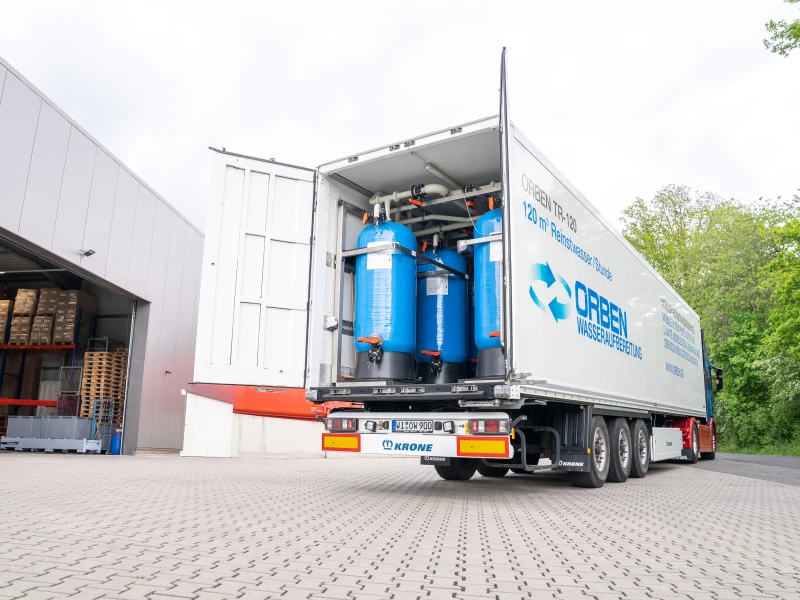
ORBEN's trailer fleet comprises three basic models that can be combined:

  • TR-10: Delivers up to 10 m³/h (10,000 l/h) of ultrapure water. The system combines ultrafiltration, conditioning, reverse osmosis, and mixed-bed ion exchange to ensure a conductivity of less than 0.1 µS/cm and a silicate content of less than 5 ppb . The DN 50 connection allows for a product water flow rate of 10 m³/h, while the inlet can supply up to 13 m³/h.
  • TR-30: With 30 m³/h, this model is suitable for larger network sections. The DN 80 product water connection delivers 30 m³/h, and the DN 100 inlet allows for 45 m³/h. The water quality matches that of the TR-10 (conductivity < 0.1 µS/cm, silicate < 5 ppb).
  • TR-60: The most powerful unit produces up to 60 m³/h of demineralized water. The DN 100 product water connection delivers 60 m³/h; the DN 100 inlet allows for 80 m³/h. Connection to a 380 V power supply (70 kW, 160 A) and the same water quality (< 0.1 µS/cm conductivity, silicate < 5 ppb) make it ideal for large district heating networks or power plant overhauls.

Since the trailers can be combined, capacities of up to 120 m³/h To implement. For smaller applications, ORBEN offers jumbo cartridges for 12,000 to 22,000 l/h; for mobile projects with a runtime of five days or more, the use of trailers is recommended.
2.2 Process Steps in the Trailer

The high water quality is achieved through several coordinated stages:

  1. Pre-filtration and Ultrafiltration removes suspended solids and organic components. This reduces the turbidity of the raw water (specification < 3 NTU).
  2. Conditioning involves dosing of hardness stabilizers and sodium; it protects membranes from fouling and reduces iron and manganese compounds (Fe < 0.1 mg/L, Mn < 0.1 mg/L).
  3. Reverse Osmosis (RO) eliminates up to 99% of salts dissolved in the raw water. This significantly reduces electrical conductivity.
  4. Membrane Degassing removes dissolved gases (e.g., CO₂ and O₂), reduces total carbonic acid, and stabilizes the pH value.
  5. Mixed-Bed Ion Exchange (MB) removes remaining ion traces and ensures extremely low conductivity (< 0.1 µS/cm).

Thanks to this modular design, the trailers are suitable for demineralized water according to VGB/VdTÜV and meet the requirements of VDI 2035 and AGFW FW 510.

2.3 Raw Water Requirements and Connection Conditions

For the trailers to operate optimally, certain limit values must be observed:

  • Iron and Manganese: < 0.1 mg/L. Higher concentrations could foul the membranes.
  • Turbidity (NTU): < 3 NTU.
  • pH value: 2–12; the wide range also allows connection to neutralized process water.
  • Temperature: 5–35 °C.

The systems can be connected to raw water pipes of various diameters (DN 50 to DN 100). For power supply, depending on the model, 10 to 70 kW as well as 230 V or 380 V are required.

2.4 Long-term Operation and Scalability

Beyond emergencies, the trailers can also be used for months or years. This is useful when investing in a stationary plant is not economical or long-term construction sites require a flexible solution. According to ORBEN the trailers, thanks to modern technology, consistently deliver high water quality over longer periods and avoid high capital costs for building new systems.

For long-term projects, the service team can monitor the systems, replace resins, and perform maintenance. A combination of several TR‑30 and TR‑60 units thus enables the supply of entire city districts with district heating.

3. Standards and Regulations (VDI 2035, AGFW FW 510, DIN 19628)

3.1 VDI 2035 – Prevention of Damage in Hot Water Heating Systems

The VDI 2035 guideline is the central set of regulations in the heating industry for preventing scale formation and corrosion-related damage. The current version from March 2021 (Sheet 1) replaces older versions from 2005 and 2009. Among other things, it regulates the following parameters:

  • Water hardness (sum of alkaline earth metals): the lower the hardness, the lower the risk of limescale deposits.
  • Electrical conductivity (µS/cm): Measure of the concentration of dissolved salts. For modern heating systems, the VDI recommends a conductivity value between 8.2 and 10 pH (see pH value), while conductivity should remain as low as possible. In low-conductivity operation (< 100 µS/cm), the likelihood of corrosion decreases.
  • pH value: The guideline specifies a target range 8.2–10.0 ; for aluminum components, a maximum of 9.0. A pH value that is too low leads to corrosion, while one that is too high can attack seals and plastic components.
  • Oxygen content: The 2021 version does not specify a concrete limit value, as the oxygen content in the system is difficult to measure. Generally, the less oxygen, the better. Earlier versions required < 0.1 mg/L.

VDI 2035 specifies these parameters in tables depending on heating capacity and system size; it distinguishes between low-salt and high-salt operation. For low-salt operation, the following apply: conductivity 10–30 µS/cm, pH 9.0–10.0, oxygen < 0.1 mg/L, total hardness < 0.02 mmol/L. For high-salt operation, the guideline values are 30–100 µS/cm (semi-saline) or 100–1500 µS/cm (saline), the pH range is 9.0–10.5; the oxygen content may be < 0.05 or < 0.02 mg/L respectively. The guideline emphasizes that adhering to these values minimizes damage.

3.2 AGFW FW 510 – District Heating and Large-Scale Heating Circuits

The German Association for District Heating (AGFW) has published the worksheet FW 510 in addition to the VDI regulations for district heating networks. It distinguishes between low-salt, semi-saline, and saline circulating waters and sets limit values for conductivity, pH, oxygen, and water hardness. The values largely correspond to the tables mentioned in Section 3.1. Since district heating networks are often large-scale and combine materials such as steel, copper, and aluminum, these specifications are essential for operational safety.

For asset managers, this means:

  • Documentation: All parameters of the filling, make-up, and circulating water must be continuously measured and documented to prove compliance with the requirements during audits.
  • Regular Make-up Water Supply: Make-up water systems should automatically feed demineralized water to maintain conductivity within the target range. High volumes of make-up water can introduce oxygen; VDI 2035 explicitly warns against this.

3.3 DIN 19628 and DIN 3696 – Ultrapure Water for Hydrogen and Battery Technology

In the context of the energy transition, new industries are emerging: electrolyzers for hydrogen production, lithium battery manufacturing, and semiconductor production require ultrapure water with extremely low conductivity. DIN 19628 defines the requirements for water used in electrolysis plants; low conductivity (often < 0.1 µS/cm) and an almost complete absence of ions and dissolved solids are crucial. DIN 3696 describes ultrapure water qualities for laboratory and medical applications, where only trillionths of ions are permitted. Mobile systems combining reverse osmosis, degassing, and mixed-bed ion exchange achieve these qualities and can be used, for example, during the commissioning of electrolyzers.
4. Risks of Non-Compliance with Water Quality Standards

4.1 Scaling and Corrosion as an Economic Risk

Untreated or improperly treated water leads to deposits and corrosion processes. These risks are severe for district heating networks as well as for industrial heating circuits:

  • Limescale (Scaling): Calcium and magnesium salts form hard deposits that narrow pipe cross-sections. Every millimeter of limescale reduces heat transfer by approximately 9%, leading to higher flow temperatures and energy losses.
  • Oxygen Corrosion: Oxygen reacts with metal, especially steel, forming rust. This leads to leaks, narrowing of pipelines, and increased maintenance costs. VDI 2035 therefore recommends minimizing oxygen ingress and operating closed systems.
  • Microbiological Contamination: Organic substances and microorganisms can form biofilms that accelerate corrosion and increase pressure loss. Adequate filtration (ultrafiltration) reduces this risk.
  • Chemical Corrosion: Unsuitable pH values or high conductivities accelerate electrochemical reactions. Aluminum and galvanized components react more sensitively; a pH value > 9.5 can lead to pitting corrosion in aluminum.

4.2 Legal and Economic Consequences

Compliance with guidelines is not only a technical but also a legal requirement. Manufacturers of boilers and heat exchangers often demand adherence to VDI 2035 as a condition for their warranty. Those who disregard the reference values risk losing warranty claims. Furthermore, energy supply contracts may include conditions that are increased in the event of high conductivity or corrosion damage.

An operational interruption due to leaks or heating system failure causes high costs: repairs, production losses, and potential contractual penalties quickly add up. The expense for proper water treatment – i.e., renting or operating a mobile plant – is comparatively low.

4.3 Practical Benefits of Trailers in Risk Management

Mobile trailers can be used preventively to minimize risks. During commissioning, the system is first flushed with ultrapure water to remove welding residues, oil, and dirt. During an overhaul, the trailer replaces the stationary demineralization plant, ensuring the network remains filled in accordance with standards. In the event of failures, it allows for a response within a few hours, preventing corrosion damage. The integrated measurement technology continuously documents conductivity and pH value; these data serve as proof for audits and inspections.
5. Sustainability and Total Cost of Ownership

5.1 Reusable Resin and Regeneration

A common criticism of ion exchange processes is resource consumption. However, ORBEN operates Europe's largest regeneration plant and relies on reusable resins, which are cleaned and reused after use. The plant regenerates up to 40 000 L of resin daily and supplies around 10 000 customers. The resin is cleaned, reloaded with acids and alkalis, and then filled into cartridges. Each cartridge receives a batch number and a filling date; the results of quality checks are 100% documented and traceable.

The plant uses Rhine water for rinsing and returns it to the river after purification. This means no municipal water is consumed, and the ecological footprint is reduced. For operators, using regenerated resins means less waste and lower procurement costs.

5.2 Resource Conservation through Mobile Systems

Mobile trailers minimize the need for stationary backup systems. Instead of building multiple demineralization systems in parallel that are rarely used, trailers can be rented as needed. This reduces capital commitment and shrinks operating areas. The modular combination of units (TR‑10, TR‑30, TR‑60) allows for precise configuration without over-dimensioning.

During operation, the service team monitors the resins and replaces them as soon as the breakthrough conductivity is exceeded. Since reusable resins are regenerated, ongoing operating costs are significantly lower compared to single-use resins.

5.3 Total Cost of Ownership (TCO)

The TCO approach considers not only acquisition costs but all costs over the entire lifecycle – maintenance, operation, downtime, energy losses, and disposal. Mobile water treatment has a positive impact by:

  • Minimizing downtime costs: Thanks to rapid availability, production downtime is reduced.
  • Improving energy efficiency: Standard-compliant water reduces heat transfer resistance and saves energy.
  • Reducing maintenance effort: Reduced corrosion minimizes repairs and extends the lifespan of heat exchangers and pumps.
  • Reduces investment costs: Renting avoids high capital commitment for reserves and is tax-advantageous.

6. Ultrapure Water for Future Industries: Hydrogen, Batteries, and More

6.1 Electrolysis Requirements

The production of green hydrogen through electrolysis requires extremely pure water. Impurities can damage the membranes and catalysts in electrolyzers or reduce their efficiency. DIN 19628 defines the specification for electrolysis water; it requires an electrical conductivity in the range of a few microsiemens per centimeter and a minimal concentration of dissolved ions. ORBEN's trailers, combining reverse osmosis, degassing, and mixed-bed ion exchange, achieve this quality (conductivity < 0.1 µS/cm).

The trailers can be used during the commissioning of electrolysis plants to perform initial flushing, fill tank farms, or serve as a backup if the stationary ultrapure water generation fails. The modular capacity also allows for the supply of larger clusters of electrolyzers.

6.2 Ultrapure Water in Battery and Semiconductor Manufacturing

The manufacturing of lithium-ion batteries and semiconductor chips requires ultrapure water according to DIN 3696. In such applications, the water may only contain traces of ions and organic components. Mobile units are suitable when pilot plants are being ramped up or when short-term expansions are planned. Since the trailers can be integrated into cleanroom processes, highly pure water can be supplied without interrupting production.

6.3 Further Applications

  • Backwashing and Rinse Water for Pickling and Pressure Tests: During power plant overhauls or in the construction of large heat storage facilities, pipelines are chemically cleaned. Afterwards, they must be flushed with demineralized water to remove acid residues. Trailers supply the required quantities.
  • Supply for Cooling Circuits: Demineralized water prevents deposits in cooling towers and heat exchangers. During seasonal peaks, the trailer can relieve the base load system.
  • Red Water in District Heating Networks: For colored, iron-containing networks, trailers with ion exchange and filtration can regenerate the water without emptying the network.

7. Best Practices for Asset and Operations Managers

7.1 Project Planning and Decision Logic

  1. Needs Analysis: Determine the required water quality (VDI 2035, FW 510, DIN 19628) and the necessary quantity. Consider whether a short-term solution (a trailer) or a modular combination is needed.
  2. Check Raw Water: Analyze the raw water condition (iron, manganese, turbidity, pH). If there are deviations, pre-treatments (filtration, softening) must be installed upstream to protect the trailers.
  3. Select the appropriate trailer: For smaller networks, TR‑10 or TR‑30 units are sufficient; large urban districts often require TR‑60 trailers or combinations up to 120 m³/h.
  4. Plan connections: Check the available pipe dimensions (DN 50 to DN 100) and power connections (230 V or 380 V). Coordinate pipe lengths and pressure losses.
  5. Timeline planning: Determine when the trailers should be delivered and installed. For revisions, they should be ready before the old water is drained.
  6. Instrumentation and monitoring: Ensure that continuous measurements of conductivity, pH, and temperature are performed and documented. This meets audit requirements and helps optimize operations.
  7. Train personnel: Operating personnel must be proficient in handling ion exchange resins, dosing agents, and measuring devices. ORBEN offers training and, upon request, handles commissioning.

7.2 Integration into daily operations

  • Manage makeup water: Install automatic makeup water units that feed standard-compliant demineralized water in case of pressure drop. Use cartridges with regenerated resins to promote sustainability.
  • Regular maintenance: Establish interval schedules for when resin cartridges should be changed and membranes cleaned. A good indicator is the breakthrough conductivity: as soon as it exceeds the standard, regeneration is required.
  • Seasonal adjustment: Consider that more heating water is needed in winter than in summer. Adjust the trailer capacity accordingly or order additional modules.
  • Emergency plan: Define contact persons, leakage scenarios, and the sequence of measures (pumping out, flushing, refilling). Ensure that service providers like ORBEN are available within a few hours.

7.3 Documentation and Auditability

The VDI standard requires complete documentation of all fill and make-up waters. In practice, this means:

  • Record the batch number and date of the resins used.
  • Document conductivity, pH value, and temperature during filling and ongoing operation.
  • Maintain service reports and maintenance logs.
  • Archive measurement data for at least the duration of the maintenance contract to support warranty claims and audits.

Modern trailers feature integrated sensors; the data can be digitally recorded and transferred to management systems. Alternatively, mobile measuring devices (conductivity and pH meters) can be used.

8. Conclusion

Mobile water treatment plants are a strategic tool for asset and operations managers in district heating networks, power plants, process facilities, and future industries such as hydrogen or battery production. They deliver ultrapure water of standard-compliant quality within the shortest possible time, bridge outages, support overhauls, and enable flexible project planning. Thanks to their modular design, capacities from 10,000 to 120,000 l/h can be achieved.

Compliance with VDI 2035 and AGFW FW 510 guidelines is essential: Only with correct conductivity, pH value, and minimal oxygen content can corrosion and scale be prevented. The VDI 2035, updated in 2021, indicates that modern systems aim for low-salt water with conductivities of 10–30 µS/cm and keep oxygen content as low as possible. During planning, it is crucial to know the raw water condition, select suitable trailers and connections, integrate metrological monitoring, and train personnel.

Sustainability plays a central role: Through reusable resins and an efficient regeneration station, resources are conserved, waste is reduced, and TCO is optimized. Mobile systems avoid high investments and create flexibility for short-term demand peaks.

In summary, mobile water treatment offers operational reliability, standard compliance, and sustainability all in one. For asset managers, this means a reliable option to actively shape the energy transition with stable heating networks, efficient process facilities, and durable infrastructure.


Related sections on our website

  • Ion exchangers and Regeneration: Learn how our regeneration station processes 40,000 L of resin daily, uses reusable resin, and guarantees the highest quality.
  • Ultrapure water systems (Reverse Osmosis and EDI): Discover systems for the continuous production of ultrapure water for laboratories, semiconductors, and electrolysis processes.
  • HVAC Heating Water: Discover products and services for the HVAC trade, from pH regulators to jumbo cartridges.
  • Measurement and Testing Technology: Precise measuring instruments for monitoring conductivity, pH value, and hardness ensure compliance with VDI 2035 and FW 510.