Heating, process, and district heating systems use water as a heat transfer medium. Its chemical composition determines the system's efficiency, lifespan, and warranty. Even a few millimeters of deposit on heat exchanger surfaces can significantly reduce heat transfer. Hardness-forming substances, dissolved salts, or aggressive anions like chloride and sulfate lead to scale deposits and corrosion. VDI Guideline 2035 and AGFW Worksheet FW 510 address these challenges with clearly defined quality requirements.
Operators and system managers in the energy supply sector must not only operate efficient heating networks but also comply with manufacturer specifications and legal regulations. HVAC installers and building services planners are equally obliged to provide high-quality heating and make-up water and to document compliance with limit values. Compliance with standards is a prerequisite for warranty claims and reduces the risk of system failures and liability cases.
VDI Guideline 2035 addresses the prevention of scale formation (Part 1) and water-side corrosion (Part 2). It defines limit values for pH, electrical conductivity, and water hardness, as well as water treatment methods.
VDI 2035 also emphasizes the documentation requirement. Operators must record measured values, make-up water quantities, and maintenance work in the system logbook to prove compliance with standards and warranty claims.
For industrial district heating and local heating networks, AGFW Worksheet FW 510 specifies particular guideline values. Table 6.1 of the guideline distinguishes between three operating modes: low-salt, saline (medium salt load), and high-salt. Important parameters are:
The AGFW guidelines emphasize that these reference values must be maintained through continuous monitoring. In low-salt operation, an oxygen content of up to 0.1 mg/l can be tolerated due to low conductivity, provided that the conductivity remains below 100 µS/cm. In high-salt operation, oxygen ingress must be excluded as much as possible, as otherwise corrosion is a risk.
The pH value largely determines the corrosion tendency of metals. In a slightly alkaline environment, protective oxide layers form. If the pH value drops, the risk of pitting corrosion and stress cracks increases. For aluminum components, the pH range must be more strictly maintained (maximum 9.0 pH), as higher pH values can trigger corrosion due to passive film dissolution.
Conductivity is an indicator of the sum of dissolved ions. Values above the permissible limits signal a high salt load and thus an increased risk of corrosion and deposit formation. With demineralized water, conductivity drops to below 10 µS/cm, which slows down corrosion and can reduce the use of oxygen scavengers.
Hardness-forming substances like calcium and magnesium ions cause scale. VDI 2035 permits a maximum of 0.3 °dH for fully softened heating water; in many manufacturer requirements, the target value is even below 0.11 °dH. A carbonate hardness of <0.02 mmol/l is particularly required in the district heating sector.
Elevated concentrations of chloride, sulfate, and nitrate promote pitting and crevice corrosion, as well as microbial corrosion. Metal ions such as iron, copper, and aluminum serve as early indicators for corrosion processes.
Dissolved oxygen accelerates corrosion. In low-salt heating systems, an oxygen content of up to 0.1 mg/l can be tolerated at conductivities below 100 µS/cm; otherwise, stricter limits are necessary.
Fine particles and magnetite ("black water") indicate ongoing corrosion. Biofilms impair heat transfer and locally alter the pH value. Regular filtration and magnetite separation are therefore essential.
A comprehensive heating water analysis includes:
VDI 2035 recommends an initial check within 48 hours after filling, another after three months of steady-state operation, and then at least annual checks. In case of malfunctions, refilling, or noticeable operational changes, additional samples should be taken.
For district heating systems according to FW 510, ongoing monitoring applies. Monthly, conductivity, pH value, and a visual inspection of color and turbidity are performed. Annually, a more comprehensive laboratory package is carried out, including the determination of hardness, carbonate hardness, anions, and metal ions. Event-driven analyses are required if larger replenishment volumes or ingress of foreign water occur.
The documentation requirement includes measured values of filling, make-up, and circulating water, results of laboratory analyses, and information on maintenance and malfunctions. This data must be archived in the plant logbook. Complete documentation reduces warranty risks and facilitates audits.
For new systems, pipes and tanks must be thoroughly flushed before filling to remove construction debris. The fill water is then softened or demineralized; alternatively, softening followed by chemical treatment can be chosen.
After filling, the parameters of fill volume, conductivity, hardness, and pH value must be documented. Initial checks are carried out within 48 hours and after three months. Continuous monitoring ensures compliance with standards.
For existing heating or district heating systems, a current analysis of the circulating water is the first step. Causes such as oxygen ingress, an unfavorable material mix, or frequent refilling are identified.
Water quality is often improved through side-stream filtration, which removes particles smaller than one micrometer, supplemented by magnetite separators. Depending on the condition, a partial or complete water change and conditioning with hardness stabilization and corrosion inhibitors may be necessary. In cases of microbiologically influenced corrosion or biofilms, a shock treatment is performed, and the killed material is removed via a water change. Continuous monitoring is then required.
VDI 2035 specifies softening and demineralization as preferred methods.
Partial demineralization reduces conductivity to a medium range. This method is primarily used in district heating systems when the system operates with saline water and oxygen ingress can be minimized. Conductivities between 30 and 100 µS/cm are permissible.
Thermal or catalytic degassing reduces oxygen content. FW 510 requires <0.05 mg/l or <0.02 mg/l oxygen for saline operation. Degassing systems or catalytic oxygen elimination systems are particularly useful at high temperatures or with long pipe runs.
Cloudy heating water indicates particles and magnetite. Side-stream filters remove particles down to less than 1 µm. Magnetite separators use magnetic fields to extract iron-containing particles from the circuit. Regular cleaning is required to maintain separation efficiency.
Corrosion inhibitors, hardness stabilizers, and pH regulators can improve water quality. However, inhibitors may only be used if they are compatible with the materials and do not excessively increase conductivity. FW 510 permits the use of oxygen scavengers or inhibitors, especially in cases of foreign water ingress or oxygen-containing make-up water. The new VDI 2035 places a stronger focus on low-salt operation; demineralized water often makes chemical conditioning unnecessary.
With the introduction of VDI 2035 Part 2, responsibility for heating water was regulated for the first time. Generally, the system operator is responsible for the proper condition of the heating water. Since operators are usually laypersons, planners and HVAC specialists bear a special responsibility. They must adhere to the prescribed limit values for hardness, pH value, and conductivity and inform the operator of any deviations.
Failure to comply with the limit values leads to the loss of warranty for all heating water-contacting components. In combined heat and power plants or district heating transfer stations, this can have serious financial consequences. Therefore, careful planning, standard-compliant filling, and regular monitoring are not an option, but a duty.
Adherence to guidelines reduces downtime, repairs, and energy losses. Limescale deposits significantly increase the flow temperature and thus fuel consumption. Corrosion leads to the premature replacement of expensive components. Standard-compliant heating water thus protects investments and lowers the Total Cost of Ownership.
An important aspect of sustainability is the use of regenerable ion exchange resins. Reusable resin allows exhausted mixed-bed resins to be regenerated and reused after use. This reduces waste and lowers operating costs by decreasing the proportion of single-use cartridges. As a pioneer in reusable resin, ORBEN operates one of the largest regeneration stations in Europe. They regenerate exhausted resins by type, allowing the resin to be reused at full capacity. This conserves resources and minimizes CO₂ emissions.
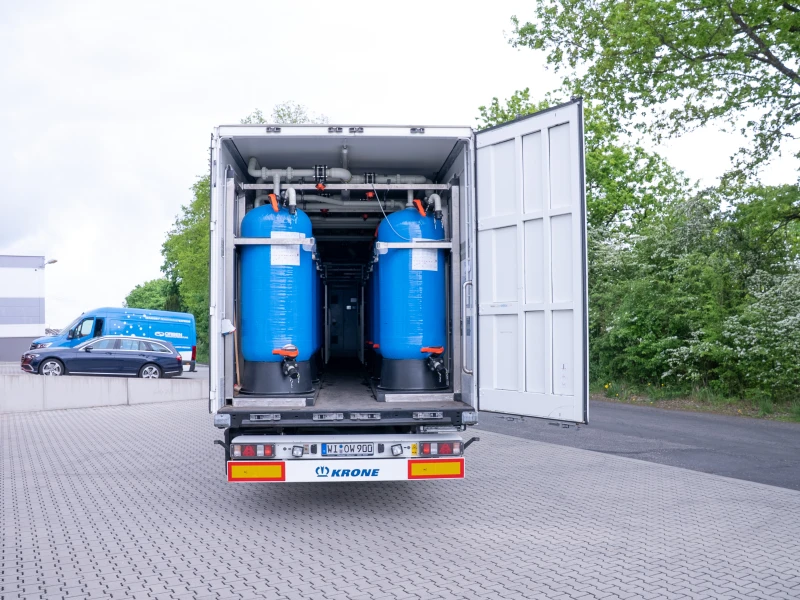
For large heating networks or emergencies, mobile trailer systems offer a flexible way to treat large volumes of water quickly. Case studies show that ORBEN TR trailers can fill entire district heating pipelines and reduce conductivity to <10 µS/cm. Mobile units allow for the compliant treatment of circulating water using a bypass method during ongoing operation – ideal for hospitals or existing networks where downtime is not an option.
Heating and circulation water is the invisible heart of modern heating systems. Its quality determines the efficiency, wear, and legal compliance of the system. VDI 2035 and AGFW FW 510 specify clear limit values for pH, conductivity, hardness, and oxygen content. Consistent adherence to these values protects against scale formation, corrosion, and operational disruptions.
For asset and operations managers, as well as HVAC professionals, this means that suitable water treatment must be selected during planning, filling must be carried out according to standards, and water quality must be continuously monitored. Mobile trailer systems, regenerative multi-use resin solutions, and modern measurement technology help reliably ensure quality and reduce total operating costs.
Standard-compliant heating water is not a luxury, but a prerequisite for economical, sustainable, and auditable system operation.


.svg)