Ion Exchange Resin: Selection, Lifespan & Regeneration
Ion Exchange Resin: Selection, Lifespan & Regeneration
Ion Exchange Resins: Selection, Lifespan, and Regeneration at a Glance
Ion exchange is a proven method for removing or exchanging dissolved ions from water. In heating, process, and circulating water, water quality is directly linked to the lifespan of the systems: limescale, corrosive salts, and undissolved gases lead to deposits, corrosion, and efficiency losses. The VDI 2035 guideline and AGFW worksheet FW 510 therefore define strict limit values for conductivity, hardness, and pH to prevent damage and ensure operational safety. In modern heating networks, manufacturers often require a "low-salt" operation with electrical conductivity below 100 µS/cm or even <20 µS/cm for district heating lines. These limit values cannot be achieved by softening alone; demineralization using ion exchange resins or combined membrane processes is required.
Ion exchange resins are the core material of this technology. They consist of organic polymers with functional groups that adsorb charged ions from the water while simultaneously releasing other ions. For example, in a cation exchanger, dissolved calcium ions in the water are exchanged for sodium ions, with the ions binding to the resin and an equivalent amount of sodium being released into the solution. When the resin is exhausted, it must be regenerated by replacing the bound ions using highly concentrated acids or alkalis.
For asset and operations managers of heating networks, as well as for HVAC professionals and building services engineering planners, the question arises: Which ion exchange resin is suitable for my application? How long does it last? And how do I organize regeneration in a standard-compliant and sustainable way? This article provides practical answers. It explains the operating principle, presents selection criteria, describes typical service lives, and imparts expert knowledge on regeneration. The VDI 2035 and AGFW FW 510 standards are taken into account, and the specific requirements of B2B applications are highlighted.
Principle of Ion Exchange
Structure and Chemistry of Resins
Ion exchange resins consist of a macromolecular matrix (usually polystyrene or polyacrylate) equipped with functional groups. Cross-linking with divinylbenzene gives the resin a spherical structure and mechanical stability. Cation exchangers carry acidic groups (e.g., sulfonic acid) which, in operation, are occupied by sodium or hydrogen ions; anion exchangers possess basic groups (e.g., quaternary ammonium groups) and are present in chloride or hydroxide form. During operation, these functional groups exchange the bound counter-ions for dissolved ions in the water. An ion exchange cartridge is typically filled with different types of resins (cation and anion or mixed bed).
The selectivity of ion exchange depends on the charge and ionic radius. The higher the charge and the larger the radius, the more strongly an ion is bound by the resin. Therefore, a doubly charged calcium ion displaces a sodium ion from the cation exchanger, and triply charged ions displace doubly charged ions. This difference in selectivity is the basis for softening and demineralization.
Softening vs. Demineralization
In softening only calcium and magnesium ions are exchanged for sodium ions. This reduces the total hardness, but the electrical conductivity of the water remains largely unchanged. The VDI 2035 standard permits a saline operating mode (softened) in certain cases, but still requires a conductivity of <100 µS/cm, a pH range between 8.2 and 10.0 (8.2–9.0 for aluminum materials), and a total hardness of ≤0.3°dH. Softening plants use strongly acidic cation resins in Na-form; they are efficient when the sum of hardness-forming substances is limited and the electrical conductivity of the system is tolerated. However, for district heating networks according to AGFW FW 510, conductivities of <20 µS/cm are required, which cannot be achieved by softening alone.
The demineralization (deionization) removes not only calcium and magnesium ions but also all other cations (e.g., sodium) and anions (e.g., chloride, sulfate). For this purpose, cation exchangers (in H-form) and anion exchangers (in OH-form) are used in series. The exchange products are hydrogen and hydroxide ions, which react to form water. In modern counter-current fluidized bed systems, achievable conductivities are between 0.2–2 µS/cm. For particularly high purity requirements, a mixed-bed exchanger is subsequently installed, which reduces the conductivity to <0.2 µS/cm. Mixed-bed cartridges are used, for example, when filling heating systems or in the production of ultrapure water.
Selecting the Right Ion Exchange Resin
The choice of resin influences efficiency, service life, regeneration intervals, and operating costs. According to IMPAG, the following criteria are crucial:
High capacity: Capacity indicates how many moles of ions can be bound per liter of resin. The higher the capacity, the longer the resin can be operated until its exchange capacity is exhausted.
Chemical Resistance: The resin must be resistant to oxidizing agents, acids, alkalis, and high temperatures to withstand demanding processes. Especially when treating boiler feedwater or in the chemical industry, oxidizing components can attack the resin; therefore, oxidation-stable resins (e.g., with a higher divinylbenzene content) should be chosen.
Service Life: The length of the service life determines the frequency of regenerations and thus the operating costs. Longer service lives reduce chemical consumption and wastewater volume.
Resin Type and Application
Strong Acid Cation Exchangers (SAC): They possess sulfonic acid groups and are capable of exchanging all cations (alkali metals, alkaline earth metals, heavy metals). SAC resins in Na-form are used for softening; in H-form, they constitute the first stage of demineralization.
Weak Acid Cation Exchangers (WAC): These resins are based on carboxylic acid groups and exchange cations only in the alkaline range. They are primarily suitable for decarbonization, to remove bicarbonate and reduce carbonate hardness.
Strong Base Anion Exchangers (SBA): With quaternary ammonium groups, they exchange all anions, including silicate. SBA resins in OH-form constitute the second stage of demineralization.
Weak Base Anion Exchangers (WBA): These resins possess primary, secondary, or tertiary amino groups and are used for the removal of strong acids. They are more resistant to organic fouling but do not remove silicates.
Mixed Bed Resins: They consist of a mixture of SAC and SBA resins, typically in a 40:60 ratio (cation:anion). Mixed bed cartridges produce deionized water with very low conductivities; they are used in ultrapure water production or for filling heating and cooling systems.
Specialty Resins: Selective exchangers are tailored for specific ions (e.g., nitrate, heavy metals); pH-compliant resins like “THERMION 2035” from ORBEN combine mixed bed resin with an alkaline component to stabilize the pH value of the heating water within the normative range.
Quality Differences and Manufacturers
The lifespan of a resin depends on the quality of the raw materials used. Divinylbenzene (DVB) cross-links the polystyrene framework and provides mechanical stability. Inexpensive resins with a low DVB content show premature wear: the resin beads break, creating "resin grit" that can pass through screens and enter process lines. According to Decker Verfahrenstechnik, the typical lifespan of an anion exchanger is 4–7 years, and that of a cation exchanger is 10 years or more; in special applications, cation resins can last up to 20 years. An anion exchanger loses functional groups over the years, while the polymer framework of a cation exchanger breaks down.
Therefore, it is advisable to use resins from established manufacturers such as Lanxess or Purolite. These manufacturers invest in high-quality DVB and offer resins with defined particle sizes and narrow particle size distribution. High-quality resins enable longer service lives, lower pressure drop, and better regeneration results. For pH-compliant mixed-bed resins, additional ion exchange components ensure that the pH value of the heating water remains within the permissible range (approx. 8.2 – 10.0) during operation.
Influence of Water Quality
The selection of the resin must be based on a comprehensive analysis of the raw water. Important factors are:
Total Hardness and Hardness-Causing Substances: The softening capacity is calculated based on the degree of hardness. For high hardness, demineralization or a combination of reverse osmosis and ion exchange is more economical.
Conductivity and Total Mineralization: Low conductivities require the use of demineralization or mixed-bed resins. For district heating pipelines according to AGFW FW 510, the conductivity of the feedwater must be <20 µS/cm, the silicic acid concentration <0.5 mg/L, and the pH value ≤7.
Silicate and Carbonic Acid: High silicate levels require strongly basic anion exchangers; for high bicarbonate levels, a combination of WAC and SAC resins is recommended for decarbonization.
Organic Contaminants, Iron, Manganese: These substances can clog resin pores and reduce exchange capacity. Pre-filtration (e.g., sand filters, activated carbon) and oxidation stages (e.g., ozone) protect the resin.
Temperature and pH Value: Some resins can only be used up to 40 °C or 60 °C. Temperature-resistant resins are available for hot water applications. The pH value of the raw water influences the protonation of functional groups; weak resins only operate efficiently within specific pH ranges.
Lifespan and Service Life
The lifespan of an ion exchange resin differs significantly from the capacity between two regenerations. Lifespan refers to the period until the resin must be discarded, not the time until the next regeneration. According to Decker Verfahrenstechnik, typical lifespans are 4–7 years for anion resins and more than 10 years for cation resins. Mixed-bed resins typically consist of 60% anion exchanger and 40% cation exchanger; their lifespan is determined by the weaker resin.
Factors that Shorten Lifespan
Mechanical Stress: During a loading-regeneration cycle, the resin can change its volume by up to 100%. Constant swelling and shrinking mechanically stress the resin beads, which can lead to breakage. High water flow rates, suspended solids, or poor distribution within the reactor intensify this stress.
Chemical Attack: Oxidizing agents (e.g., chlorine), organic acids, or iron/manganese can destroy functional groups or attack the polymer matrix. In cation exchangers, the loss of divinylbenzene causes the resin beads to break down.
Biofouling: Bacteria and algae form biofilms on the resin surface, impairing exchange kinetics. Systems used infrequently are particularly susceptible. In such cases, at least annual regeneration is necessary to remove biological growth.
Contamination by Oils and Greases: These hydrophobic substances block the resin pores and are difficult to remove. In applications involving lubricating oils or organic compounds, upstream activated carbon filtration should be used.
Measures to Extend Lifespan
Raw Water Treatment: Filtration, softening, activated carbon, or oxidation remove particles, iron, manganese, and organic components, thereby protecting the resin.
Regeneration Strategy: Regular, complete regeneration (see next section) prevents irreversible fouling processes and extends service life. Incomplete regeneration leads to partial loading and accelerated wear.
Material Quality: High-quality resins with a defined divinylbenzene content and narrow particle size distribution are more resistant to mechanical and chemical stress.
System Design: Even water distribution across the resin bed and moderate flow rates (≤50 m/h) prevent channeling and abrasion.
Monitoring: Conductivity measurements at the resin outlet, differential pressure measurements across the resin bed, and regular TOC (Total Organic Carbon) analyses provide indications of loaded or fouled resins.
Regeneration: Process, Chemistry, and Organization
Regeneration restores the original ion exchange capacity by returning the loaded functional groups to their original form (Na/H or OH/Cl). The process consists of several steps. The following description is based on practical descriptions from GeWaPur's technical article:
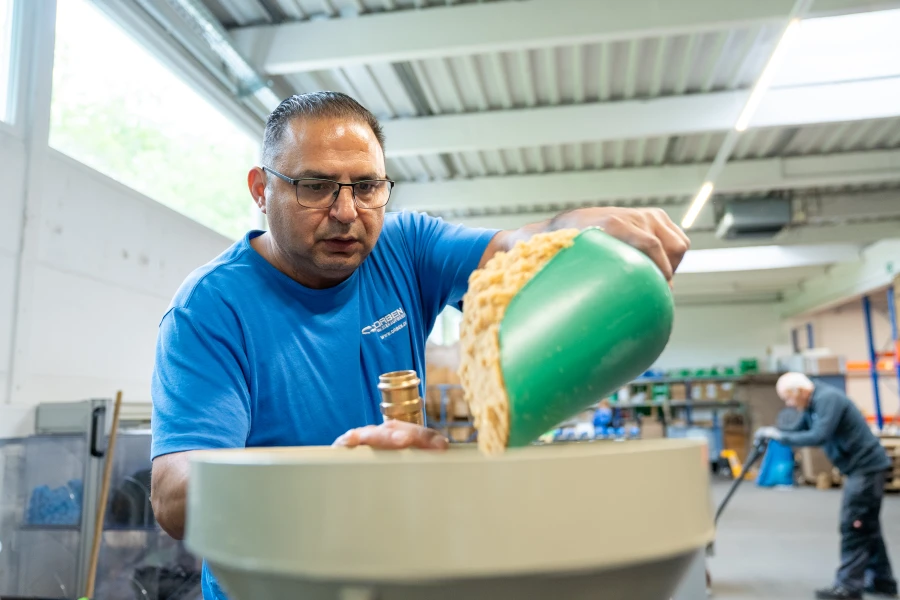
Resin Preparation: The exhausted resin is removed from the cartridge or column and examined visually and chemically. If necessary, it is pre-washed with demineralized water to remove loose particles.
Separation for Mixed Bed Resins: For mixed bed resins, cation and anion resins must be separated before regeneration. This is done by hydraulic sedimentation: Due to different densities, cation resins settle faster, while anion resins float on top.
Chemical Regeneration:
Cation Exchangers: The resin is treated with an acid (usually 10–15% hydrochloric acid or sulfuric acid) which displaces the cations bound in the resin (e.g., Na⁺, Ca²⁺) and restores the H⁺ form. Contact times of 30–60 minutes are common.
Anion Exchangers: Anion resins are regenerated with a caustic solution (e.g., 4–6% sodium hydroxide); the bound anions (e.g., Cl⁻, SO₄²⁻) are displaced, and the OH⁻ form is created. Here too, sufficient contact time is required.
The simplified chemical reaction equations are: R‑Na + HCl → R‑H + NaCl (cation exchanger) and R‑Cl + NaOH → R‑OH + NaCl (anion exchanger).
Rinsing: After chemical treatment, the resin is thoroughly rinsed until the pH of the rinse water is neutral. This prevents the transfer of chemicals into operation and protects downstream components.
Mixing: For mixed bed resins, the regenerated cation and anion resins are recombined in a defined ratio (typically 40:60).
Packaging and Quality Control: The reprocessed resin is filled into mixed bed cartridges, drums, or containers. Each batch is tested for capacity, conductivity, and organic load and documented with a test report. Modern regeneration service providers monitor TOC and guarantee reproducible quality.
Difference between On-Site Regeneration and Central Regeneration Station
On-Site Regeneration: For smaller systems or emergencies, mobile on-site resin regeneration can be beneficial. The resins are exchanged and regenerated in the plant room or in a trailer. This solution minimizes downtime and transport distances but is only practical for limited resin quantities.
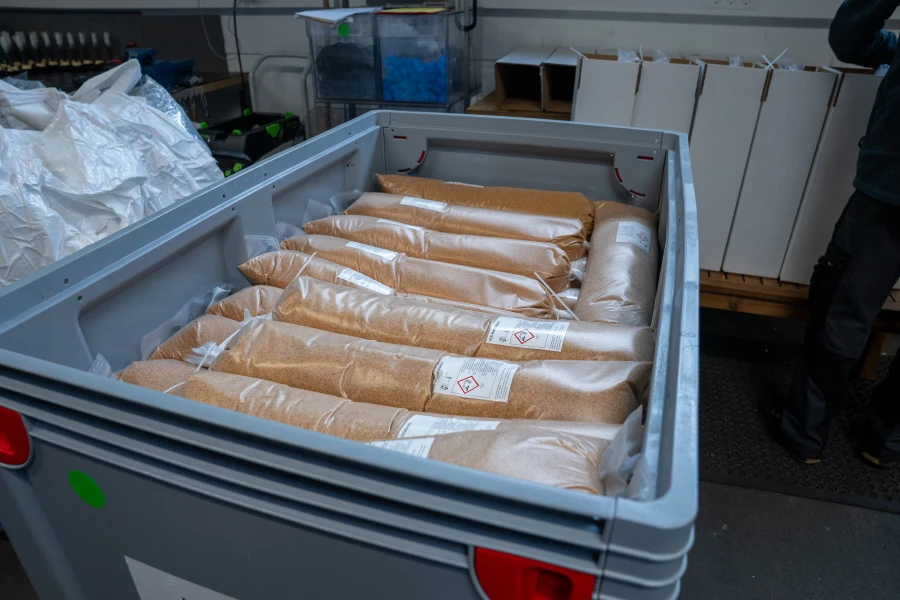
Central Regeneration: Large-scale plants or continuous processes utilize central regeneration stations. These are equipped with automatic facilities for separation, regeneration, and quality control. Resins are delivered in large containers and collected again after regeneration. ORBEN operates one of Europe's largest regeneration stations and can regenerate cation, anion, mixed-bed, and selective exchangers in large quantities.
Environmental and Safety Aspects
Regeneration requires handling acids and alkalis, as well as treating the resulting wastewater. VDI Guideline 2035 states that when treating heating water, protection against corrosion and deposits is paramount, and various methods such as softening, demineralization, hardness stabilization, and pH regulation must be applied. The following aspects must be considered during regeneration:
Neutralization of Regenerate Wastewater: The rinse water after regeneration contains salt solutions, acids, and alkalis. It must be neutralized and disposed of according to local regulations.
Safety Equipment: When handling concentrated acids and alkalis, protective equipment and emergency showers are required. Personnel must be trained.
Transport and Logistics: Resins and chemicals must be transported in suitable containers. The operator must ensure that the legally required transport documents are available.
Standards and Regulations
VDI 2035 – Technical Guideline for Preventing Damage in Hot Water Heating Systems
VDI Guideline 2035 (Parts 1 and 2) defines the "generally accepted rules of technology" for the quality of filling and make-up water in heating systems. Its aim is to prevent corrosion, deposit formation, and sludge accumulation to ensure trouble-free operation, as well as energy and cost savings. Key points:
Softening Limit Values: VDI 2035 defines a limit for total hardness after complete softening of 0.3°dH (0.05 mol/m³). Softened water must therefore have a very low residual hardness content.
Conductivity: For low-salt operating modes (fully demineralized or deionized water), the guideline requires a conductivity of <100 µS/cm for materials without aluminum and <100 µS/cm even for aluminum materials. Manufacturers may require stricter limit values.
pH value: The pH value of the heating water should be in the range of 8.2–10.0; for systems with aluminum, it must not exceed 9.0.
Regeneration Intervals: The guideline recommends regular monitoring of conductivity and pH value. If the limit values are exceeded, the resin must be regenerated or replaced.
AGFW FW 510 – District Heating Guideline
This guideline specifies the requirements for the circulating water in district heating pipelines and industrial heating networks. For "demineralized water," it requires the following limit values: electrical conductivity <20 µS/cm, silica <0.5 mg/L, and pH ≤7. These strict requirements necessitate a combined use of reverse osmosis, mixed-bed ion exchangers, and pH regulation. For operators of district heating pipelines, this means:
Only fully demineralized or demineralized water according to AGFW FW 510 may be used.
The selection of the resin must ensure that the conductivity remains within this range even during replenishment and filtration.
pH-stabilizing resins (e.g., THERMION 2035) can be helpful as long as the pH value remains ≤7.
Documentation and Auditability
Both VDI 2035 and AGFW FW 510 require traceable documentation of water treatment. This includes:
Analysis Protocols: Recording of conductivity, pH value, total hardness, alkalinity, and silicate.
Regeneration Records: Date of regeneration, chemicals used, flushing parameters, TOC analysis, test protocol of the resin batch.
Plant Logbook: Continuous documentation of fill and make-up water, system volume, and operating conditions.
With professional regeneration service providers, operators can ensure auditability and minimize liability risks.
Planning and Sizing of Ion Exchange Systems
For planners and operators, correct sizing is crucial. The following steps are to be considered:
Water Analysis and Target Values: Determine conductivity, hardness, alkalinity, silicate, organic constituents, and temperature. Define the desired target values (e.g., <30 µS/cm for heating water, <20 µS/cm for district heating).
Select Process: Determine whether softening, demineralization, or combinations with reverse osmosis are appropriate. For high salt loads, an upstream reverse osmosis system can significantly reduce the chemical costs of ion exchangers; standards permit this as an alternative method.
Select Resin Type: Choose resins with high capacity and chemical resistance; consider pH-compliant resins if the heating water is to be operated in the upper pH range. For district heating, a resin with pH regulation is not always suitable (max. pH ≤7).
Capacity Calculation: The exchange capacity (in mol/L or Eq/L) multiplied by the resin volume yields the total capacity. Divide this by the ion concentration of the feedwater to determine the theoretical throughput until regeneration. Safety margins account for irregularities in water quality.
Hydraulic Design: The bed area and height determine the flow velocity. Excessively high velocities lead to channeling and incomplete exchange; excessively low velocities result in high costs. Reference values for mixed-bed cartridges are 20–40 m/h.
Regeneration Concept: Determine whether on-site regeneration, an exchange service ("Resin Express"), or the operation of your own regeneration station is planned. Consider the space requirements for acids/alkalis, safety equipment, and neutralization facilities.
Monitoring Strategy: Install inline conductivity measurements at the resin outlet and, if necessary, pH and TOC sensors. Plan regular laboratory analyses according to VDI 2035 and AGFW FW 510.
Sustainability: Reusable Resin and Total Cost of Ownership
In the past, mixed-bed cartridges were often used as disposable products. With modern reusable resins, sustainability and cost-effectiveness are paramount. Repeated regeneration saves raw materials and reduces waste. According to GeWaPur, regeneration significantly reduces costs compared to new purchases; reuse conserves resources and ensures consistently high water quality. ORBEN uses reusable resins in its regeneration station that can be regenerated multiple times, and offers a Resin Express Service, which enables quick on-site replacement. This minimizes downtime and supports flexible projects.
The Total Cost of Ownership (TCO) of an ion exchange system includes not only the acquisition costs of the resins, but also:
Regeneration Costs: Chemicals, energy, water, and personnel.
Transport Costs: Shipping of exhausted resins to the regeneration station and return transport.
Wastewater costs: Neutralization and disposal of rinse water.
Lifespan: High-quality resins with a long lifespan reduce the frequency of replacements.
Downtime costs: Plant downtime during regeneration or resin replacement. Mobile trailer systems can reduce this.
Careful planning, the use of high-quality resins, and efficient regeneration can significantly reduce TCO. Sustainable reusable resins pay off in the long run and contribute to achieving environmental goals.
Practical Examples and Applications
Heating System Filling and District Heating Networks
When filling heating systems, the goal is to comply with standards such as VDI 2035 while operating economically. Mixed-bed ion exchangers with pH regulation (e.g., THERMION 2035) enable the production of demineralized water with a conductivity of <100 µS/cm and a pH value between 8.2 and 9.5. Indicator resin mixtures show by color change when the capacity is exhausted, simplifying practical application. For district heating networks with conductivity requirements <20 µS/cm, combined reverse osmosis/ion exchange systems are frequently used.
Industrial and Process Water
In the chemical industry, electronics and semiconductor manufacturing, and the food and pharmaceutical industries, the highest demands are placed on water quality. Here, pure and ultrapure water with conductivities <0.2 µS/cm and low silicate and TOC values are required. Mixed-bed resins (ultrapure water resins) are used, often in a polisher stage after reverse osmosis. The resins can be regenerated using special processes and achieve multiple cycles.
Selective Exchangers for Specific Ions
Nitrate, boron, heavy metal, or perfluoroalkane removal requires selective resins. These resins possess special functional groups that preferentially bind certain ions. Applications include drinking water treatment (nitrate removal), wastewater treatment (heavy metals), or industrial circulating water purification. The service life strongly depends on the concentration of the target ions; after loading, the resins are regenerated with suitable regenerating agents (e.g., brine, lye).
Emergency and Trailer Systems
For large projects, maintenance, or unexpected failures, ORBEN offers mobile trailer systems. These deliver demineralized water with capacities from 10,000 to 60,000 l/h and can be used for initial filling as well as temporary supply. The trailers are equipped with mixed-bed or two-stage ion exchangers and feature measurement and monitoring technology. The advantage: plants do not have to be shut down when the fixed treatment plant is undergoing maintenance.
Ion Exchange Resins: Basis for Safe and Standard-Compliant Water Treatment
Ion exchange resins are the central element of many water treatment processes and enable compliance with strict standards such as VDI 2035 and AGFW FW 510. The selection of the correct resin depends on the target quality, water composition, and operational requirements. High capacity, chemical resistance, and a long service life are important. High-quality resins from reputable manufacturers typically have a lifespan of four to over ten years.
Proper regeneration restores full performance and conserves resources. The regeneration process includes the separation of mixed-bed resins, chemical treatment with acids and alkalis, thorough rinsing, and strict quality controls. Regeneration offers economic and ecological advantages.
For asset managers, operations managers, and specialist planners in the field of heating networks, energy, and process plants, investing in sustainable reusable resins and professional services is worthwhile. They increase operational safety, reduce the Total Cost of Ownership, and contribute to sustainability.
Other areas on our website
Heating Water and Regulations: Everything about VDI 2035 and AGFW FW 510 – from limit values and measurement methods to practical decision support for operators.


.svg)