Water is the heat transfer medium in heating systems, district heating networks, and process circuits. Its chemical composition determines whether a system operates energy-efficiently or fails prematurely due to scale formation and corrosion. In advanced heat generators, tolerances have become tighter: different materials such as steel, copper, aluminum, or stainless steel react sensitively to electrochemical processes. The higher the concentration of dissolved salts, the higher the electrical conductivity of the water, and the stronger the corrosion currents that form galvanic cells between different metals. The VDI 2035 and AGFW FW 510 standards therefore define clear limit values for electrical conductivity, pH value, and oxygen content to prevent damage. Adhering to these parameters ensures trouble-free and economical operation.
For asset and operations managers in heating networks, energy, and process plants, operational safety, standard compliance, and sustainability are paramount. HVAC and building services planning must simultaneously meet economic and technical requirements. This article explains in detail what the term conductivity heating water entails, what limit values apply, how conductivity and pH value interact, and how precise measurement and documentation are carried out. Finally, strategies for heating water treatment, for adhering to limit values, and for reducing the total operating costs are presented.

Electrical conductivity is a material's ability to transport electrical charge. In aqueous solutions, dissolved ions perform this task. It is usually expressed in Siemens per centimeter (S/cm) or, in the heating sector, in micro-Siemens per centimeter (µS/cm). An important distinction exists between conductivity as a material property and the measured conductance value. The conductance value also takes into account the geometry and design of the measuring system through the so-called cell constant, making measurement results from different sensors comparable. Due to this relationship, electrical conductivity is the reciprocal of specific resistance, while the conductance value describes the actual measurement result under defined conditions.
Pure water has a very low conductivity of a few microsiemens due to the low concentration of its own H⁺ and OH⁻ ions; distilled water is around 0.055 µS/cm. As soon as salts such as sodium, calcium, or magnesium ions are dissolved, conductivity increases sharply, as these ions transport charges. For metals like copper or aluminum, conductivity is many orders of magnitude higher, which is why power lines are made of these materials. In heating systems, however, the water's conductivity does not depend on metallic conductivity, but on the sum of dissolved ions. A high salt load increases the likelihood of galvanic cells forming between different materials and electrochemical corrosion occurring.
The VDI 2035 and AGFW FW 510 standards distinguish between low-salt and high-salt operating modes. As conductivity decreases, the probability of corrosion is reduced: In low-salt systems, the standard allows for higher oxygen tolerance because the electrochemical potential is lower. Specialist literature on VDI 2035 explains that at conductivities below 100 µS/cm, a five times higher oxygen content can be tolerated. Conversely, corrosion currents increase with rising conductivity; if the conductance value exceeds 100 µS/cm, the corrosion risk increases significantly, which is why a low-salt operating mode is preferred in practice.
In addition to corrosion, conductivity also affects the efficacy of oxygen scavengers and corrosion inhibitors: At low conductivities, fewer chemicals are needed to bind oxygen because fewer ions are present. Low conductivity thus supports sustainable operations, as fewer additives are required, which benefits both the environment and the budget.
VDI Guideline 2035 regulates the quality of fill, top-up, and circulating water in hot water heating systems to prevent scaling and corrosion. It defines limit values for water hardness, electrical conductivity, pH value, and oxygen content. In low-salt operation, the electrical conductivity of the heating water at 25 °C, according to VDI 2035 and the KW-Energie information sheet, must be less than 100 µS/cm. For the pH value, VDI 2035 recommends a slightly alkaline range between 8.2 and 10.0. In systems with aluminum components, such as heat exchangers, the pH range must be more strictly adhered to: 8.2–9.0. In this mode of operation, an oxygen content of a maximum of 0.1 mg/l is tolerated; the lower the conductivity, the higher the permissible oxygen content.
The guideline distinguishes between softened ("full softening") and demineralized ("demineralized water") heating water. Softening only removes hardness-forming substances (calcium and magnesium) and replaces them with sodium, whereby the conductivity largely remains constant. Demineralization removes all cations and anions, resulting in ultrapure water with very low conductivity; the pH value automatically regulates itself due to the lack of buffer capacity. For many modern heat generators, manufacturers recommend demineralized water due to the lower risk of corrosion. VDI 2035 also emphasizes the documentation requirement: measured values, top-up quantities, and maintenance work must be recorded in the system logbook to prove compliance with standards and warranty claims.
The pH value influences the formation of protective oxide films on metal surfaces. In a slightly alkaline environment (pH 8.2–10), stable passive layers form, which slow down corrosion. If the pH value drops, the concentration of H⁺ ions increases, which can dissolve metal ions from the material. For aluminum components, the optimal range is smaller because high pH values can dissolve the passive film of aluminum. Therefore, in systems with aluminum alloys, conditioning must be carried out even at pH 9. Conversely, an excessively high pH value leads to deposits and can neutralize organic acids from degraded antifreeze agents, causing the system to become unbalanced.
For local and district heating systems, AGFW Worksheet FW 510 sets stricter requirements. The regulations distinguish between three operating modes: low-salt, saline (medium salt load), and high-salt. The electrical conductivity ranges for low-salt circulating water are between 10 and 30 µS/cm; for saline operation, 30 to 100 µS/cm is permissible. A conductivity between 100 and 1,500 µS/cm is tolerated only in exceptional cases and requires strict oxygen control. The pH value for low-salt operation should be between 9.0 and 10.0 ; for saline operation, it may rise to 10.5 . The oxygen content for low-salt water must be below 0.1 mg/l, and for saline water, below 0.05 mg/l . In both cases, the total hardness (alkaline earth metals) is limited to a maximum of 0.02 mmol/l .
AGFW FW 510 indicates that at conductivities below 20 µS/cm, the function of water level electrodes can be impaired. Furthermore, magnetic-inductive flow measurements can yield incorrect results at very low conductivity values. The guideline emphasizes that continuous monitoring is necessary and recommends using only demineralized water in low-salt systems to permanently keep the conductivity below 100 µS/cm.
Electrical conductivity correlates closely with water hardness and the content of dissolved salts. Hardness-forming substances like calcium and magnesium ions contribute to conductivity as positive ions, while corrosive anions such as chloride, sulfate, and nitrate also transport electrical charge. A practical rule of thumb is: Hardness (°dH) × 30 ≈ Conductivity in µS/cm. Accordingly, a water hardness of 20 °dH corresponds to approximately 600 µS/cm. During softening, calcium and magnesium ions are replaced by sodium, which is why conductivity does not decrease – the risk of corrosion remains high. Full demineralization, on the other hand, removes both cations and anions, resulting in ultrapure water with conductivities < 0.1 µS/cm.
During conductivity measurement, an electric field is generated between two electrodes. The ions dissolved in the water move within the field and generate a current proportional to the ion concentration. Modern measuring devices primarily use four-pole conductivity cells to minimize polarization effects. In heating applications, the conductivity value is measured in micro-Siemens per centimeter and converted to a reference temperature of 25 °C for better comparability. Automatic temperature compensation is therefore essential because conductivity increases with rising temperature (rule of thumb: +2% per °C).
The difference between conductivity and conductance is also relevant during measurement. Conductivity is a material property and independent of the measuring cell's geometry, whereas conductance is the product of conductivity and the cell constant. The cell constant takes into account the electrode surface area and distance; high-quality measuring devices specify it in their product specifications and allow calibration with standard solutions. Selecting the correct measuring range is important: Handheld devices for heating water typically cover 0–2,000 µS/cm with a resolution of 1 µS/cm and an accuracy of ±2%. Devices with automatic temperature compensation and a calibratable electrode increase measurement reliability, especially at low conductivities.
Manufacturers like UWS Technologie or Egger offer measuring devices specifically designed for heating water analysis. A dual measuring device for pH value and conductivity, such as the "WaterBoy," simplifies heating water control for HVAC professionals. The devices guide the user through a three-point calibration and provide a digital measurement log. Handheld conductivity meters have a measuring range of 0–1,999 µS/cm, a resolution of 1 µS/cm, and an accuracy of approximately ±2%. They are equipped with automatic temperature compensation (0–50 °C) and use replaceable electrodes. In practice, measuring devices should be calibrated annually and checked against calibration solutions of different conductivities. Regular calibration is essential to obtain reliable measurement values and thus meaningful documentation in accordance with VDI 2035.
Correct sampling is a prerequisite for accurate measurement results. Technical articles emphasize that water samples should always be taken from well-circulated points; for wall-mounted units, the filling and draining device is suitable, while for floor-standing units, a higher connection point should be chosen. Stagnant water must not be used, as dissolved gases and deposits can falsify the measurement. The sampling vessel must be clean, oil-free, and rinsed. The measuring probe and vessel should be rinsed with heating water before the actual measurement to avoid contamination. A short piece of hose is recommended to minimize air ingress.
Electronic measuring devices with temperature compensation are necessary for measuring electrical conductivity. The sample must not be taken near chemical dosing points, as locally high concentrations can occur there. After measurement, the device should be rinsed with distilled water and the electrode stored dry to prevent contamination. At particularly low conductivities (below 20 µS/cm), the AGFW guidelines warn against incorrect measurements by magnetic-inductive flow meters and impaired water level sensors. In such cases, high-quality four-pole sensors and laboratory measurements are advisable.
VDI 2035 recommends clear monitoring intervals: A first measurement of all parameters should take place within 48 hours after initial filling. A second check follows after three months of steady-state operation; subsequently, at least annual measurements should be carried out. In the event of malfunctions, larger replenishment volumes, or noticeable operational changes, additional samples must be taken and evaluated. For district heating systems according to AGFW FW 510, monthly checks of conductivity, pH value, and visual water assessment are stipulated, as well as comprehensive annual laboratory analyses. All measurement values, calibration protocols, replenishment volumes, and maintenance work must be documented in the plant logbook to ensure compliance with standards and audit security.
Meeting standard values requires systematic heating water treatment. Various methods are employed depending on the raw water quality, system size, and operating mode.
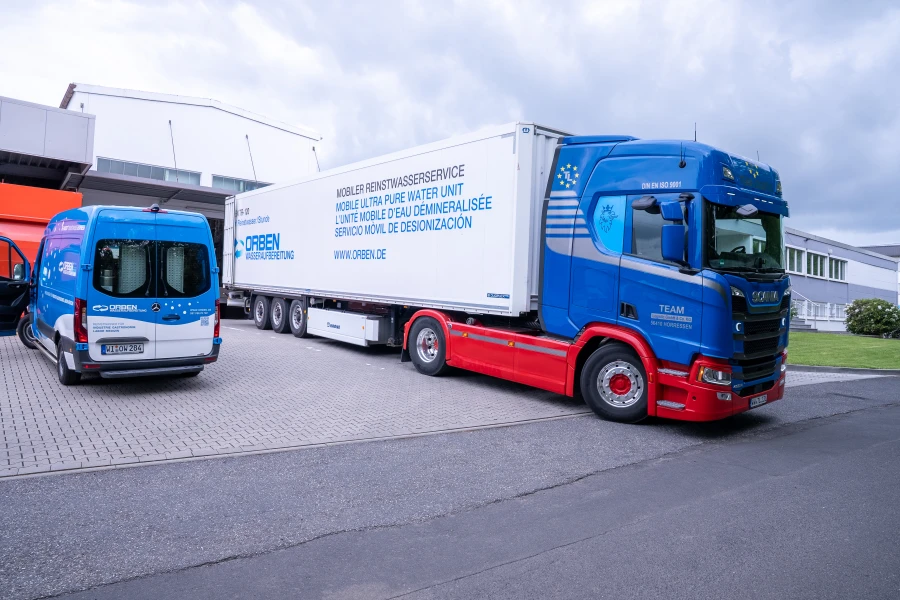
The most effective method for reducing conductivity is demineralization. All cations are exchanged for hydrogen ions (H⁺) and all anions for hydroxide ions (OH⁻), resulting in pure water after the reaction. Mixed-bed ion exchangers combine cation and anion exchange resins in a single cartridge, producing demineralized water with conductivity below 1 µS/cm. These systems are suitable for initial filling or replenishment of heating systems. Once the exchange capacity is exhausted, the resins must be regenerated. ORBEN operates its own regeneration station and offers multi-use resin, which, unlike single-use resin, is regenerated multiple times, thereby reducing waste and conserving resources.
In low-salt operating modes, the heating water is completely demineralized. This reduces conductivity to < 100 µS/cm, and the system tolerates higher oxygen concentrations. Due to the low ion concentration, the pH value automatically regulates itself because of the absence of buffer substances; additional conditioning is usually unnecessary. Demineralization can be performed stationary or mobile. Mobile trailer systems or cartridges are used particularly in large systems and in emergencies, enabling fast, flexible treatment. Multi-use resin and mobile trailers can reduce overall operating costs and environmental impact.
If complete demineralization is not possible or economical, softening can be a viable option. This involves exchanging hardness-forming calcium and magnesium with sodium. This prevents scale formation but does not reduce conductivity; the salt content remains high. The risk of corrosion due to high conductivity persists, which is why many manufacturers no longer recommend softening alone. VDI 2035 Part 2 indicates that in saline operation, conductivity up to 1,500 µS/cm is only tolerated in exceptional cases, and strict oxygen control is then required.
A proven practice is Side-stream demineralization: Here, a portion of the circulating water is passed through an ion exchanger. Continuous circulation reduces the overall conductivity without the need to completely drain and refill the system. An example from Heating Journal practice: In cases of high electrical conductivity in heating water – for instance, due to exhausted demineralization cartridges or large quantities of untreated make-up water – side-stream demineralization is recommended; in extreme cases, the system should first be flushed with potable water. Side-stream demineralization reduces the salt load and restores the pH value to the normative range.
Oxygen ingress is a significant corrosion factor. Pressure maintenance systems, leaks, or diffusion-open plastic components can introduce air into the system. Reliable pressure maintenance and minimizing make-up water quantities are therefore fundamental prerequisites. Mechanical degassers, vacuum degassers, or membrane degassing systems efficiently remove dissolved gases. In saline systems where conductivity is > 30 µS/cm, oxygen content must be strictly controlled. Chemical oxygen scavengers such as sodium sulfite, DEHA, or organic inhibitors can bind oxygen; however, the AGFW working sheet points out that the use of such chemicals increases salt content and raises conductivity. Their use must therefore be carefully considered.
Particles, magnetite (black iron oxides), and biofilms impair heat transfer and indicate ongoing corrosion. In saline operating modes, where galvanic corrosion is more pronounced, iron particles are increasingly formed. Filtration systems, magnetite separators, and continuous flow management remove these particles. Regular monitoring of particle load through sampling and online turbidity measurement helps assess the system's condition.
Should the pH value fall outside the normative range, alkalizing agents or acid dosing may be necessary. However, VDI 2035 recommends using conditioning chemicals only in exceptional cases. In low-salt systems, the pH value regulates itself through the autoionization of water; additions can destroy passive layers. In saline systems, stabilizing the pH value to 9.0–10.5 is important to prevent corrosion of steel and copper. Organic acids from degraded antifreeze agents lower the pH value; in such cases, the cause should first be addressed, and if necessary, side-stream demineralization performed.
.webp)
A standardized procedure for conductivity measurement ensures that the measurement results are accurate, reproducible, and auditable.
Adhering to the limit values for electrical conductivity and pH directly contributes to extending the lifespan of heating systems. Even a few millimeters of scale or deposits can significantly reduce heat transfer and increase energy consumption. Corrosion damage leads to expensive repairs and potential downtime. According to VDI 2035, low-salt operation with conductivities < 100 µS/cm allows for higher oxygen tolerance and reduces the need for oxygen scavengers. Full demineralization reduces the use of chemicals, which lowers operating costs and decreases environmental impact.
Sustainability also plays a role in the selection of water treatment systems. ORBEN relies on reusable resin, which can be regenerated multiple times compared to single-use resin, thereby conserving resources and reducing waste. Mobile trailer systems and modular full demineralization plants enable flexible and efficient treatment measures – both for project business and in emergencies. Digital monitoring of conductivity using sensors and data loggers supports proactive maintenance management and minimizes personnel effort.
An excessively high electrical conductivity of the heating water indicates an ingress of dissolved salts. Causes can include exhausted full demineralization or mixed-bed cartridges, improper make-up with untreated water, leaks in the heat exchanger (ingress of foreign water), or the dosing of chemicals. Inadequate regeneration of ion exchangers can also lead to high conductivity values. In such cases, a water analysis is recommended first, followed by partial stream demineralization or – in the event of severe contamination – complete demineralization.
Conductivity is highly temperature-dependent; therefore, the conductivity value is converted to a reference temperature of 25 °C. A temperature increase of 1 °C raises conductivity by approximately 2%. Modern measuring devices feature automatic temperature compensation. If measurements are performed without temperature compensation, the values must be corrected accordingly; otherwise, limit values may appear to be exceeded.
VDI 2035 stipulates an initial measurement within 48 hours of filling, a check after three months, and then at least annual measurements. For district heating networks, AGFW FW 510 requires monthly checks and a comprehensive annual analysis. Additional measurements should be taken in the event of larger replenishment volumes, system modifications, or noticeable operational changes. Digital sensor technology also enables continuous monitoring.
The pH value alone does not provide information about conductivity. In low-salt solutions, the buffering effect is weak due to the low ionic strength; the pH value quickly stabilizes after a deviation. Nevertheless, the pH value can provide indications for certain processes: A significantly elevated pH value indicates self-alkalization or an overdose of alkalizing agents, while a significantly lowered pH value points to organic acids from antifreeze or cleaning agents. In any case, conductivity and pH value should be measured separately.
Electrical conductivity is a central quality parameter for heating and district heating systems. Low conductivity reduces the risk of corrosion, increases oxygen tolerance, and minimizes the use of chemical additives. Standards VDI 2035 and AGFW FW 510 specify clear limit values: < 100 µS/cm for low-salt operation and 10–30 µS/cm in district heating networks. Furthermore, they define pH ranges, oxygen limits, and documentation requirements. Operators, planners, and HVAC professionals should be aware of these limit values and regularly measure conductivity. A structured measurement procedure, careful sampling, and the use of calibrated measuring devices with temperature compensation are prerequisites for reliable values. Full demineralization, partial flow demineralization, degassing, and magnetite separation can keep conductivity stable within the desired range. Sustainable multi-use resin systems, mobile trailers, and digital sensor technology reduce long-term operating costs and increase operational reliability.
Consistent monitoring of conductivity is therefore not an option, but a must for every future-proof heating or district heating network.


.svg)