Demineralized heating water is no longer a niche topic for a few special systems. In building services engineering, the VDI 2035 provides the central reference framework for preventing scale formation and water-side corrosion in hot water heating systems within buildings at flow temperatures below 100 °C. For industrial heat supply and district heating systems, the AGFW FW 510additionally applies, which assesses water quality in the network and in the associated treatment plants with a view to operational safety and availability. ORBEN explicitly addresses this area with solutions for initial filling, replenishment, bypass and inline treatment – from classic heating systems to district and local heating networks.
But this is precisely where many projects go wrong: Demineralization is often treated as if it were the goal. In reality, it is only a process within an operating strategy. Anyone who focuses solely on low conductivity often misses the real issues: oxygen ingress, magnetite, sludge, residual hardness, biofilm, installation contaminants, leaks, incorrect replenishment, or a pH value that develops differently in the system than at the filling point. Demineralized heating water is therefore not a checkbox on a checklist, but rather the starting point for stable system operation.
For operators, planners, and skilled trades, the relevant question is therefore not: Is demineralized water good? The relevant question is: When is demineralized heating water the right choice, which demineralization process suits the system, and where does the protective effect of the process end? Precisely this decision-making logic is more valuable in practice than any blanket advice.
In the heating sector, terms like Demineralized water, demineralized water and deionized water are often used largely synonymously. This refers to water from which practically all dissolved ions have been removed. Technically, this means: cations such as calcium, magnesium, sodium, or potassium, and anions such as chloride, sulfate, or nitrate are removed. The result is very low residual hardness and low electrical conductivity. This is precisely what distinguishes demineralization from mere softening, where hardness-forming substances are removed or replaced, but the overall salt load does not decrease to the same extent.
This is relevant for heating systems because two damage mechanisms are addressed simultaneously. Firstly the risk of scale and deposit formation is reduced because calcium and magnesium ions are absent. Secondly with the reduced salt load, the conductivity of the water decreases, which lessens the promotion of electrochemical corrosion processes. This logic is why low-salt operation is technically preferred in many modern systems.
However, it's important to add: Demineralized does not automatically mean “fully conditioned”. While demineralized water enters the system with excellent prerequisites, its behavior there depends on the actual system: the material mix, the tightness, the condition of the network, residues from installation or renovation, and the handling of make-up water. Those who ignore this overestimate the effect of demineralization.
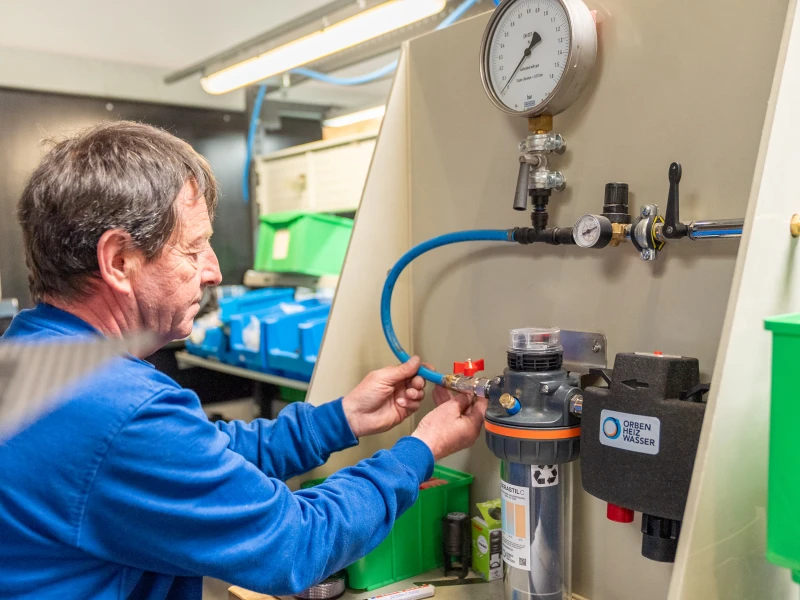
The umbrella term "demineralization" encompasses several technical approaches. For small and medium filling volumes in HVAC practice, the dominant methods are usually Mixed-bed ion exchangers. They contain a mixture of cation and anion exchange resins, allowing the water to be demineralized in a compact single stage. This solution is robust, mobile, and easy to handle for initial filling or replenishment. ORBEN provides mobile and stationary systems, as well as pH-compliant mixed-bed resins, precisely for this purpose.
In addition, there are single-bed or cascade solutions consisting of cation and anion exchangers. These are more sophisticated in terms of process technology and particularly useful where water quality, regeneration concepts, or system size demand a different process logic. In the current ORBEN context, this distinction is explicitly presented as a decision between cation exchangers, anion exchangers, and mixed-bed systems — not as academic chemistry, but as a selection decision with direct relevance for standard compliance, operation, and costs.
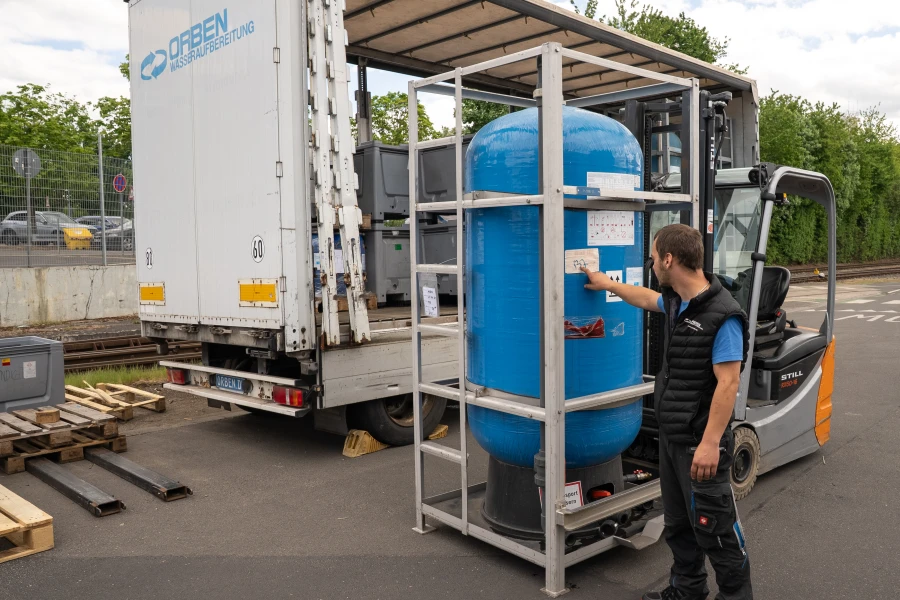
For large volumes or project-critical applications, reverse osmosis systems often come reverse osmosis systems into play, often combined with a downstream mixed bed as a polisher. Reverse osmosis economically reduces the salt load in large quantities, while the mixed bed precisely lowers the residual conductivity. ORBEN describes exactly this setup for large-volume applications and refers in a case study from Pfaffenhofen to the mobile production of standard-compliant heating water for a 500 m³ buffer tank directly on site. There, the necessary heating water quality was produced from hydrant water using a trailer and reverse osmosis in just a few days.
In industrial environments or high-purity process chains, EDI, EDI, or electrodeionization, can also play a role. For conventional heating water, EDI is not always the primary standard method, but it becomes relevant when demineralization is integrated into larger water treatment chains or when particularly consistent quality levels are required. Crucially: Not every demineralization process is economically and operationally suitable for every system size. Anyone applying the same technical logic for 500 liters and 500,000 liters is out of touch with reality.
The strength of demineralization lies in its ability to mitigate several problem areas simultaneously. Untreated fill water can introduce hardness formers, corrosive salts, and other substances into the system. Modern heat generators, highly effective heat exchangers, and high-efficiency pumps, in particular, react significantly more sensitively to this than older, less responsive systems. In the Pfaffenhofen case study, ORBEN explicitly states that modern systems simply can no longer simply rely on drinking water quality should be operated if efficiency, warranty, and service life are to be maintained.
A second advantage is its relevance to low-salt operation. The lower the conductivity, the less pronounced electrochemical corrosion mechanisms become. This is why demineralized water is considered the more robust choice in many situations – especially for systems with sensitive components, when manufacturer specifications apply, or whenever not just limescale but also the entire salt load becomes an issue. Official manufacturer documents from BWT and Grünbeck also highlight this logic and link it to the note that standard-compliant heating water quality is relevant for operational safety and, in some cases, for warranty claims.
Thirdly, from a documentation perspective, full demineralization is often easier to justify clearly than alternatives close to limit values. Those who work with demineralized water often create more distance from problematic raw water values and reduce dependence on regionally highly fluctuating drinking water quality. This is particularly relevant in project business, for recurring replenishment, or for cross-location standards.
Nevertheless, it holds true: The better choice does not automatically mean the only sufficient choice. This is precisely where the limitations of the demineralization process begin.
Perhaps the most important point for operators of larger systems: Full demineralization does not remove design flaws or air ingress. The AGFW explicitly emphasizes on its official FW-510 page that the primary prerequisite for trouble-free operation is degassed circulating, filling, and make-up water . Furthermore, introduced or generated gases – such as oxygen, nitrogen, carbon dioxide, or hydrogen – should be continuously removed from the system, for example, via partial flow degassing. This makes it clear: a low salt content does not replace degassing.
This is crucial in practice. Anyone who fills a system with demineralized water but simultaneously operates a leaky pressure maintenance system, diffusion-permeable sections, problematic replenishment, or unresolved air ingress will not permanently control corrosion. Full demineralization improves the starting conditions, but it does not remove the entry point for oxygen.
A second common misconception is: If the water is fully demineralized, the system is clean. That's not true. Full demineralization primarily addresses dissolved salts, but not automatically particulate contamination such as magnetite, sludge, rust particles, or organic deposits. ORBEN therefore deliberately differentiates between full demineralization on the one hand and magnetite/sludge separators and deaerators on the other. This is not a minor detail, but a clear signal: water chemistry and dirt load are two different issues.
This can be particularly critical in existing systems. If an old or sludged-up system is simply topped up with demineralized water without assessing the system's condition, the new salt load can be reduced, but existing deposits, corrosion products, and legacy contaminants remain in the circuit. Therefore, in the case of renovations or problems, a combination of filtration, magnetite separation, bypass treatment, and, if necessary, cleaning necessary before full demineralization can reliably achieve its effect.
A third borderline case concerns the pH value. Many practical texts state that demineralized water or a suitable mixed-bed resin "automatically" brings the heating water into the desired range. This is often true as a tendency, but dangerous as a blanket statement. ORBEN itself already states in its current article on VDI 2035 that full demineralization frequently brings the makeup water into the target range, but in special cases or with makeup water, an active pH adjustment may be necessary.
Manufacturer's documentation confirms this limitation. BWT points out in its system manual that an immediate pH measurement after commissioning is not advisable, because the relevant system pH value only stabilizes after an operating phase influenced by materials, temperature, and possible residual substances. Grünbeck also emphasizes that chemical reactions and pH shifts in the heating circuit are unavoidable and require conditioning if deviations occur. In other words: Demineralized water is a very good start, but it doesn't automatically guarantee a stable pH.
If a system constantly requires top-up water, the primary issue isn't the conductivity, but often the leak, the pressure maintenance system or the operating method. If a heating network introduces gases, the degassing strategy must be appropriate. If an existing system is contaminated with residues, magnetite, or biofilm, simply refilling it with pure water is insufficient. If aluminum components are present, the pH range needs closer monitoring. And if operators only know raw water values but fail to measure system values, no reliable statement about operational safety can be made.
The limitation of the demineralization process, therefore, always arises when a chemical solution encounters a hydraulic, structural, or operational problem . In such cases, more than just a cartridge is needed.
Anyone searching for a heating water pH value table is usually looking for a quick number. This isn't sufficient for practical application. The pH value in a heating system isn't just a target figure; it's the result of materials, operating methods, water quality, oxygen conditions, residual substances, and conditioning agents used. Therefore, an isolated number is often less helpful than a reliable interpretation of the figures.
As a rough guide, in the context of VDI 2035, for heating systems without problematic aluminum configurations, slightly alkaline ranges of around 8.2 to 10.0 are often cited. For systems with aluminum or mixed aluminum installations the permissible range is typically narrowed in manufacturer documentation, often up to 9.0. ORBEN also refers to this narrower corridor for aluminum in his current VDI 2035 contribution. At the same time, manufacturer documentation from BWT and Grünbeck shows that individual configurations may require even finer differentiations. The correct conclusion is therefore not: "There is one single pH value." The correct conclusion is: There is a material- and system-dependent target range.
Even more important is the time of measurement. BWT explicitly states that the pH value can only be meaningfully assessed after an operating phase – often after about 8 to 12 weeks or at the time of the first maintenance – can be meaningfully assessed. This is precisely where a common practical error lies: the pH on the day of filling is treated as the final state, although the water in the real system must first stabilize. Especially with new systems, during renovations, or with residues from flushing, cleaning, or installation, the later system pH can deviate noticeably from the initial filling.
For operators, this means: the sought-after "table" is just the starting point. The pH assessment only becomes truly reliable when three questions have been answered. Firstly: Which materials are installed? Secondly: When was the measurement taken? Thirdly: Is the system clean, leak-proof, and operationally stable? Only then does a numerical value become a reliable basis for decision-making.
The effective heating water treatment does not begin with a product, but with an assessment of system type, volume, materials, operating condition, and risk. Those who make this assessment carefully will almost automatically arrive at the appropriate demineralization method.
For new, closed building systems with manageable volumes, the logic is usually simple: The fill water is inline treated, i.e., before it enters the system. Mobile filling devices, mixed-bed cartridges, or compact fixed installations are practical for this, as long as the fill volumes, raw water values, and manufacturer specifications are suitable. ORBEN explicitly describes this application area for initial filling and replenishment in the HVAC sector.
For systems with regular replenishment a one-time demineralized filling is often not enough. Then a proper replenishment strategy with treatment of the make-up water, monitoring, and clear accountability. Otherwise, the initially good water quality will gradually deteriorate again. Especially in this area, many damages arise not from the initial filling, but from years of neglected replenishment.
For existing systems with operational quality issues a bypass method is often the better choice. In this process, a partial flow of the circulating water is treated and returned to ongoing operation. ORBEN impressively demonstrates this in Leipzig: There, 140,000 liters of system water in a hospital operation were treated via bypass without interrupting operations. Even after frost damage, existing circulating water was treated via bypass; target values significantly below 100 µS/cm were deliberately chosen because re-desalination from older pipe sections was expected.
For large volumes, tight project schedules, or temporary high demands the pure cartridge logic quickly reaches its economic and logistical limits. Then mobile trailer systems or larger demineralization plants are more sensible. In the heating water sector, ORBEN specifies filling capacities of up to 120,000 liters per hour and links this with large-scale plants, district/local heating, and peak demands. In Pfaffenhofen, for precisely this reason, water deliveries by tank trucks were not used; instead, the heating water was generated on-site.
The short practical rule is therefore: Inline for clean initial filling, make-up unit for continuous operation, bypass for existing systems and malfunctions, trailer or large-scale plant for volume, deadlines, and project pressure. It's not the method that is "right," but its suitability for the task.
At the latest in the context of district heating and large-scale plants, it becomes clear why an article about limits is more important than another basic text. AGFW FW 510 applies to industrial heat supply and district heating plants with hot water, as well as to hot water systems directly connected to district heating networks. AGFW states as the primary prerequisite for trouble-free operation degassed circulating, filling, and make-up water. The association also states very clearly on the conditioning side: The pH value is adjusted if necessary via alkalizing agents ; other limit and assessment parameters are essentially maintained through degassing, softening, demineralization, and filtration .
This is precisely where the practical limit of a purely demineralization-focused approach lies: In heating networks, it's rarely enough to think only in terms of "fully demineralized" water. One must consider process chains . For example: pre-analysis, demineralization, alkalization, partial stream degassing, filtration, monitoring, and documentation. ORBEN already incorporates this logic in its own technical articles and project examples, describing combinations of trailers, reverse osmosis, mixed bed, conditioning, and degassing for larger systems.
For asset managers, this is the crucial shift in perspective. In a heating network, demineralized water is not "the product," but rather a component of water management. Those who only focus on the filling line underestimate the operational risk. Conversely, those who consider demineralization, degassing, filtration, and replenishment together gain availability, auditability, and predictable water chemistry.
Full demineralization is often discussed in projects based on the purchase price . This is too narrow a view. The decisive factor is the total operating costs: resin consumption, regeneration, disposal, installation time, downtimes, logistics, personnel commitment, documentation, and the risk of water chemistry-related damage. This is precisely where the difference between a short-term cheap solution and a long-term economical one becomes apparent.
In its own positioning, ORBEN strongly relies on reusable resin and regeneration in its own regeneration station. The website describes the facility as Europe's largest regeneration station, with regeneration volumes of up to 40,000 liters per day, as well as a batch number and filling date for each cartridge. The SEO/GEO blueprint explicitly identifies this topic as a key differentiator for sustainability, TCO, and auditability.
The economic impact is particularly evident with recurring demand and larger volumes. A disposable approach generates waste and ongoing replacement costs. Reusable and regeneration concepts shift the perspective to lifecycle instead of single purchase. In large projects, a second TCO lever comes into play: on-site generation instead of water transport. The Pfaffenhofen case study illustrates this very vividly: 500,000 liters of treated water would otherwise have corresponded to approximately 35 tanker truck loads. In such cases, mobile treatment is not only technically, but also logistically and economically viable.
Sustainability here is not a mere image exercise. It becomes robust when it is linked to resin-side circular economy, less waste, reduced transport burden, and reproducible water quality .
An underestimated part of any DI strategy is documentation. Many systems perform poorly not because they were filled incorrectly once, but because no one can clearly trace afterwards what happened when with which water. This is precisely why auditability plays such a significant role in the ORBEN blueprint.
In practice, robust documentation should cover at least the following points: raw water analysis, chosen treatment method, fill and top-up water volumes, conductivity, pH value, visible plant condition, additives used, resin exchange or regeneration, maintenance steps, and relevant system components such as pressure maintenance or degassing. Official plant logbooks from BWT and Grünbeck demonstrate precisely this logic: not only target values, but also measurement times, follow-up checks, and ongoing logging throughout the operating period.
Especially for pH values, documentation is more important than gut feeling. If the first meaningful measurement point is only after the stabilization phase, this appointment must be planned and logged. If additives are used, their concentration must be controlled. If regular top-ups occur, the quantities and causes must be recorded. Otherwise, deionization remains a one-time technical act instead of becoming part of a controlled operational process.
Ultimately, this is the core message of this topic: Full Demineralization of Heating Water works best when processes, operational management, and documentation are aligned. Those who only demineralize without measuring, evaluating, and tracking are only realizing a fraction of the potential benefits.
In many systems, fully demineralized heating water is the technically sound solution to combat hardness, salt load, and increasing demands on efficiency, warranty, and operational reliability. Modern systems, in particular, benefit from low-salt operation. For many new constructions, renovations, replenishment concepts, and large projects, full demineralization is therefore not a luxury, but rather the state of the art.
The limitations arise when the system is not viewed as a complete system . Demineralized water does not replace degassing, filtration, leak-tightness, pH monitoring, or a sound replenishment strategy. Those who understand this plan better. Those who ignore it will later be surprised by corrosion despite low conductivity.
The right decision is therefore not simply “demineralization: yes or no”. The right decision is: Which demineralization process suits the volume, materials, operating mode, risk, documentation requirements, and TCO? This very question holds the key to the true economic efficiency of heating water treatment – and it is precisely here that the distinction between standard-compliant filling and permanently stable system operation emerges.


.svg)