In industrial energy and process plants, local and district heating networks as well as in commercial buildings, the quality of heating water plays a decisive role in the operational safety, efficiency and lifetime of the systems. Asset and plant managers are required by standards such as VDI 2035 and AGFW FW 510 to comply with limits for conductivity, pH, hardness and oxygen content in order to prevent corrosion and stone formation. At the same time, they have economic goals, want to fulfill documentation and audit obligations, and pay attention to sustainability and total operating costs. The HVAC specialist trade and TGA specialist planning support them in this and must also be aware of normative requirements.
In this article, the two most important heating water treatment processes — bypass and inline — are compared. In addition to a detailed description of the procedures, decision-making criteria, regulatory principles and practical examples are explained. Since the ORBEN blog already contains comprehensive content on ion exchangers, pure and ultrapure water, mobile trailer systems and sustainability, this article focuses on a strategic deepening: How can bypass and inline processes be used in a targeted manner to treat heating water in accordance with VDI 2035 and AGFW FW 510? At the same time, the perspective of the core and second person should be taken into account. This article is deliberately written in a technical and practical way to address the needs of asset managers and technicians alike.
The VDI 2035 regulations “Preventing damage in hot water heating systems” have been the standard for the quality of heating water in Germany for many years. The guideline defines clear limits for conductance (electrical conductivity), pH, carbonate hardness and oxygen content to prevent corrosion and deposit formation. For systems without aluminum components, VDI 2035 requires a pH value of between 8.2 and 10.0. If the system contains aluminum, the pH value must be in the range 8.2 to 9.0. The electrical conductivity of the water should be less than 100 µS/cm in low-salt mode and the oxygen content must not exceed 0.1 mg/L. This low oxygen content minimizes the risk of oxygen corrosion.
The AGFW FW 510 worksheet is intended as a supplement for local and district heating networks. It sets particularly strict conductivity limits for low-salt operation: 10-30 µS/cm, a pH range of 9.0 to 10.0 and a total hardness of < 0.02 mmol/L (corresponds to almost salt-free water). Higher guide values of up to 1500 µS/cm and pH values of up to 10.5 may be permitted for saline networks, and operation must then be secured using corrosion inhibitors. These stricter values reflect the high requirements for large heating networks, where long pipes and high operating temperatures can promote corrosion.
Compliance with these limits is not only relevant from a technical point of view, but also has legal and economic consequences. Manufacturers and insurers link warranty claims and liability issues with the standard-compliant quality of filling and operating water. If conductance, pH and hardness are not monitored, corrosion damage can occur, resulting in high repair costs and plant downtime. According to specialist literature, correct water quality and continuous treatment prevent energy losses, increase operational safety and extend the life of heat sources and pipes. In times of high energy prices and strict CO₂ requirements, this is a key factor for profitability.
For TGA planning and the HVAC trade, knowledge of the regulations means that suitable materials, valves and treatment processes must be selected. The trend is towards salt-free operation with demineralized water, as this minimizes corrosion risks and often makes inhibitors unnecessary. However, there are plants in which saline operation is tolerated, for example in older district heating networks. The choice of the right process — bypass or inline — therefore depends on the standard requirements, the system structure, the operating volume and the economic conditions.
Both in bypass and inline processes, the focus is on full desalination with ion exchangers. Mixed-bed ion exchangers remove both cations (calcium, magnesium, sodium) and anions (chloride, sulfate, hydrogen carbonate) almost completely. The result is virtually salt-free water that has a very low conductivity. The regeneration of such mixed-bed resins is carried out in specialized treatment plants; ORBEN uses reusable resins to increase sustainability and reduce the need for disposable cartridges. According to company information, trailer systems are available for larger projects to enable mobile and large volume preparation.
In the bypass process, a partial flow from the existing heating network is routed via an external desalination unit. This unit usually consists of a prefilter to remove particles (e.g. magnetite), a mixed-bed cartridge for full desalination and optional measurement and documentation equipment. The heating water is circulated continuously or intermittently until the total quantity in the system reaches the desired guide values. During the process, the system remains in operation; only the secondary flow is diverted via the bypass and fed back in after cleaning.
Practice guidelines recommend determining the system parameters before starting bypass desalination: water volume, hardness, conductivity and pH value. A water meter is used for documentation, which records the treated volume. The mobile unit is then connected to the flow and return flow via KFE valves. The mixbed cartridge is dimensioned in such a way that the entire heating water supply is gradually brought to a conductivity of below 100 µS/cm and a standard-compliant pH value. Progress can be monitored via regular measurements. Once the target is achieved, the bypass is closed and the unit dismantled, while the heating network remains running.
The inline process (also known as inline correction or inline desalination) is firmly integrated into the heating network. A defined portion of the heating water is continuously passed through the ion exchanger and then fed back into the main circuit. Modern systems have an internal pump so as not to interfere with the hydraulics of the heating system. Prefiltration removes particles, while the mixed-bed cartridge reduces residual conductivity. Sensors monitor conductivity and differential pressure and provide information about the condition of the filter and resin. When exhausted, the filter elements or resin cartridges are replaced.
According to external sources, inline correction is used in particular when new boilers are installed, corrosion problems occur or chemical inhibitors need to be reduced. Since no complete emptying is necessary, this process results in minimal operational interruptions.
The choice between bypass and inline methods depends on numerous factors. Asset managers must simultaneously consider compliance with standards, operational safety, economic aspects and sustainability goals. The most important decision criteria are explained in more detail below.
The larger the heating water volume and the more complex the piping, the more appropriate it often makes sense to use an inline system. In large district heating networks with an output of several megawatts, a continuous desalination process is necessary to comply with the strict conductance limits of AGFW FW 510. The bypass process would require a variety of cartridge changes and long running times. On the other hand, small to medium-sized plants, for example in office buildings or apartment buildings, can be economically renovated with temporary bypass desalination, especially if they are only filled once.
Companies with critical production processes, hospitals, and data centers cannot afford extended downtime. An inline system is an advantage for them, as the processing takes place during operation. Although a bypass process is also reliable, it requires active monitoring and can lead to brief pressure fluctuations in individual cases. For plants that are shut down seasonally (e.g. leisure facilities), the bypass process is a flexible option for refilling before commissioning.
Investment decisions are increasingly being made based on overall operating cost criteria. The bypass process has low initial costs, but can be more expensive due to frequent cartridge changes for large volumes of water. The inline process requires higher initial investments, but often results in lower operating costs due to lower resin consumption costs and better energy efficiency. In addition, an inline system increases plant safety, which minimizes downtime costs. Sustainability also plays a role: The use of reusable resin reduces waste and improves the ecological balance. Operators should check whether the systems they use use recyclable resins and how the withdrawal is organized.
VDI 2035 and AGFW FW 510 require complete documentation of water quality. Inline systems offer the advantage of permanent data recording: guide values, pH values, temperature and flow can be saved automatically. Bypass systems require manual measurements, the results of which must be recorded in maintenance logs. For operators who meet audit or certification requirements (e.g. ISO 9001 or EN 50001), a permanently installed system makes it easier to comply with these requirements. On the other hand, anyone who only needs a one-time certification for initial filling can also work in accordance with the standards using the bypass procedure, provided that the documentation requirement is meticulously implemented.
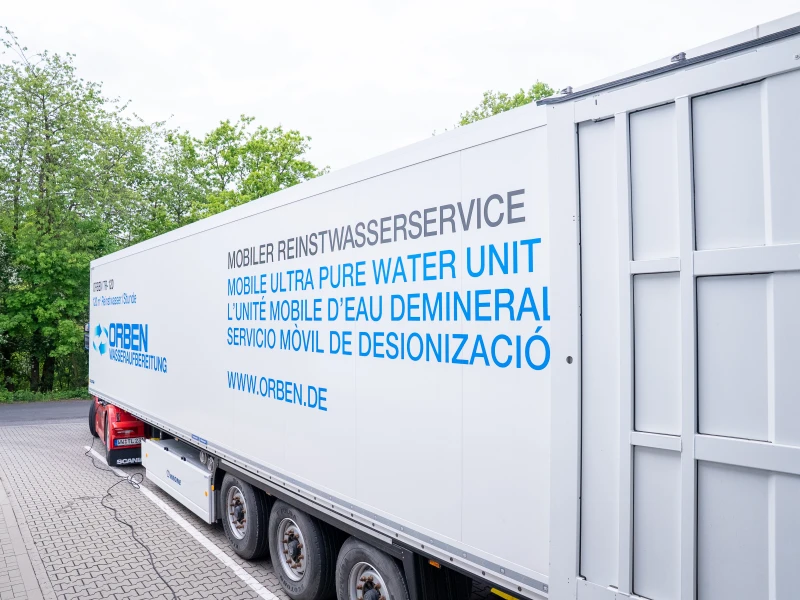
In emergency situations such as burst pipes, frost damage or system downtime, heating water correction must be carried out quickly. Mobile bypass systems are suitable for such applications because they can be connected without major installation costs. ORBEN offers trailer systems that are on site within a very short time and pump large quantities of water. Once the work has been completed, the units can be removed again. Inline systems, on the other hand, are intended for ongoing operation and only provide limited help in acute emergencies. For project characters with a clearly defined time frame (e.g. new buildings, renovations), the appropriate process can be selected based on the project plan.
The choice of materials in the heating system influences pH and desalination requirements. Aluminum alloys require a lower pH value (8.2—9.0), while steel and copper tolerate pH levels of up to 10.0. In mixed installations, the stricter standardized values should be met to prevent corrosion. The length of the pipe also influences residence times and thus the effectiveness of the process: In long networks, the pH value can homogenize more slowly. Inline systems continuously compensate for such fluctuations. In bypass mode, a tight cycle of control measurements is recommended.
A deaconess hospital in the greater Leipzig area was faced with the problem that its heating water significantly exceeded the VDI limits. The system consisted of around 285 kilometers of pipeline with a total volume of around 140,000 liters. Deposits and corrosion products reduced energy efficiency and, in the event of a failure, there was a risk of an interruption of the heat supply.
ORBEN used a mobile bypass desalination plant to condition the entire volume of water. First, water samples were taken, conductivity was measured and pH and hardness were determined. The mobile unit was then connected to flow and return lines via the KFE valves. The heating water was passed through a prefiltration and a mixed-bed cartridge in a closed circuit. Over several days, the guide value was gradually reduced to < 100 µS/cm and the pH value was brought within the normal range.
The benefits for the hospital were minimal operational interruption and rapid implementation: While the bypass treatment was ongoing, the heat supply could be maintained. After completion of the measure, the efficiency of the heating system improved and potential damage was prevented in the long term. In addition, a measurement report was created, which served as proof for insurers and auditors.
Frost damage in a production plant led to leaks and contamination in the heating circuit. The operators opted for a permanently installed inline correction unit because continuous operation was required without re-emptying. An ORBEN Inline Select 62 system was integrated into the return flow and permanently withdrew part of the heating water. The unit had a pre-filter stage and a mixbed cartridge for full desalination. An internal pump ensured that the system was not hydraulically affected.
The system pumped around 2100 liters per hour, which completely treated a large part of the heating water in a short period of time. Sensors monitored conductivity and pressure loss; as soon as the resin cartridge was exhausted, it was replaced by a regenerated reusable resin cartridge. Production was able to continue without interruption and, after preparation, the plant met the guideline limits of VDI 2035. Continuous data recording also made it possible to provide evidence to maintenance and quality management.
For district heating suppliers, the AGFW requirements are considered mandatory. The conductance limits of 10—30 µS/cm and the pH range of 9.0 to 10.0 in low-salt operation require continuous monitoring and readjustment. In practice, utility companies often use a combination of inline systems and mobile bypass units: The inline system ensures consistent water quality during normal operation. In the event of faults, repairs or network expansions, mobile bypass trailers are used to quickly bring newly fed water to the required quality or to specifically clean sub-circuits. This redundancy increases supply security and makes it easier to comply with standards.
In addition to heating water treatment, pure and ultrapure water applications are becoming increasingly important in future industries such as hydrogen and battery production. These industries require ultra‑pure water for electrochemical processes, which is why they often use ion exchangers and reverse osmosis. Bypass and inline methods provide an interface: In systems that require both process heat and ultrapure water, the existing desalination technology can also be used to condition the heating water. This creates synergies that reduce investment costs and improve sustainability. Asset managers should be aware of such cross-cutting technologies and pay attention to expandability when purchasing modular systems.
A systematic approach is required to operate a heating system in accordance with standards. The following steps provide structured guidance for operators and specialist planners. They can be used regardless of the chosen method, but must be adapted to the respective framework conditions.
Before choosing a treatment process, operators should determine the current state of the plant. This includes:
Representative water samples should be used to determine the current quality of the heating water. The following parameters are decisive:
The measured values form the basis for designing the desalination system and selecting the process.
Based on the above analysis, operators decide whether a bypass or inline procedure makes sense. Criteria include:
Regardless of the procedure, the heating water quality should be checked regularly. Measurement intervals depend on the type of system and the degree of wear of the resin. With inline systems, a weekly check of the conductivity and pH value is sufficient, while bypass users should measure frequently, especially during treatment. In addition, annual inspections are useful to check the tightness of the pipes, the condition of the pumps and the function of the measuring devices.
The economic analysis is a central criterion for asset managers. The bypass process requires a relatively low investment in a mobile treatment unit and is therefore suitable for one-off projects and smaller plants. The running costs result from the resin consumption, the use of personnel and the energy requirements of the mobile pumps. With very large volumes of water, resin consumption can be considerable, as the mixed-bed cartridges must be changed regularly. A cost calculation should therefore include the expected number of cartridge changes and regeneration costs.
The inline process requires a higher initial investment, as the device is firmly integrated into the system. Running costs, on the other hand, are more predictable because resin cartridges are changed at longer intervals and the energy consumption of the integrated pump is low. At the same time, the energy consumption of the entire plant is reduced, as corrosion-free pipes and heat exchangers enable more efficient heat transfer. This can put the initial additional costs into perspective. ORBEN systems rely on durable components and reusable resins, which further reduces overall costs.
In order to find the right solution, an evaluation matrix is ideal. Asset managers can weight the following parameters:
By combining these factors, companies can determine the economically viable process. In many cases, a hybrid solution makes sense: An inline system provides basic protection, while a bypass trailer is available for maintenance and emergencies.
The use of regenerative resins is a decisive contribution to sustainability. Instead of disposable cartridges, which are disposed of as hazardous waste after exhaustion, ORBEN uses reusable resins, which are regenerated and reused in a central plant after use. This circular principle reduces raw material consumption and reduces the ecological footprint. At the same time, disposal costs are falling. Operators can thus position themselves as responsible towards the environment and society.
Properly treated heating water reduces corrosion and deposit formation in heat exchangers. As a result, the heat transfer coefficient increases, flow temperatures can be reduced and fuel consumption is reduced. According to experts, clean systems lead to measurable savings in energy and CO₂. In combination with renewable energy and heat pumps, professional heating water treatment helps to achieve climate goals.
Economical use of water is particularly important in regions with scarce water resources. Inline systems avoid frequent draining and refilling of heating water, which reduces water consumption and effort. Mobile bypass units can clean the old heating water so that it can be reused. Asset managers should integrate these aspects into their sustainability strategy and work in partnership with their suppliers.
Modern desalination systems are increasingly equipped with IoT technologies. Sensors not only monitor conductivity and pH, but also temperature, flow rate, and even chemical parameters. The data is transferred to cloud platforms in real time and enables predictive maintenance. Algorithms allow anomalies to be identified at an early stage, minimizing corrosion risks and optimising maintenance operations. This digitalization fits in with the growing importance of data security and audit management in industrial plants.
As part of the energy revolution, heating systems are increasingly being operated in hybrid mode. Gas and oil boilers are supplemented by heat pumps, biomass boilers or solar thermal energy. The same water quality requirements still apply to these systems, as corrosion and deposit formation occur independently of the heat generator. Bypass and inline processes can be used in hybrid heating systems, but must be adapted to different operating modes (e.g. variable temperatures for heat pumps). Innovative desalination units are able to automatically adapt to changing operating conditions and dynamically regulate the pH value.
In the future, desalination systems may be able to automatically regenerate resins on site. This would further reduce transport routes and regeneration costs. At the same time, 3‑in‑1 systems could be created that combine bypass, inline and reverse osmosis functions. The modular design makes it possible to scale systems in accordance with current requirements. Research is also working on more environmentally friendly resins and on membranes that selectively remove specific ions.
Treating heating water is not an optional issue, but a mandatory task for operators of heating networks and technical systems. The VDI 2035 and AGFW FW 510 regulations provide clear limits that enable corrosion-free and efficient operating modes. Asset and operational managers are faced with the choice between the temporary bypass procedure and the permanently installed inline process. Both methods have specific benefits and challenges, which must be weighed against factors such as plant volume, business interruptions, budget, total cost of ownership, sustainability, and auditability.
The bypass is suitable for one-off treatments, emergencies and projects with manageable amounts of water. It offers flexibility and low investment costs. The inline process, on the other hand, ensures continuous water quality, minimizes downtime and makes documentation easier. The combination of both approaches makes it possible to operate heating systems in accordance with standards, economically and sustainably.
Companies should invest in analyzing their systems at an early stage in order to select the appropriate process and benefit from the advantages of corrosion-free heating over the long term. Ecological aspects such as the use of reusable resin, the reduction of water consumption and energy efficiency also play a role. A look into the future shows that digitization, IoT monitoring and modular systems will make heating water treatment even more efficient and sustainable. For planners and installers, the comparison of bypass and inline thus provides a valuable basis for decision-making when implementing projects in the area of heat supply.


.svg)