Ion exchange resins are the core components of many water treatment systems – whether they soften heating water, demineralize process streams, or provide ultrapure water for energy and battery production. Over time, their exchange capacity is depleted: foreign ions occupy the active resin sites, and the resin loses its capacity. While simple cartridges are disposed of after depletion, high-quality ion exchangers can be regenerated multiple times. For asset and operations managers in district heating networks, industrial and process plants, as well as for HVAC trades and building services planners, regeneration is therefore a strategic lever. Understanding the process and knowing standards like VDI 2035 and AGFW FW 510 can significantly influence operational safety, service life, and total operating costs.
The following article comprehensively explains how ion exchangers are regenerated, what legal frameworks apply, and why complete documentation is crucial for auditability and warranty claims. It draws on the content hubs "Ion Exchangers and Regeneration," "Heating Water and Regulations (VDI 2035/FW 510)," "Mobile Water Treatment and Trailer Systems," and "Sustainability and Reusable Resin."
Ion exchangers consist of macromolecular synthetic resins that absorb dissolved ions and exchange them for other ions of the same charge. In water treatment, a distinction is made between strongly acidic cation exchangers and strongly basic anion exchangers. Cation exchangers replace positively charged ions like calcium or magnesium with sodium or hydrogen ions; anion exchangers replace negatively charged ions like chloride or sulfate with hydroxide ions. Mixed-bed filters combine both resin types to achieve almost complete demineralization.
During operation, the resins become depleted by absorbing foreign ions. To restore their exchange capacity, they must be regenerated regularly. The Orben specialist portal describes that ion exchange resins become ion-loaded during operation and only regain full capacity through proper regeneration. Without regeneration, water quality decreases, conductivity increases, and there is a risk of scale buildup, corrosion, or microbial contamination – especially in hot water and district heating networks.
For heating water systems, standards such as VDI Guideline 2035 and AGFW Worksheet FW 510 define clear limit values. VDI Guideline 2035 requires an electrical conductivity of the circulating water of less than 100 µS/cm for low-salt operation and recommends a pH value between 8.2 and 10 for systems without aluminum (with aluminum 8.2–9). AGFW Worksheet FW 510 is even stricter: for low-salt operation, the conductivity must be between 10 and 30 µS/cm and the pH value between 9.0 and 10.0. If these parameters are exceeded, the corrosion rate increases, and the service life of boilers, heat exchangers, and pipes decreases. Especially for mixed-bed demineralization used for heating system fillings, these standards determine project eligibility and warranty claims.
VDI Guideline 2035 serves as a foundational document for hot water heating systems. Part 1 addresses the prevention of scale formation and defines limit values for the sum of alkaline earth metals and conductivity depending on boiler output. Part 2 focuses on corrosion prevention, specifies pH ranges, and limits oxygen content. VDI 2035 distinguishes between low-salt and high-salt operation; for low-salt operation, the conductivity of the circulating water at 25 °C must be below 100 µS/cm, while for high-salt operation, values between 100 and 1,500 µS/cm are permissible. For systems without aluminum, the guideline recommends a pH value between 8.2 and 10; with aluminum, the pH value must not exceed 9, as aluminum would otherwise corrode. The total hardness of the water must not exceed 0.11 °dH, depending on the boiler output.
AGFW Worksheet FW 510 supplements the VDI rules and is aimed at local and district heating networks. For low-salt operation, it requires an electrical conductivity between 10 and 30 µS/cm and a pH value between 9.0 and 10.0. For high-salt operating modes, it distinguishes several stages: 30–100 µS/cm is considered moderately saline, 100–1,500 µS/cm as high salinity. At the same time, the oxygen content in low-salt networks should be below 0.1 mg/l and in high-salt systems below 0.02 mg/l. These parameters serve as binding target values for asset managers and are crucial for planning regeneration intervals and selecting resin types.
For water softening systems in drinking water installations, the rules of the German Technical and Scientific Association for Gas and Water (DVGW) and the DIN EN 14743 standard also apply. The DVGW information on water treatment in drinking water installations points out that only devices complying with generally accepted technical standards may be used. The technical requirements for water softening systems are specified in DIN EN 14743 and DIN 19636-100; they focus on hygienic safety and minimizing salt and water consumption. Water softening systems that meet these standards must, among other things, provide for disinfection of the ion exchange resin during each regeneration and trigger an automatic forced regeneration after four days. Furthermore, the devices must contain a backflow preventer to prevent contamination of the drinking water.
For ion exchange resins, this means: the regeneration process must not only be chemically efficient but also hygienically flawless. Operators must ensure that regenerants and rinse water meet the requirements of the Drinking Water Ordinance and that regenerate wastewater is disposed of properly.
The regeneration of ion exchangers generates acidic or basic regenerates that may be contaminated with heavy metals. Decker Verfahrenstechnik points out that regeneration produces wastewater requiring treatment, which may not be discharged into the sewage system without appropriate chemical-physical treatment. In some applications, a permit or official notification is required. Mixed-bed applications, for example, can accumulate copper from tap water (up to 2 mg/L); the regenerate then easily exceeds monitoring values of 1 mg/L and may not be discharged unregulated. On the anion side, trimethylamine, which is odorous, forms during regeneration. Specialist companies like Orben meet these legal requirements through closed regeneration cycles, wastewater treatment, and proper disposal – an aspect to consider when choosing a service provider.
The regeneration of ion exchangers is divided into several phases, which differ depending on the resin type and operating mode. Generally, a distinction is made between the regeneration of cation exchangers, anion exchangers, and mixed-bed resins.
Cation exchangers are preferably regenerated with strong acids. Decker Verfahrenstechnik states that strongly acidic cation exchangers are usually regenerated with 8% hydrochloric acid (HCl); sulfuric acid is rarely used due to sulfate formation. Alternatively, sodium chloride can be used, but for high purity requirements, hydrochloric acid is the common choice. The regeneration process involves three washing phases:
During regeneration, the pH value and conductivity of the rinse water must be monitored to determine the end point of the rinsing process. After chemical regeneration, the resin can be conditioned, if necessary, by converting it into the form required for the specific application (e.g., H⁺-form or Na⁺-form).
Anion exchangers are regenerated with alkalis. According to GROSS Wassertechnik, sodium hydroxide or potassium hydroxide solution is used for the regeneration of anion exchangers. The alkali displaces the absorbed anions (e.g., chloride, sulfate) and charges the resin with hydroxide ions. Here too, several washing phases are required: a displacement phase, a slow rinse, and a fast rinse.
Mixed-bed filters, used for complete demineralization, consist of a mixture of cation and anion exchangers. For effective regeneration, the resins must first be separated, as the acidic regenerant for cations would destroy the anion resins and vice versa. Decker Verfahrenstechnik points out that mixed-bed ion exchangers are usually separated for regeneration first, and then the individual fractions are regenerated separately. After separate regeneration, the resins are recombined in defined mixing ratios and conditioned.
In regeneration, a distinction is made between co-current and counter-current processes. In the co-current process, raw water and regenerant flow in the same direction (usually from top to bottom). GROSS Wassertechnik explains that this process was primarily used at the beginning of ion exchange technology. A problem is the so-called "ion leakage": the lower resin layers are rinsed with already contaminated regenerant, which results in incomplete regeneration and requires higher chemical consumption.
In the counter-current process, the regenerant flows opposite to the service flow, for example, in the fluidized bed process. This ensures that the exhausted resin first comes into contact with fresh regenerant, reducing ion leakage and lowering chemical consumption. Therefore, counter-current regeneration has largely become standard practice.
The timing of regeneration depends on the loading state of the resin, the raw water quality, and the required pure water quality. A practical indicator is the increase in conductivity in the filtrate: GROSS Wassertechnik recommends regeneration when the conductivity downstream of the ion exchanger suddenly increases or the conductivity value approaches the standard limit for the respective application. For mixed-bed cartridges, exhaustion is indicated by a sudden sharp increase in the conductivity of the treated water. Modern systems use conductivity, pH, and flow measurements to automatically trigger regeneration cycles and optimize chemical consumption.
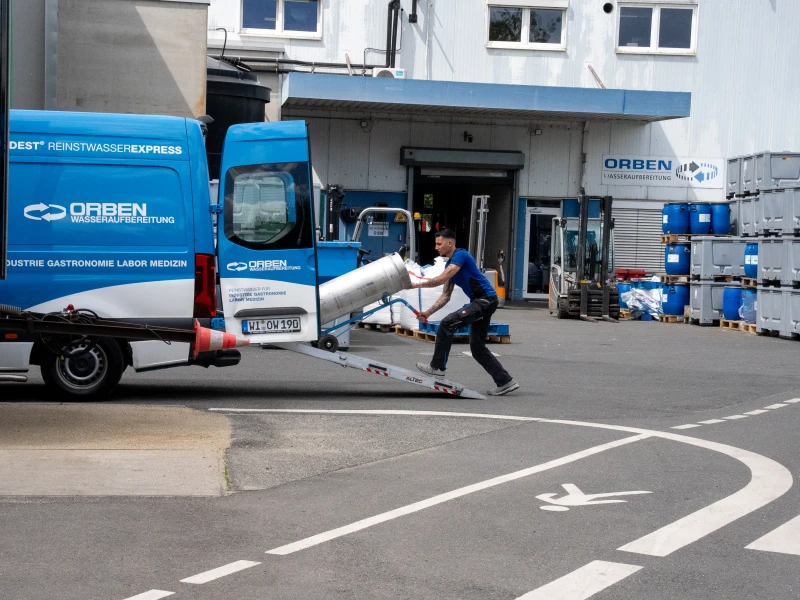
Orben has developed a uniform standard for regeneration, originally derived from the food and pharmaceutical industries. Each cartridge leaving the regeneration station is provided with a batch number and a filling date. Comprehensive documentation ensures that every batch can be traced. Every batch undergoes a 100% inspection; the results are logged and stored for future reference. This approach guarantees transparency and auditability throughout the entire lifecycle of the resins – regardless of whether the cartridge was filled in Wiesbaden, at the Meudt site, or in a decentralized service vehicle.
For asset and operations managers, this means: All regenerations are traceable, standard violations are documented, and can be demonstrated in case of warranty claims or certification audits.
According to DVGW information and DIN EN 14743, the ion exchange resin must be disinfected with each regeneration, and the systems must have mandatory regeneration cycles. Disinfection prevents the growth of microorganisms and Legionella, which could otherwise settle in the resin bed. Orben uses defined acid or alkali concentrations for this purpose and monitors conductivity, pH value, and regeneration parameters to ensure complete and hygienically safe regeneration.
For standard-compliant heating water and process water systems, VDI 2035 and AGFW FW 510 require continuous documentation of water quality. Operators should maintain an operations logbook in which conductivities, pH values, hardness levels, oxygen contents, and regeneration times are recorded. During audits, these records can demonstrate that the system was operated in accordance with standards. Modern digital systems allow measurement data to be automatically collected and transmitted in real-time to monitoring platforms.
The reuse of regenerated resins reduces waste and conserves resources. Orben emphasizes that the use of reusable resins – as opposed to disposable resins – minimizes waste and reduces the need for new production. Even in the case of the Frankfurt district heating project, special resins were refreshed after initial filling and practically reused indefinitely.
During regeneration at the Orben regeneration station, Rhine water is used for flushing and subsequently returned to the Rhine in a biologically improved state. This conserves drinking water and reduces environmental impact.
Regenerated resins have a longer lifespan and result in lower operating costs. Precise process control and controlled flow rates extend the lifespan of the resins and reduce chemical consumption. Compared to purchasing new cartridges, operators save on material costs, waste disposal fees, and transport. Counter-current regeneration reduces chemical consumption, contributing to further savings.
The total costs of a water treatment plant include not only acquisition but also operation, regeneration, energy, downtimes, and disposal. Longer resin service lives, standard-compliant parameters, and comprehensive documentation help preserve warranty claims, avoid downtimes, and significantly reduce the Total Cost of Ownership over the system's lifespan.
Anyone looking to have resins regenerated should carefully select a service provider. The following criteria are important from the perspective of the core persona:
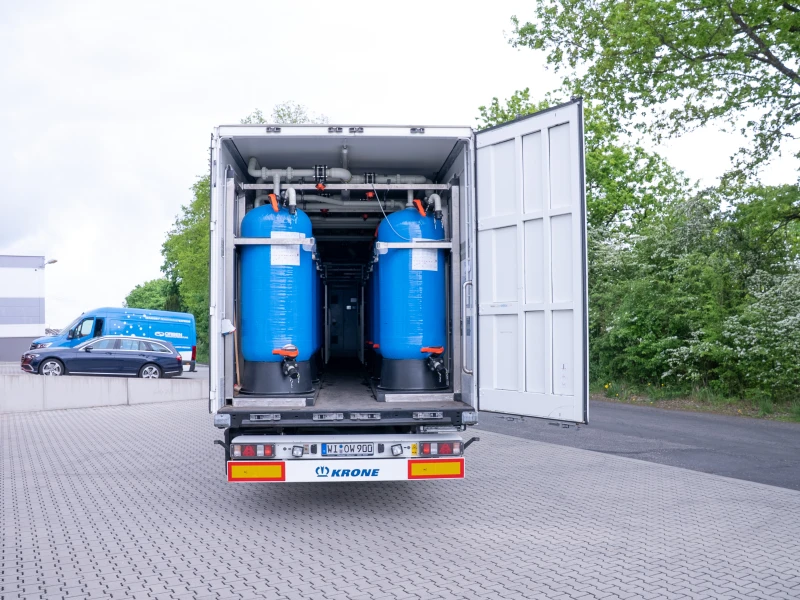
A special edition of Heizungsjournal documents the use of Orben trailer systems for filling a new district heating pipeline at Frankfurt Airport. The circulating water had to meet the strict requirements of AGFW Guideline FW 510 and be reduced to a conductivity of less than 30 µS/cm. The existing tap water, with a conductivity of over 300 µS/cm, was reduced to < 10 µS/cm using special mixed-bed filters and partial stream demineralization. Orben deployed the special trailer "TR 15000," which can produce up to 120,000 liters of ultrapure water per hour. After the initial filling, the mixed-bed filters were simply replaced; the exhausted special resins could be regenerated in Wiesbaden and reused almost indefinitely. This example demonstrates the importance of mobile systems for large-scale projects and how strategic regeneration combines operational safety and sustainability.
In power plants, battery factories, and chemical facilities, the quality of feedwater directly impacts efficiency and product quality. Ion exchangers are used here for softening, decarbonization, nitrate or sulfate removal, and complete demineralization. During complete demineralization, resins are subjected to high stress; therefore, separate and careful regeneration is essential. Counter-current regeneration allows operators to reduce chemical consumption while achieving the highest water qualities.
For operators of heating and district heating networks, pH, conductivity, and oxygen limit values are central. Standard VDI 2035 recommends a conductivity of < 100 µS/cm and pH values between 8.2 and 10. For systems with aluminum components, the pH value must be between 8.2 and 9. Regenerated mixed-bed resins enable these values to be achieved by almost completely removing the sum of alkaline earth metals and other ions. Regular measurements and timely resin regeneration prevent scale formation and corrosion and secure the manufacturer's warranty.
Industry trends such as hydrogen electrolysis, battery cell manufacturing, and semiconductor production place the highest demands on water quality. Pure and ultrapure water must be free of ions, organic substances, and particles. Ion exchange combined with reverse osmosis and electrodeionization (EDI) are used here. Regenerated anion and cation resins are essential for stable EDI processes and for the economical production of high-purity water. A reliable regeneration partner ensures, through batch management and hygiene concepts, that the resins meet the high purity requirements.
Controlling conductivity, pH value, and hardness is crucial for determining regeneration times and complying with standards. Modern systems feature online sensors and data loggers that automatically monitor limit values from VDI 2035 and FW 510. If exceedances occur, forced regeneration is triggered – this requirement is also stipulated in DIN EN 14743.
Digital platforms enable the linking of measurement data with operational parameters such as flow rate or temperature. From this data, algorithms can make predictions about the resin's loading status and plan regenerations proactively. For asset managers, this reduces unplanned downtimes and facilitates audits.
Water treatment is constantly evolving. Particularly relevant for the future of ion exchangers and their regeneration are:
The regeneration of ion exchangers is far more than just a chemical process – it is an integral part of operational safety, compliance with standards, and sustainability. Standards such as VDI 2035 and AGFW FW 510 specify clear limit values for conductivity, pH value, hardness, and oxygen content, which can only be met with well-maintained and regularly regenerated resins. The regeneration process differentiates between cation and anion exchangers and requires several washing phases; counter-current methods reduce chemical consumption.
Comprehensive documentation – such as the ORBEN Standard with batch number, filling date, and 100% control – is a prerequisite for auditability and warranty claims. Environmental regulations and DVGW rules require disinfection with every regeneration and proper wastewater treatment. Those who consider these aspects benefit from longer resin lifetimes, lower operating costs, and water quality compliant with standards.
In the age of the energy transition, demands are growing: heating networks, hydrogen plants, and battery factories require large quantities of ultrapure water. Mobile trailer systems deliver up to 120,000 liters per hour in emergencies. Reusable resins, digital monitoring, and intelligent regeneration processes ensure that operators can work reliably even on demanding projects.


.svg)