In modern heating and district heating systems, water circulates as a heat transfer medium. This medium is subjected to high thermal and chemical stress: temperature fluctuations, different materials (steel, copper, aluminum, stainless steel), and long operating times promote corrosion, scale deposits, and sludge formation. The VDI Guideline 2035 and the AGFW Worksheet FW 510 therefore define clear limit values for the composition of heating and circulating water. They specify the maximum permissible electrical conductivity, total hardness, and pH value to prevent damage. Adhering to these parameters extends the service life and efficiency of the systems; manufacturers provide warranties, and operators fulfill their documentation and audit obligations.
This article is aimed at asset and operations managers for heating networks, energy and process plants, as well as HVAC professionals and building services planners. It explains the limit values for conductivity, hardness, and pH value according to VDI 2035 and AGFW FW 510, demonstrates their mutual interactions, and provides practical advice on water measurement and treatment. Furthermore, it places these requirements in a business and sustainability context: compliance with standards increases operational safety, reduces Total Cost of Ownership, and promotes sustainable projects through reusable resin and trailer systems. Finally, the article presents ORBEN Solutions that treat heating water economically, ecologically, and in compliance with standards.
The VDI Guideline 2035 is the most important German regulatory framework for the protection of hot water heating systems. It consists of two parts: Part 1 addresses the prevention of scale, and Part 2 the prevention of corrosive damage. In the latest version (valid since March 1, 2021), limit values were updated, and the topics of scale and corrosion were merged. Among other changes, the limit value for complete softening was raised to 0.3 °dH, and the pH restriction for aluminum materials was increased to 9.0.
VDI 2035 distinguishes between low-salt and high-salt operating modes. In low-salt operation, water is freed from soluble ions through desalination (demineralization or softening plus pH value regulation) to such an extent that the electrical conductivity is below 100 µS/cm. The guideline recommends a pH value between 8.2 and 10 for systems without aluminum and between 8.2 and 9.0 for systems with aluminum materials; the total hardness should be ≤ 0.3 °dH. For smaller systems with low specific system volume, higher hardness values are permissible; for heating capacities up to 50 kW, water hardness must not exceed 16.8 °dH, while systems over 600 kW only accept < 0.11 °dH. In practice, this magnitude corresponds to a hardness limit of approximately 0.5 °dH. Overall, the larger the system and the higher the specific water content, the lower the hardness of the heating water must be to prevent scale formation in heat exchangers.
VDI 2035 also stipulates that operators must maintain a system logbook. Fill and make-up water, as well as heating water, must be measured and documented during initial filling and after 8–12 weeks. Thereafter, inspections should be carried out at least annually. The responsibility for complying with the limit values lies with the operator, but planners and HVAC specialist companies are also held accountable, as they fill and maintain the system. If the limit value for water hardness (< 0.11 °dH), pH value (8.2–10.0), or conductivity (< 100 µS/cm) is exceeded, the warranty of many manufacturers becomes void.
The AGFW Worksheet FW 510 applies to district heating systems. It specifies stricter values because district heating networks have larger volumes and often a greater variety of materials. Table 6.1 of the worksheet (guideline values for directly or indirectly heated systems) distinguishes between low-salt and high-salt circulating water. In low-salt networks, electrical conductivity should be between 10 and 30 µS/cm, the pH value in the range of 9.0–10.0, and oxygen content below 0.1 mg/l. Hardness (sum of alkaline earth metals) must not exceed 0.02 mmol/l (≈ 0.11 °dH). In high-salt operating mode, conductivity values of > 30–100 µS/cm (up to 1,500 µS/cm for very high-salt systems) are tolerated, provided oxygen ingress is excluded and the pH value is set to 9.0–10.5. The worksheet allows higher pH values because the high salt content reduces electrochemical corrosion current; at the same time, it demands strict monitoring of oxygen content to prevent gas bubble formation and thus operational disruptions.
For operators in Switzerland and Austria, the Swiss regulatory framework SWKI BT 102-01 and the Austrian ÖNORM H 5195-1 are relevant. SWKI BT 102-01 requires heating water to have a hardness of less than 5 °f (≈ 2.8 °dH), with make-up water after commissioning needing to be below 1 °f hardness and 100 µS/cm; the pH value may be between 8.2 and 10.0. ÖNORM H 5195-1 sets the pH limit range depending on the aluminum content to 8.0–9.5 (without aluminum) or a maximum of 8.5 for aluminum materials. These national regulations illustrate that the operation of large heating networks is subject to strict guidelines even outside Germany – an aspect that must be considered in international projects.
Water hardness is primarily determined by dissolved calcium and magnesium ions. These alkaline earth metals form sparingly soluble carbonates (scale) at high temperatures. Even a one-millimeter layer of scale can reduce heat transfer by up to ten percent. In heating networks with large heat transfer surfaces and narrow pipe cross-sections, scale formation leads to increased pump current, losses, and in extreme cases, pipe rupture. VDI 2035 therefore sets limit values for total hardness, which are based on heating capacity and specific system volume. Small systems with heating capacities < 50 kW may tolerate a total hardness of up to 16.8 °dH, provided the boiler heating surface is at least 20 l/kW. For larger systems, the permissible values decrease drastically; from 600 kW, only 0.02 mol/m³ (≈ 0.11 °dH) is allowed.
For practical purposes, a titrimetric determination of total hardness is sufficient. A sample is titrated with a color indicator and a complexing agent until the color changes. The number of drops allows the hardness to be calculated in degrees German hardness (°dH). KW-Energie-Informationen emphasizes that in practice, an accuracy of 0.1 °dH can be achieved if double the water quantity and complexometric titration are used. For routine checks, a value of < 0.5 °dH is sufficient. In large industrial plants, hardness can also be analyzed using ion chromatography or ICP spectroscopy; these methods provide more precise results and are suitable for analytical laboratories.
Softening removes calcium and magnesium through ion exchange and replaces them with sodium. This reduces scale formation; however, the water's conductivity remains almost unchanged or even increases because sodium ions remain in the exchange process. Full demineralization (desalination) removes all cations and anions, significantly reducing conductivity, and the water is referred to as "low-salt." Both processes require ion exchange resins. While disposable resin cartridges are common in households, professional operators are increasingly relying on reusable resin. Regenerable mixed-bed resins, such as the Vadion pH-Control mentioned in the source, can achieve conductivities < 100 µS/cm while simultaneously adjusting the pH value to the required range. The technology becomes sustainable when the resin is regenerated after use: ORBEN operates Europe's largest regeneration station and offers a Resin Express service that exchanges exhausted resins on-site and takes them for regeneration. This reduces resource consumption, and operators benefit from consistent capacities.
Electrical conductivity indicates the concentration of dissolved ions in water. It is measured in microsiemens per centimeter (µS/cm). The higher the salinity, the higher the conductivity. Conductivity and corrosion are directly related: dissolved salts enable the flow of electrochemical current, which accelerates corrosion processes. Low-salt operation modes with conductivity values < 100 µS/cm significantly reduce electrochemical corrosion current, which is why they are recommended as a standard by VDI 2035. In local and district heating networks, the AGFW worksheet goes even further: conductivity values of 10–30 µS/cm are required here. These low values make it easier to tolerate higher oxygen concentrations because charge transport remains limited.
Conductivity measurements are easy to perform with portable digital conductivity meters. It is important that the probe is regularly calibrated and that no foreign ions (e.g., cleaning agents) affect the result during measurement. For very low conductivity values (< 20 µS/cm), AGFW guidelines warn against measurement errors in flow measurements based on the MID principle (Magnetic-Inductive). In these ranges, water-level-controlled electrodes in steam generators may no longer function reliably. Operators should therefore use alternative level sensors or redundant measurement systems.
The conductivity of the circulating water strongly depends on the quality of the make-up water. In low-salt operation, make-up water must only be demineralized or softened and desalinated, otherwise the conductivity value will increase. According to AGFW FW 510, limiting electrical conductivity to < 100 µS/cm is a prerequisite for tolerating higher oxygen levels. In high-salt operation, oxygen ingress must be strictly avoided: otherwise, the combination of high salinity and oxygen can greatly accelerate corrosion. Make-up water quantities should remain as low as possible; leakage losses must be quickly remedied, and a refill unit should be equipped with mixed-bed cartridges that immediately adjust the make-up water's conductivity value. ORBEN offers complete refill units with system separators and mixed-bed resin, which also meet the requirements of the drinking water protection standard EN 1717.
The pH value is a measure of the acidity or alkalinity of water. In heating systems, a slightly alkaline range is desired because it promotes the formation of a protective oxide layer on ferrous materials and reduces the solubility of aluminum. A pH value that is too low dissolves metals from pipes and leads to corrosion damage; a pH value that is too high can destroy the passive layer or attack aluminum materials. VDI 2035 therefore specifies a permissible range of 8.2–10.0 (for materials without aluminum) and 8.2–9.0 (for aluminum). The KW-Energie guideline emphasizes that the pH value at 20 °C should be between 8.2 and 10.0 and must be limited to a maximum of 9.0 when aluminum is used.
The AGFW worksheet FW 510 specifies the pH range for low-salt district heating networks as 9.0–10.0; for high-salt operating modes, pH values up to 10.5 are permissible, as long as there is no oxygen in the system. For indirectly heated systems, these values may be deviated from; in practice, for indirect heating, pH values from 8.5 are sufficient to minimize the risk of corrosion.
The pH value can be determined with electrochemical measuring devices; regular calibration with standard buffers is mandatory. To adjust the pH value, alkaline additives are used. The AGFW draft recommends sodium hydroxide (NaOH) or trisodium phosphate (Na₃PO₄). Both increase salinity – slightly with sodium hydroxide, more significantly with trisodium phosphate – and thus affect conductivity. Therefore, the pH value is initially raised only to the range of 8.2–9.0 and then stabilized. It is important that the system is free of cleaning agent residues, glycol, and microorganisms; otherwise, the pH value is difficult to stabilize. Mixed-bed resins with integrated pH regulation can automatically correct the pH value during flow; ORBEN relies on such resins to achieve low-salt operation without chemicals.
The three parameters – conductivity, water hardness, and pH value – influence each other. Softening reduces hardness but can increase conductivity because sodium ions remain in the water. Demineralization reduces both hardness and conductivity; the result is low-salt water with a low corrosion tendency. The pH value strongly depends on the ratio of ions; at very low conductivity values, it is difficult to measure and can fluctuate if carbonic acid (CO₂) enters the system. Excessive pH increase enhances the solubility of aluminum, while a pH value that is too low attacks iron and copper. In low-salt systems with conductivity values < 100 µS/cm, pH values around 8.5–9.0 are considered ideal to create a balance between corrosion protection and material compatibility. In high-salt systems, higher pH values are necessary because the higher salinity dampens the corrosion current.
Heating systems consist of various materials. Steel, cast iron, and copper are compatible with weakly alkaline water; however, excessively high pH values lead to the detachment of protective layers. Aluminum materials are particularly sensitive: at pH values above 9, corrosive aluminates form. VDI 2035 therefore limits the pH value to 8.2–9.0 in the presence of aluminum. In district heating systems, aluminum alloys in the primary circuit can also be operated at pH 10, provided the manufacturer's specifications allow it. Manufacturers of combined heat and power plants (CHPs) often demand stricter pH ranges (8.2–9.0) and hardness values (< 0.11 °dH) to avoid jeopardizing their warranty. Operators should record the material lists of their systems and adjust pH regulation accordingly.
The standards emphasize the importance of regular measurements and documentation in the plant logbook. During initial filling, water hardness, conductivity, and pH value should be measured in both the filling water and the make-up water. A second measurement is taken after 8–12 weeks, as the pH value stabilizes in the system and residual substances are released from the materials. After that, the heating water quality is checked at least once a year. For district heating contracts, quarterly analyses are often agreed upon. The measured values must be documented and signed to prove compliance with limit values in the event of a warranty claim.
Portable combination devices are suitable for electrical conductivity and pH value. They measure both parameters simultaneously and are equipped with interchangeable electrodes. Hardness is determined on-site using titration or test strips; for exact values, samples can be analyzed in the laboratory using ion chromatography. For district heating systems requiring extremely low conductivity values of 10–30 µS/cm, high-resolution measuring devices with temperature compensation are necessary. An additional oxygen analysis (e.g., with polarographic or optical sensors) is useful, as AGFW FW 510 specifies oxygen limit values of < 0.05 mg/l or < 0.1 mg/l.
Compliance with standards can only be proven if measurements are logged and deviations are documented. The plant logbook serves as a central documentation tool. In addition to the measured values, it should also record the date of filling, the replacement of ion exchange resins, make-up water quantities, and any chemical additives. For B2B operators, this complete documentation is also important in the context of product liability. In warranty cases, the operator can prove compliance with the guidelines; at the same time, it protects them from claims for damages.
The most sustainable method for obtaining low-salt water is ion exchange. Mixed-bed cartridges remove both cations and anions, providing demineralized water with conductivity values below 100 µS/cm. To operate sustainably, operators should rely on regenerable multi-use resins. ORBEN operates Europe's largest regeneration station; exhausted resins are collected, reprocessed, and reused. Regeneration conserves resources and reduces waste. The multi-use resin strategy thus lowers overall operating costs compared to single-use cartridges, which must be disposed of after use. Another advantage: the capacities of regenerated resins remain constant, reliably keeping conductivity below target levels during operation.
In existing plants, especially in district heating networks, heating water can be treated using the bypass method during ongoing operation. A partial flow from the circuit is directed through a mixed-bed cartridge; this gradually reduces conductivity, hardness, and pH value to the desired levels. The Evangelisches Diakonissenkrankenhaus Leipzig used this method to demineralize 140 m³ of circulating water during clinic operation, thereby obtaining standard-compliant heating water according to VDI 2035 – a project that ORBEN realized with the help of mobile desalination systems. In the inline method, the ion exchange unit is integrated directly into the main flow. This method is particularly suitable for smaller systems and ensures that any make-up water is treated immediately. Both approaches can be combined with pH regulators and measuring devices, allowing operators to continuously monitor water conditions.
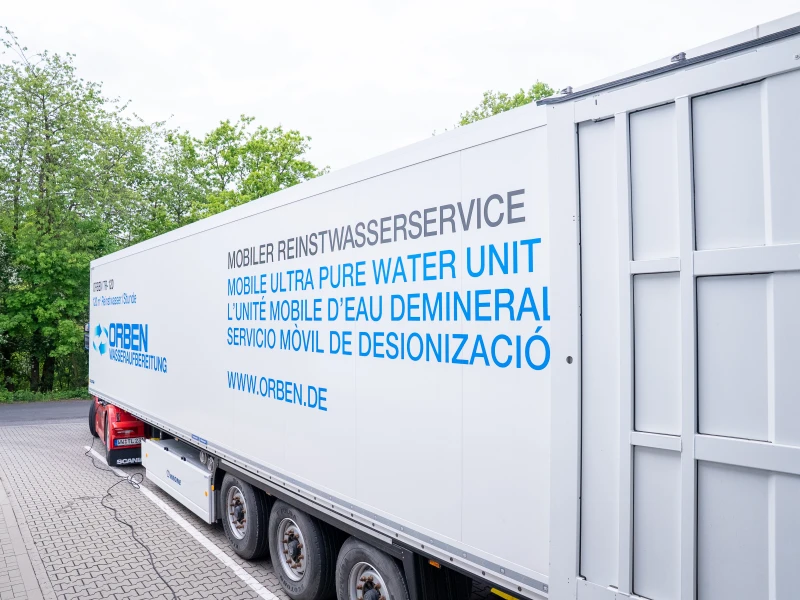
For large-scale plants, projects with high water demand, or emergencies (e.g., after ingress of foreign water), mobile trailer systems are the first choice. The AGFW guideline requires rapid restoration of target values in the event of foreign water ingress. Mobile trailer units supply large quantities of demineralized water (10,000–60,000 l/h per trailer) and can be connected to heating water networks on-site. ORBEN offers such trailer systems with integrated measurement and control technology. They are also suitable for temporary projects in industry or the energy sector, such as during overhauls of power plant boilers or for supplying ultrapure water to hydrogen and battery production facilities. For operators, this means flexibility and security: they can respond to temporary peaks, commissioning, and emergencies without having to maintain their own large-scale plants.
The energy transition brings new demands on water quality. Hydrogen electrolyzers and battery production facilities require ultrapure water (Type I) with conductivity values in the low microsiemens range. ORBEN provides customized ultrapure water concepts (reverse osmosis plus electrodeionization) tailored to user needs. For operators of heating networks, integrating ultrapure water systems can be beneficial if process chains (e.g., gas and steam turbines, fuel cells) are to be connected. However, the focus remains on heating water treatment according to VDI 2035, from which ultrapure water technologies emerge.
Standard-compliant heating water treatment is initially an investment. However, it reduces operating costs in the long term. Hard or saline waters cause scale and corrosion, leading to efficiency losses and repairs. Even a one-millimeter layer of scale leads to an efficiency loss of up to ten percent. If these damages are avoided, energy costs decrease significantly. The use of regenerable multi-use resins saves material and disposal costs. Furthermore, resin cartridges can be used multiple times, reducing the consumption of plastic and resin in the cycle. Documenting water quality increases legal certainty and protects against expensive warranty claims – an economic factor not to be underestimated.
Sustainability is an important decision-making factor for asset managers. The regeneration of ion exchange resins is resource-efficient: several kilograms of plastic and resin are saved per regenerated cartridge, and the brine generated during exchange can be disposed of in a controlled manner or returned to process cycles. ORBEN relies on multi-use resin and operates resin regeneration stations nationwide. For customers, this means simple logistics: the Resin Express picks up exhausted cartridges and returns regenerated ones. This way, even large quantities of heating water can be treated sustainably. For district heating networks, which often contain several million liters of water, this is an important contribution to reducing environmental impact.
Heating and process systems often require maintenance or refurbishment within tight timeframes. Mobile trailer systems enable a quick and flexible response for projects, construction sites, or emergencies. In cases of external water ingress, leaks, or dismantling, new circulating water compliant with VDI 2035 can be supplied immediately. Bypass and inline systems allow for water treatment without interrupting operations – a crucial advantage for hospitals, data centers, or industrial plants. ORBEN solutions combine this flexibility with close integration into the three-tier HVAC sales network and MEP planning.
The limit values for conductivity, hardness, and pH according to VDI 2035 and AGFW FW 510 are not an end in themselves. They ensure the functionality of modern heating and district heating systems, prevent corrosion, scale formation, and sludge, and ensure efficient heat exchange. Asset and operations managers who adhere to these values benefit from higher operational reliability and lower total operating costs. Compliance with these standards is also a prerequisite for warranty claims and technical approvals.
By using regenerable ion exchange resins, modern bypass and inline processes, and mobile trailer systems, the limit values can be reliably and sustainably achieved. The combination of measurement and documentation requirements, sustainable technology, and professional service creates transparency and auditability – an important foundation for the energy transition and future-proof heating networks. ORBEN supports planners, specialist tradespeople, and operators with suitable products, services, and consulting, ensuring that standards are put into practice.


.svg)