The ORBEN bypass demineralization is a process for heating water treatment where heating water is passed through a mobile or stationary treatment system during ongoing or preparatory system operation. This reduces salts, hardness formers, suspended solids, and magnetite without the entire heating system needing to be completely drained.
This is particularly relevant for HVAC specialists, service technicians, building services planners, and operators of larger heating systems. Modern heating systems react more sensitively to unsuitable fill and make-up water than older systems. Heat generators, heat pumps, condensing boilers, buffer tanks, high-efficiency pumps, control valves, and plate heat exchangers now operate with tight tolerances. Even minor deposits, increased conductivity, incorrect pH values, or magnetite can reduce efficiency and cause malfunctions.
The search intent behind this topic is clear: Anyone searching for ORBEN bypass demineralization wants to know, what the process technically does, when it is used, which standards are relevant, and which ORBEN systems are suitable for it.. That is exactly what this article is about.
The exclusive focus is on the HVAC and building services context: heating water, fill water, make-up water, replenishment, VDI 2035, DIN EN 14336, measurement, and documentation. It does not cover power plants, process water, laboratory water, or industrial ultrapure water applications. This ensures the article remains technically precise and directly useful for the target audience.
The ORBEN bypass demineralization is the treatment of heating water via a separate partial flow of the heating system. The water is drawn from the heating circuit, passed through a treatment system, and then returned to the heating circuit. This can reduce conductivity, hardness formers, dissolved salts, magnetite, and suspended solids.
In this context, the term "bypass" means: The entire system water is not replaced all at once. Instead, a partial flow is repeatedly passed through the treatment. This allows the water quality to be improved step by step. This is particularly interesting for existing systems, larger heating circuits, buffer tanks, or systems with existing sludge.
In everyday HVAC operations, bypass demineralization is primarily used when:
The key advantage: Bypass demineralization combines technical water treatment with practical site logistics. The specialist company can connect the system, circulate, filter, demineralize, measure, and document the water. This transforms a mere filling process into a controlled one.
Bypass demineralization is important because heating water is constantly in contact with all water-carrying components during operation. If this water is not suitable, it affects not only laboratory values but also the system itself: heat exchangers, pumps, valves, seals, storage tanks, control devices, and operational safety.
VDI 2035 addresses the prevention of damage in hot water heating systems, particularly due to scale formation and water-side corrosion. The VDI describes the scope of application for hot water heating systems according to DIN EN 12828 within a building with an intended flow temperature of up to 100 °C.
The most important risks are:
For operators of larger heating systems, bypass demineralization is also economically relevant. A poorly treated system can consume more energy, require more maintenance, and fail prematurely. For specialist tradespeople, it is a tool to ensure a smooth handover and demonstrably meet manufacturer requirements.
ORBEN bypass demineralization is based on a simple principle: heating water is treated in circulation until the relevant parameters are within the desired range. What's crucial is not only the resin, but the interplay of treatment, flow, filtration, magnetite separation, measurement, and documentation.
Electrical conductivity indicates how many dissolved ions are present in the water. High conductivity means a high salt load. In low-salt operation, conductivity is reduced to minimize electrochemical corrosion processes.
For practical purposes, conductivity is particularly valuable because it can be measured quickly on-site. It also indicates whether a demineralization cartridge is still working effectively. If the conductivity at the outlet rises again, the resin is exhausted or the flow rate does not match the treatment process.
Total hardness describes the proportion of calcium and magnesium compounds. These hardness-forming substances are relevant for scale formation. During full demineralization, not only calcium and magnesium are removed, but also other dissolved salts such as chlorides, nitrates, and sulfates are reduced. ORBEN describes THERMION 2035 pH conform as a mixed-bed ion exchange resin for the full demineralization of heating water according to VDI 2035, which removes dissolved salts and hardness-forming substances.
The pH value is an operating parameter, not an isolated aesthetic value. It must match the material mix of the system. Aluminum components, in particular, require attention because excessively high pH values can be critical for the material. At the same time, an excessively low pH value can promote corrosion.
Important in practice: Fully demineralized water may initially have low conductivity after treatment, but the pH value can change after contact with system materials and residues. Therefore, measurements should be taken again after filling and circulation. This logic corresponds to the recommendation already included in the existing article, which advises evaluating the pH value not in isolation, but together with conductivity, hardness, oxygen ingress, and replenishment.
Magnetite is formed by corrosion processes in iron-containing system components. It is particularly critical for modern high-efficiency pumps because magnetic particles can accumulate on strong magnets. Heat exchangers, valves, and control elements can also be affected by particles.
Therefore, pure demineralization is often not sufficient for existing systems. The heating water should be filtered first or in parallel. ORBEN describes THERMOSTIL ULTRAFLEX as a mobile heating water filter unit for the removal of magnetite, solid particles, and suspended solids from the system water. Afterward, a THERMION 2035 demineralization cartridge can be used in bypass operation.
The flow rate must match the treatment process. If water is passed through the resin too quickly, the target quality may not be achieved. If the process is too slow, the on-site working time becomes unnecessarily long. Therefore, system volume, raw water quality, existing conductivity, temperature, and target values are important.
According to ORBEN, THERMOSTIL mobil 4000 is designed for systems with up to approximately 6,000 liters of water content, including buffer tanks; its circulation capacity during filtration is specified at approximately 1,200 l/h. THERMOSTIL mobil 4000 PRO is designed for medium to large systems and is described with a circulation capacity in bypass mode of approximately 2,400 l/h.
A common mistake is that fill water is taken directly from the drinking water supply without checking hardness, conductivity, and pH value. This can already be problematic for small systems, but can become significantly more expensive for larger heating systems with buffer tanks. The specialist company should know what raw water is present and what target values apply before filling.
Softening reduces hardness-forming substances but does not remove all dissolved salts. Conductivity often remains comparatively high. Therefore, in many HVAC applications, demineralization is the technically superior solution when low-salt operation is desired or required. The difference between "soft" and "low-salt" should be clearly explained during customer consultations.
Especially during renovations, boiler replacements, or heat pump installations, contaminated existing water often remains in the system. If magnetite and sludge are not removed, they enter new components. The new heat generator is then installed cleanly but operated with old dirt. For HVAC companies, this is a common cause for complaints.
Mixed-bed resin has a limited capacity. The capacity depends on the raw water quality and the target conductivity. If the cartridge is operated for too long, the conductivity at the outlet increases. Therefore, continuous monitoring is required. ORBEN systems use conductivity measurement or conductivity display for capacity monitoring.
Many damages do not occur during initial filling, but over months or years due to unsuitable replenishment. Each replenishment can introduce new salts, hardness-forming substances, and oxygen into the system. Therefore, a replenishment unit with a water meter, demineralization, and documentation is not a comfort accessory, but part of the operating concept.
Without a measurement log, water treatment remains an assertion. However, for specialist companies, operators, and manufacturers, proof is what matters. At a minimum, the fill water volume, conductivity, pH value, hardness, date, measuring device, treatment method, resin change, and replenishment volumes should be documented.
Immediately after demineralization, the pH value can appear different than after circulation, heating, and contact with system materials. Therefore, the pH value should not be measured only once directly during filling. A control measurement after a stabilization phase is technically advisable.
For this article, only regulations relevant to HVAC and building services are relevant. It does not concern district heating, power plants, laboratories, or pharmaceuticals.
VDI 2035 is the central guideline for preventing damage in hot water heating systems. It addresses damage caused by scale formation and water-side corrosion and provides recommendations for hot water heating systems within buildings.
For HVAC specialist companies, this means: Fill water, make-up water, and heating water must be considered in such a way that scale formation and corrosion are minimized. This includes the assessment of hardness, conductivity, pH value, oxygen ingress, and materials.
DIN EN 14336 addresses the installation and commissioning of water-based heating, cooling, and domestic hot water systems in buildings. The DIN-Media page for the draft DIN EN 14336:2024 describes requirements for the installation and commissioning of such systems up to a maximum operating temperature of 110 °C.
This is relevant for bypass demineralization because filling, flushing, commissioning, testing, and handover should not be considered separately. Water quality is part of a proper commissioning.
When refilling from the potable water network, the potable water installation must be protected. ORBEN documents describe SERASTIL ready versions with an automatic filling valve, a type BA system disconnector, and a demineralization cartridge. The separation of the potable water line and the heating system is achieved via the integrated system disconnector.
In practice, this means that replenishment is not just a matter of water quality, but also of the hygienically and standard-compliant separation of systems.
Not every heating system requires the same solution. The correct choice depends on the system volume, the condition of the heating water, the raw water quality, the timeframe, and future replenishment.
MethodSuitable forAdvantageLimitationSimple Filling CartridgeSmall to medium-sized fillingsLow effort, easy handlingLimited capacity, little process control for larger systemsMobile Bypass DemineralizationNew filling, renovation, larger existing systemsFiltration, circulation, demineralization, measurement in one processRequires professional connection and monitoringBypass Filtration before DemineralizationSludged existing systemsRemoves magnetite, suspended solids, and solid particlesDemineralization may need to be supplemented separatelyStationary Bypass DemineralizationLarge existing systems with recurring demandContinuous monitoring and automatic treatment possibleFixed installation and design requiredReplenishment UnitRegular make-up water quantitiesEnsures future replenishmentDoes not replace treatment of contaminated existing water
The decision should not be based on gut feeling. A pragmatic approach is as follows:
A specialist HVAC company is modernizing the central heating system of an apartment building with commercial units on the ground floor. The old heat generator is being replaced with a modern condensing boiler system, including a buffer tank and high-efficiency pumps. The piping network largely remains in place. The system volume is approximately 5,500 liters.
Before commissioning, the specialist company checks the existing heating water. The conductivity is significantly elevated, black particles are found in the filter, and the water appears visibly contaminated. Simply refilling the system would mean that some of the old deposits would remain in the system or quickly re-enter the new components.
The specialist company therefore opts for a bypass process. First, the heating water is routed through filtration and magnetite separation. Afterwards, demineralization is integrated via a suitable treatment cartridge. During the process, conductivity, pH value, circulation flow rate, and the condition of the filter are monitored.
After treatment, the system is commissioned. The measured values are documented in the system logbook. The operator also receives the recommendation to perform a check measurement after an operating phase and to only add makeup water in the future via a suitable makeup water unit.
The result: The new system does not start with contaminated existing water, the specialist company can demonstrably prove the water quality, and the operator has a clear basis for maintenance and makeup water.
ORBEN supports HVAC and building services professionals with a range focused on heating water, including mobile and stationary systems, mixed-bed resin, filtration, measurement and testing technology, makeup water solutions, and service.
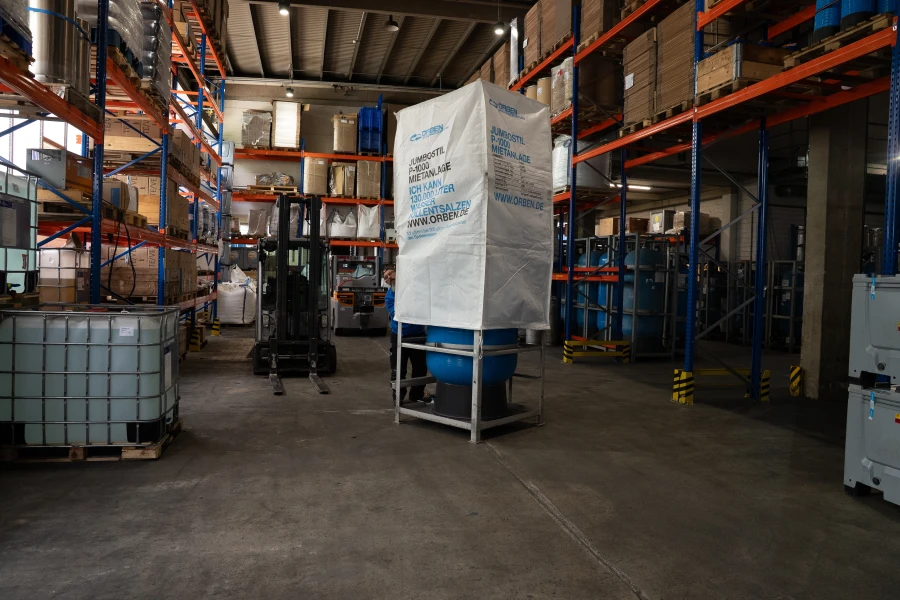
THERMOSTIL mobil is designed for mobile heating water treatment using the bypass method. The systems combine filtration, magnetite separation, circulation, water meters, treatment cartridges, and measurement. According to ORBEN, THERMOSTIL mobil 4000 is suitable for systems with a water content of up to approximately 6,000 liters, including buffer tanks, while THERMOSTIL mobil 4000 PRO is intended for medium to large systems.
THERMOSTIL ULTRAFLEX is particularly relevant when existing water is contaminated with magnetite, sludge, or suspended solids. ORBEN describes the system as a mobile heating water filter unit that removes heating sludge, suspended solids, and solid particles from the heating system. Subsequently, a THERMION 2035 demineralization cartridge can be used for demineralization in bypass operation.
THERMOSTIL fix is the stationary solution for larger existing systems. ORBEN describes THERMOSTIL fix as a stationary complete system for efficient heating water treatment using the bypass method according to VDI 2035, ideal for existing systems with volumes starting from approximately 50 m³. The intelligent control continuously monitors heating water quality, automatically starts treatment when needed, and indicates an upcoming resin change.
THERMION 2035 pH conform is ORBEN's high-performance mixed-bed resin for heating water treatment. It is designed for complete demineralization of heating water according to VDI 2035 and integrated into ORBEN bypass and filling systems. ORBEN states that dissolved salts and hardness formers are removed, and the pH value is automatically regulated.
Measurement is crucial for specialist companies. The ORBEN Measuring Box contains measuring devices and accessories for measuring and documenting conductivity, pH value, total hardness, and temperature. The Measuring Box Pro also offers automatic documentation and can generate measurement reports.
SERASTIL refill units are relevant for operation after initial filling. They ensure that make-up water is treated according to VDI 2035. In the "ready" versions, a filling valve, a type BA system separator, and a demineralization cartridge are combined as a treatment concept.
Important note: ORBEN is not presented here as a blanket universal solution. The appropriate solution depends on the system. For a smaller system, a cartridge is often sufficient. For existing systems with contaminated heating water, filtration plus bypass demineralization is advisable. For large existing systems, a stationary solution may be more economical. For continuous refilling, a suitable refill unit is required.

The ORBEN Bypass Demineralization is a process for heating water treatment where heating water is drawn from the heating circuit, passed through a treatment system, and then returned to the system. This process can reduce salts, hardness formers, magnetite, and suspended solids. The advantage is that not only freshly filled water is treated, but existing system water can also be improved through circulation. This method is particularly suitable for new fillings, renovations, boiler replacements, and larger existing systems where water quality needs to be measurably and demonstrably improved.
Bypass demineralization is advisable when the heating water does not meet the system requirements or when existing system water continues to be used. Typical cases include boiler replacement, integration of a heat pump, renovation of a heating central, expansion with buffer tanks, or noticeable measurement values for conductivity and pH. Magnetite, sludge, and suspended solids also indicate the need for in-circulation treatment. For small new fillings, a cartridge may suffice. For larger systems or contaminated existing water, the bypass method is often the more controlled solution.
Important values are conductivity, pH value, total hardness, temperature, top-up volume, and the visible condition of the water. Conductivity indicates the salt load, hardness is relevant for scale formation, and the pH value influences corrosion susceptibility. Additionally, it should be checked whether magnetite or suspended solids are present. For existing systems, the top-up volume is also crucial. Frequent top-ups can introduce oxygen and new salts. Individual values should never be assessed in isolation. The system context, including materials, heat generators, and manufacturer specifications, is always decisive.
Not automatically, but in many modern heating systems, demineralization is the more comprehensive technical solution. Softening primarily reduces calcium and magnesium, which are the hardness-forming substances. However, other dissolved salts remain in the water, so conductivity often remains elevated. Demineralization also removes other dissolved ions and significantly lowers conductivity. This allows for low-salt operation. Which solution is better depends on the system volume, raw water quality, manufacturer specifications, and target values. HVAC professionals should not make this decision generally, but rather after measurement and system assessment.
Magnetite is a black, magnetic corrosion product that can form in heating systems. It can affect pumps, valves, heat exchangers, and control components. Modern high-efficiency pumps are particularly sensitive because magnetic particles can adhere to their permanent magnets. This can lead to noise, blockages, performance losses, or malfunctions. Pure demineralization removes dissolved salts but not automatically all particles. Therefore, for contaminated existing water, a combination of filtration, magnetite separation, and subsequent bypass demineralization is advisable.
Yes. This is precisely a key advantage of the bypass method. With an existing system, it's not always necessary to remove all the heating water at once. Instead, the existing water can be circulated through a mobile or stationary system. This filters out particles, separates magnetite, and reduces dissolved substances. This is particularly interesting for renovations, boiler replacements, or larger systems with buffer tanks. However, the system's condition should be checked beforehand. Heavily contaminated systems often require intensive filtration or cleaning first.
Documentation should include at least the date, system, system volume, fill or circulation volume, conductivity, pH value, total hardness, temperature, method used, cartridge used, resin change, and the person performing the work. For top-ups, additional make-up water volumes should also be documented. ORBEN measuring boxes support specialist companies in measuring conductivity, pH value, total hardness, and temperature. The Measuring Box Pro can digitally assist with measurement and documentation and create measurement protocols upon request.
THERMOSTIL mobil is designed for mobile use on construction sites. It is suitable for new fillings, renovations, and existing systems where the specialist company requires a portable complete system. THERMOSTIL fix is a stationary solution for large existing systems where heating water quality needs to be continuously monitored and automatically treated as needed. ORBEN describes THERMOSTIL fix 12000 as a system for existing systems with volumes starting from approximately 50 m³, including intelligent control for continuous monitoring of heating water quality.
Topping up determines whether the achieved water quality remains stable. If untreated tap water is repeatedly refilled later, hardness-forming substances, salts, and oxygen will re-enter the system. Therefore, after bypass demineralization, the quality of the make-up water should also be ensured. A suitable top-up unit ensures that smaller quantities of make-up water are treated directly. For operators, the water meter is also important because it shows how much water has been topped up. Frequent topping up can indicate leaks or operational problems.
Yes, bypass demineralization can also be relevant for heating systems with heat pumps, provided it concerns the water-carrying heating circuit. Heat pump systems, in particular, often operate with buffer tanks, low temperature differentials, and sensitive components. Clean, low-salt, and documented heating water supports trouble-free operation. It is important to observe the manufacturer's specifications for the heat pump and other components. For existing systems, it should be particularly checked whether magnetite, sludge, or elevated conductivity are present before integrating a heat pump.
The ORBEN Bypass Demineralization is a practical process for HVAC specialist companies, building services planners, and operators of larger heating systems. It helps not only to fill heating water but also to treat, filter, demineralize, measure, and document it in a controlled manner.
The most important point: heating water quality is not a matter of chance. It must be planned, tested, and maintained during operation. Conductivity, pH value, hardness, magnetite, suspended solids, and make-up water quantities must be considered together. Those who only fill but don't measure risk future complaints. Those who only soften but ignore conductivity may not be solving the actual problem. Those who forget about make-up water lose the achieved water quality during ongoing operation.
ORBEN supports this process with suitable HVAC solutions: THERMOSTIL mobil for mobile bypass demineralization, THERMOSTIL ULTRAFLEX for filtration and magnetite separation, THERMOSTIL fix for large existing systems, THERMION 2035 pH conform as a mixed-bed resin, ORBEN Measurement Kits for measurement and documentation, and SERASTIL for standard-compliant make-up water.
For specialist companies, this means: bypass demineralization is not just a technical step, but a proof of quality. For operators, it means: less risk, better traceability, and a solid foundation for efficient heating system operation.


.svg)